
Nvidia’s $279B supply bill and $48B in stakes: a map of AI’s shortages and demand props
Nvidia is paying for the capacity it depends on, and the payments show where AI infrastructure shortages are. Supply and capacity commitments rose from $119B to $279B in one quarter, “primarily related to memory,” with $267B due by FY29. Supplier stakes are small beside that: $2B each in Lumentum and Marvell, Coherent and Synopsys. Non-marketable equity grew from $3.8B to $47.9B in a year, a further $25B is committed to AI model makers and infrastructure financiers, and guarantees reach up to $108.5B. The commitments rank memory as the tightest constraint, then power and data-centre capacity, then optics. The exposure runs both ways: Nvidia’s $23.7B of first-half equity gains and its commitments depend on the demand that payments help to create.
Technosight
Nvidia’s $279B supply bill and $48B in stakes: a map of AI’s shortages and demand props
+7/10 Long | Price $215 | Target $326 (+52%)
4 hours ago
Takeaway: Nvidia is paying for the capacity it depends on, and the payments show where AI infrastructure shortages are. Supply and capacity commitments rose from $119B to $279B in one quarter, “primarily related to memory,” with $267B due by FY29. Supplier stakes are small beside that: $2B each in Lumentum and Marvell, Coherent and Synopsys. Non-marketable equity grew from $3.8B to $47.9B in a year, a further $25B is committed to AI model makers and infrastructure financiers, and guarantees reach up to $108.5B. The commitments rank memory as the tightest constraint, then power and data-centre capacity, then optics. The exposure runs both ways: Nvidia’s $23.7B of first-half equity gains and its commitments depend on the demand that payments help to create.
Research series: AI Infrastructure & Semiconductor research. Earlier research: How NVDA rivals compete for OpenAI Meta and Anthropic, NVDA, AMD, INTC, INTC Foundry, AVGO, MRVL
The claim
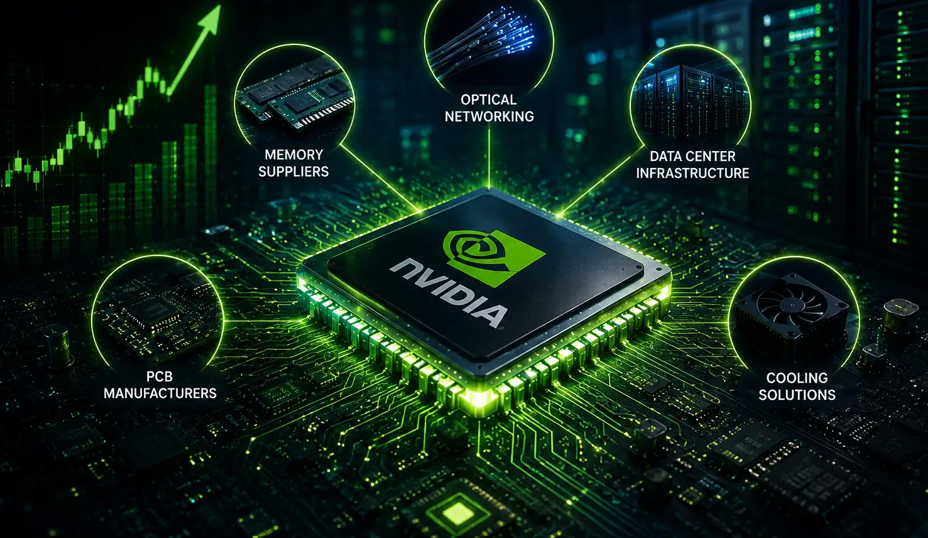
Nvidia pays for the capacity it depends on. Each payment points to a constraint: memory, optical lasers, interconnect, design software, foundry and CPUs, power and capital. The question for suppliers’ investors is whether the payment is safety, because demand is locked in, or a signal of where Nvidia expects shortages.
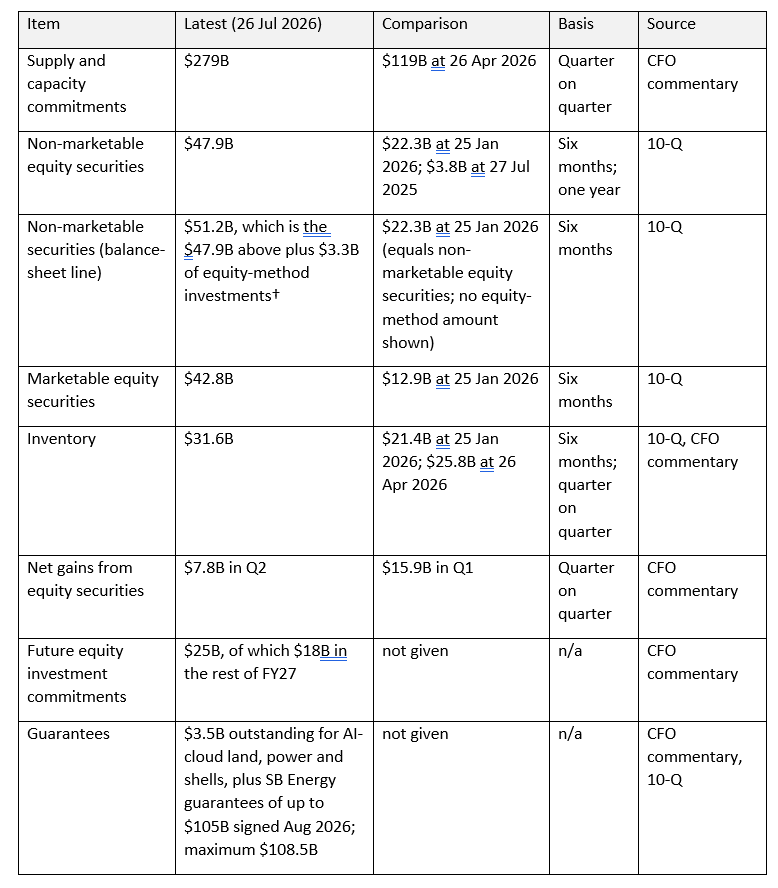
The $279B is 2.9 times Nvidia’s quarterly revenue of $96.2B. $92B of it falls due in the rest of fiscal 2027, $87B in fiscal 2028 and $88B in fiscal 2029.
The $51.2B balance-sheet line contains the $47.9B of non-marketable equity securities, so the two are not additive.
What Nvidia is locking in, by constraint
Each large Nvidia payment sits next to a component that limits how many systems it can ship. The instruments differ: equity, purchase commitments, convertible bonds and guarantees. Terms are disclosed only in part.
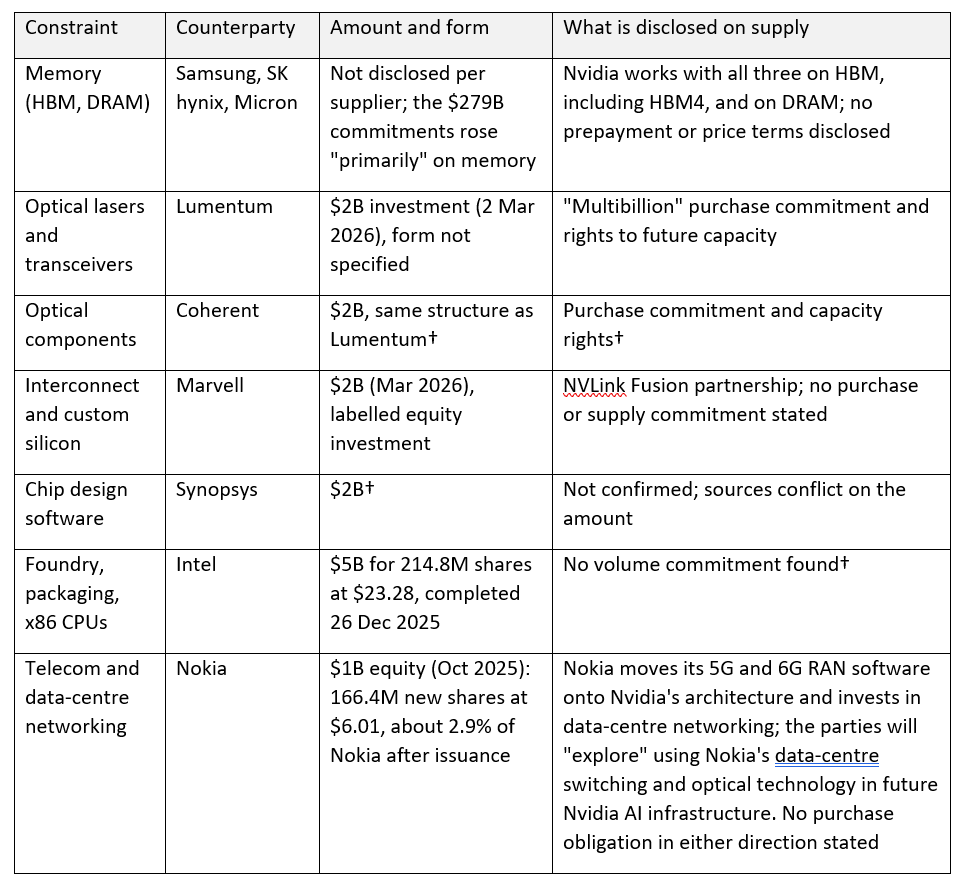
The table covers suppliers and partners. Stakes in customers, custom-chip partners and the power and land guarantees are in the ecosystem table further down.
Two patterns stand out in the supplier table. In optics and interconnect, Nvidia pays a roughly equal $2B to each supplier and, in the Lumentum case, ties it to purchase commitments and future capacity. In memory, the largest line, the commitment is a purchase obligation, and no equity stake or prepayment has been disclosed.
The disclosed equity investment commitments of $25B are “focused on AI model makers, infrastructure financiers,” so the next $18B in the rest of FY27 goes to the demand side.
Entrenching the ecosystem: stakes in customers
A second group of payments goes to buyers of Nvidia systems and to the parties that finance their data centres. These do not secure supply. They secure demand and the capacity to deploy it.
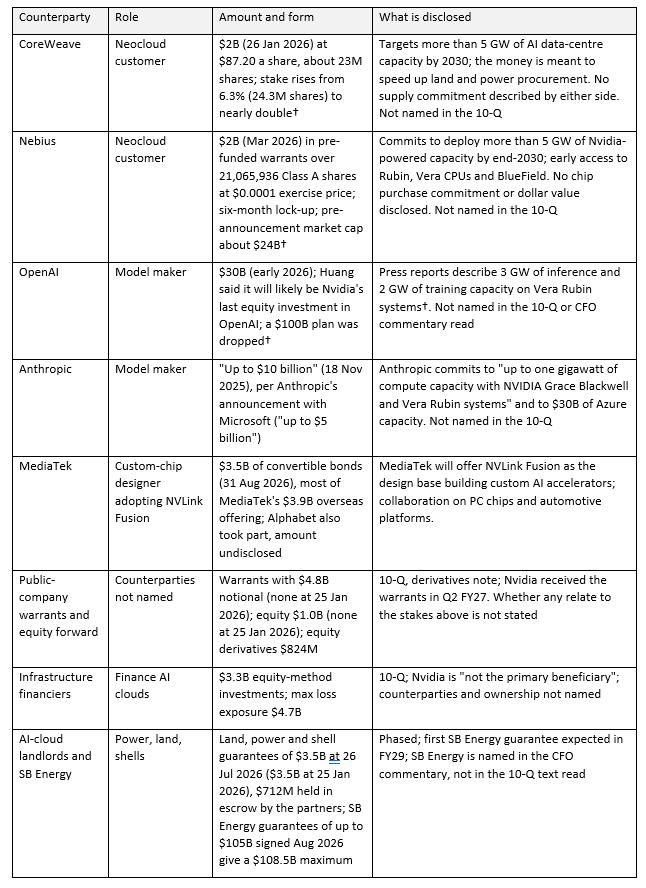
The 10-Q names none of these customers or model makers. It refers to “AI model makers” only as a customer category, and says five direct customers made up 22%, 14%, 13%, 11% and 10% of accounts receivable at 26 July 2026, without naming them. The OpenAI and CoreWeave amounts therefore rest on press reports, and the Anthropic amount on the company announcement, not on a filing. Nvidia’s non-marketable equity of $47.9B includes private holdings that the filing does not itemise.
The MediaTek bonds put Nvidia’s interconnect inside chips that cloud companies commission as alternatives to Nvidia GPUs. Ryan Shrout of Shrout Research: “Nvidia collects rack-scale adoption even on the designs where it may lose the compute socket.” Huang on the circularity charge: “This is not circular because obviously they do their own business and we do our own business.”
The model-maker and financier stakes fit the $25B of equity commitments that the CFO commentary describes as “focused on AI model makers, infrastructure financiers.” Nebius’s commitment is stated in gigawatts, not dollars, so the demand it locks in cannot be sized from the disclosures. The risk is circularity: Nvidia funds buyers whose purchases of Nvidia systems then support its revenue and the marks on its stakes.
The commitments behind the stakes
The equity stakes are small next to the purchase and guarantee obligations. Nvidia’s 10-Q and CFO commentary for the quarter to 26 July 2026 give the following.
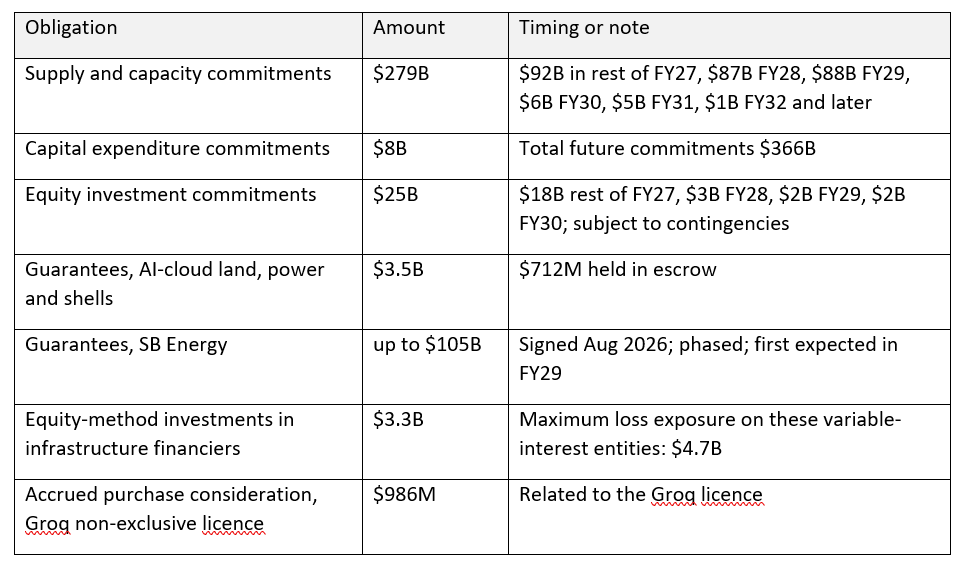
Non-marketable equity securities were carried at $47.9B on 26 July 2026 against $3.8B a year earlier. In the first half Nvidia added $31.0B, marked up $7.5B and moved $12.7B to marketable securities after the holdings began trading. Cumulative gross unrealised gains on the book are $9.1B. Including marketable securities ($42.8B) and equity-method holdings ($3.3B), the components sum to about $94B; a BigGo summary of the 10-Q puts total equity investments at about $99B, against about $7B a year earlier†.
Net gains on equity securities were $7.8B in Q2 and $15.9B in Q1, $23.7B for the half. Over the same period Nvidia issued $25.0B of senior notes and grew inventory to $31.6B from $25.8B. The gains are marks on stakes in companies that buy or supply Nvidia products, so a share of reported income now moves with those companies’ valuations.
The Intel stake shows the size of that effect. Nvidia paid $5B, and a 13F filing values the 214.8M shares at about $30B on 30 June 2026, against about $9.5B three months earlier. A value of about $19.2B by late August has been cited but is not confirmed in any source found†.
Safety for suppliers or a map of constraints
The case for safety. A purchase commitment is revenue that does not depend on the next order. $279B of commitments, $92B of them due in the rest of FY27, gives memory makers visibility that they did not have a year ago. In optics, Lumentum has a “multibillion” purchase commitment and Nvidia has rights to future capacity, so the stake and the demand arrive together. A supplier that Nvidia has funded and committed to is less likely to lose its allocation to a rival buyer.
The case for a map of constraints. Nvidia pays most where capacity is short. Memory is the largest line, and the commitments rose by $160B in one quarter, “primarily related to the procurement of memory.” Optics, interconnect and design software each received $2B. Nvidia is also underwriting land, power and shells through guarantees of up to $108.5B. The payments rank the constraints: memory first, then power and data-centre capacity, then optics.
Where they diverge
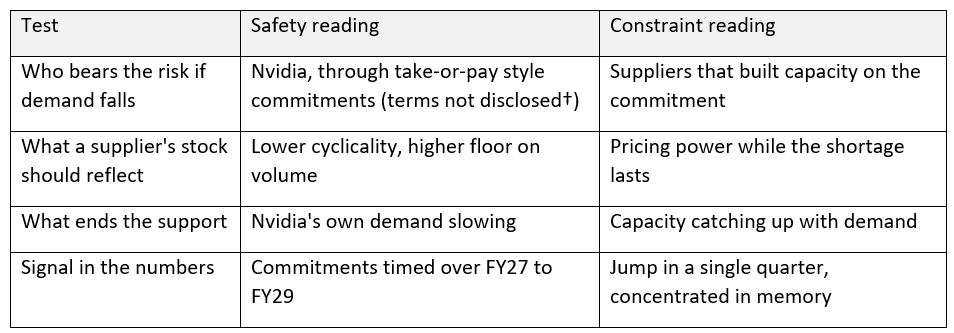
The timing favours the constraint reading for now. $267B of the $279B is due by FY29, and the one-quarter jump of $160B is too large and too concentrated in memory to be routine supply planning. If the commitments were a safety net for suppliers, they would be spread across the chain. They are concentrated where supply is tightest.
The safety reading matters once the shortage eases. Commitments of this size make Nvidia the buyer that suppliers cannot refuse, but they also make Nvidia the party holding inventory and obligations if its own sales slow. Inventory is already up 22% in a quarter, to $31.6B.
What it means for LITE, COHR, MRVL, SNPS, INTC and NVDA
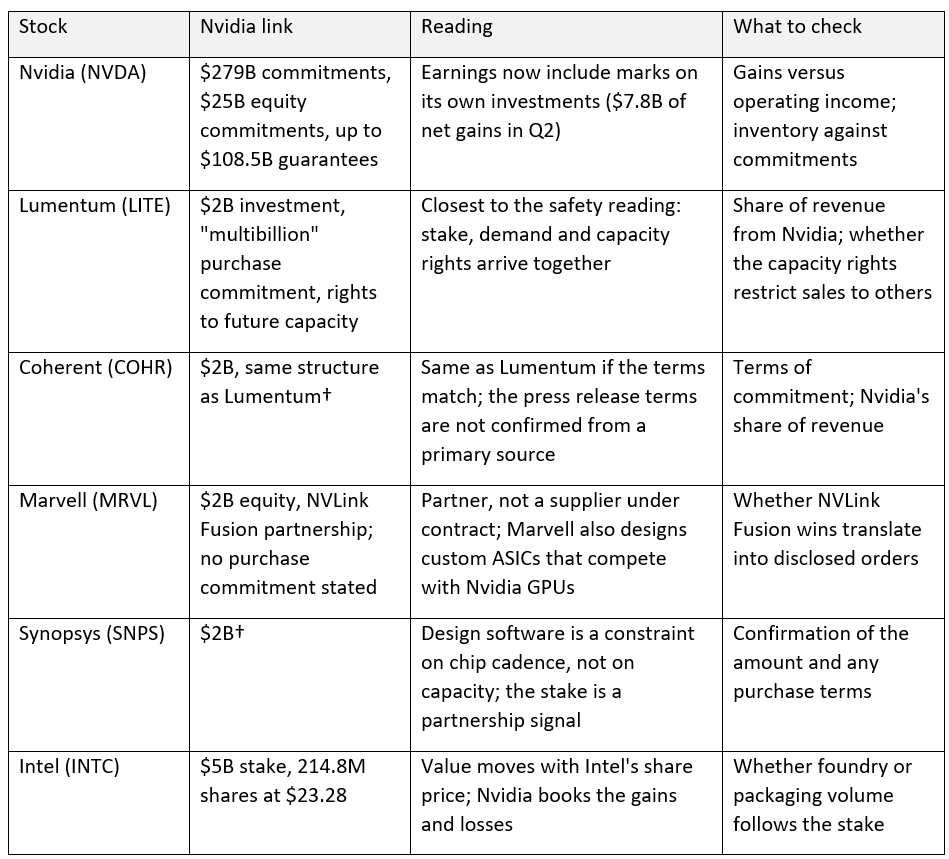
Stake values for LITE, COHR, SNPS and INTC at current prices, and each supplier’s revenue dependence on Nvidia, are not in this draft. The data was not available in the sources used, and no estimates are given.
Memory is missing from the coverage list. The largest commitment, $279B “primarily related to the procurement of memory,” sits with Samsung, SK hynix and Micron, none of which are among the six stocks. If the commitments are the clearest signal of where Nvidia sees constraints, memory suppliers are where the signal points. Adding Micron, SK hynix or Samsung to the coverage list, or at least a read-across note, would fit the thesis better than Synopsys, where the link is a $2B stake with unconfirmed terms.
Nokia, CoreWeave and Nebius are outside coverage. Nokia appears in the supplier table; CoreWeave and Nebius are customers and appear in the ecosystem table.
Risks and what to watch
Risks to the thesis
Marks reverse. $23.7B of first-half equity gains rest on valuations; a fall in Intel or other holdings flows into reported income.
Commitments outrun demand. $279B is 2.9 times a quarter of revenue; $267B falls due by FY29. Terms such as cancellation rights and prepayments are not disclosed†.
Guarantees. SB Energy guarantees of up to $105B are phased and first expected in FY29, but the maximum equals 38% of the supply commitments.
Circularity. Investments in AI model makers and infrastructure financiers fund customers that buy Nvidia systems. The $25B of equity commitments is focused on these groups.
Source quality. Several amounts (Synopsys, Coherent, Intel after 30 June, MediaTek) rest on secondary sources.
What to watch
Next 10-Q: change in supply commitments and what share is memory; any disclosure of prepayments.
Quarterly net gains from equity securities against the $7.8B in Q2.
Inventory against the $31.6B at 26 July 2026.
The first SB Energy guarantee draw and any new guarantees.
Disclosure of customer concentration at Lumentum, Coherent and Marvell: whether Nvidia becomes a named 10% customer.
13F filings for the quarter ending 30 September: Intel and other stake values.
Sources
Filings and company documents
Press and secondary
The Star (Reuters), Nvidia invests $3.5B in MediaTek convertible bonds, 31 Aug 26
Implicator, Nvidia invests $3.5B in MediaTek to put NVLink inside rival AI chips
Anthropic, Microsoft, Nvidia and Anthropic announce partnerships, 18 Nov 2025
Yahoo Finance via TechLeap, Nvidia caps OpenAI stake at $30B
Not confirmed from a primary source †
Intel value of about $19.2B in late August, MediaTek $3.5B convertible bonds, Coherent terms: no primary source found.
† marks items not verified against a primary source. Figures are from the filings above for the quarter ended 26 July 2026 unless stated.
Semiconductors
Explore all company fundamental valuations, DCF intrinsic models, and thematic deep-dives in Semiconductors.
Quantitative Models
Automated daily equity screening across 6 quantitative factor models with 15-minute EMA regime confirmation.
More Research from the Desk
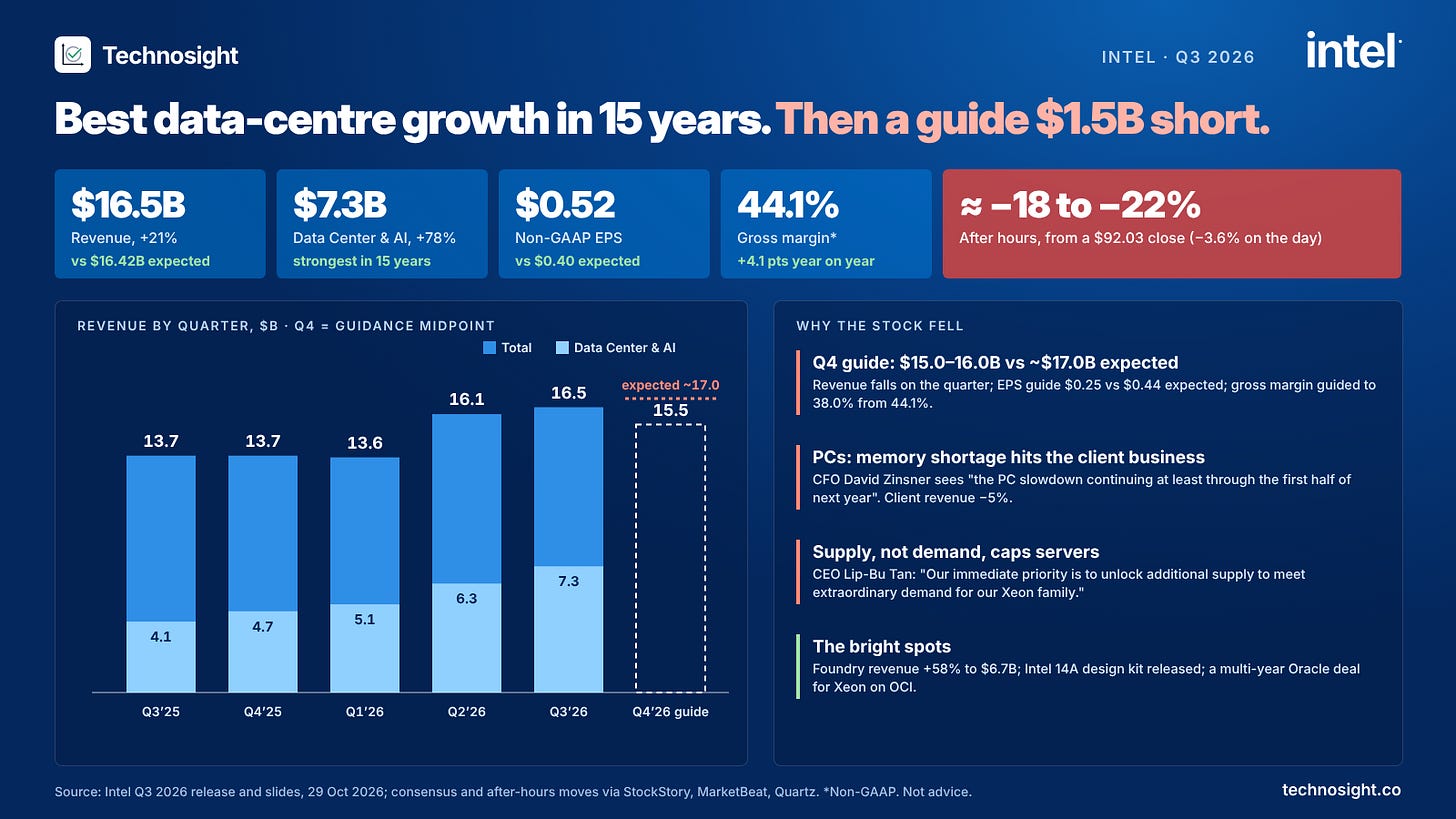
Intel Inc (INTC) earnings: data center jumps 78%, but Q4 guidance cut triggers 25% sell-off
Intel’s Q3 print delivered a stark contrast between a surging Data Center business (+78% YoY to $7.3B) and a severe guidance reset. While Q3 beat top- and bottom-line estimates ($16.5B revenue, $0.52 non-GAAP EPS), Q4 revenue guidance ($15.0B–$16.0B vs. $17.1B consensus) sent shares down ~25% pre-market. Management highlighted supply bottlenecks in substrate packaging, a memory-driven PC downturn running into H1 2027, and a $300M revenue hit from the Fab 28 explosion in Israel. With capex ramping for 18A/14A and 2027 expected to be cash-flow negative, we adjust the score from -2/10 to -1/10 Neutral.
How Nvidia's rivals compete for OpenAI, Meta and Anthropic: AMD’s $80+B warrants and Broadcom’s $42B loan
Nvidia sells roughly 70% of AI chips at a 75% gross margin, and OpenAI, Meta and Anthropic each buy from it and from at least one rival. Its rivals cannot win on specification alone, so they pay to be the second source: AMD with warrants worth $84.3B to each of Meta and OpenAI, a 50-100% discount if AMD earns $14.1B to $28.1B per gigawatt; Broadcom with up to $42B of loans to Anthropic; and Cerebras with a warrant to OpenAI. Nvidia answers with investments in the same buyers and outside financing, not price cuts.