
How Nvidia's rivals compete for OpenAI, Meta and Anthropic: AMD’s $80+B warrants and Broadcom’s $42B loan
Nvidia sells roughly 70% of AI chips at a 75% gross margin, and OpenAI, Meta and Anthropic each buy from it and from at least one rival. Its rivals cannot win on specification alone, so they pay to be the second source: AMD with warrants worth $84.3B to each of Meta and OpenAI, a 50-100% discount if AMD earns $14.1B to $28.1B per gigawatt; Broadcom with up to $42B of loans to Anthropic; and Cerebras with a warrant to OpenAI. Nvidia answers with investments in the same buyers and outside financing, not price cuts.
How Nvidia's rivals compete for OpenAI, Meta and Anthropic: AMD’s $80+B warrants and Broadcom’s $42B loan
+7/10 NVDA | +3/10 AMD, +3/10 AVGO, +3/10 MRVL, +5/10 GOOG, +5/10 ALAB
Takeaway: Nvidia sells roughly 70% of AI chips at a 75% gross margin, and OpenAI, Meta and Anthropic each buy from it and from at least one rival. Its rivals cannot win on specification alone, so they pay to be the second source: AMD with warrants worth $84.3B to each of Meta and OpenAI, a 50-100% discount if AMD earns $14.1B to $28.1B per gigawatt; Broadcom with up to $42B of loans to Anthropic; and Cerebras with a warrant to OpenAI. Nvidia answers with investments in the same buyers and outside financing, not price cuts.
Research series: The largest AI buyers no longer simply purchase chips. They split orders between Nvidia and its rivals, and the rivals pay for the slot with shares, loans and custom designs. This article follows what it costs the supplier’s shareholders and reported margins. Earlier research: Companies which dilute investor equity to earn revenue, NVDA, AMD, GOOG, AVGO, MRVL, ALAB.
Who are the buyers and what they buy
OpenAI, Anthropic and Meta decide the contest, and each has announced supply from Nvidia and at least one rival, counted in gigawatts. Barclays puts a gigawatt of AI capacity at $50-60B in total, with compute and networking 65-70% of it, and Huang has said “every gigawatt is about $40-$50B to Nvidia” (Benzinga).
They buy three things: merchant GPUs in racks (Nvidia’s Blackwell and Rubin, AMD’s MI450 in Helios), custom accelerators designed with Broadcom or Marvell (Google’s TPU, OpenAI’s first chip, Meta’s MTIA), and leased capacity (Anthropic’s five-year TPU lease, Meta’s rental of Google TPUs).
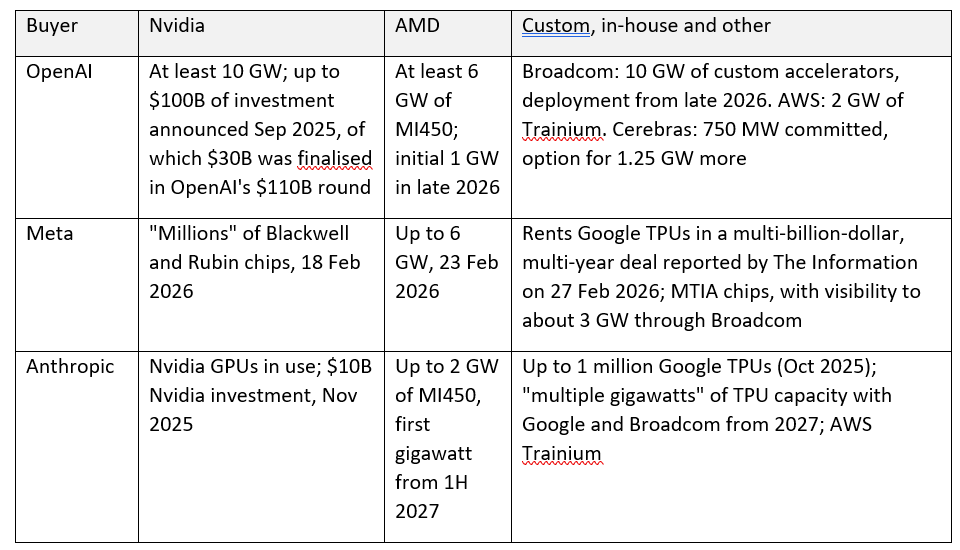
Smaller buyers follow the same pattern. Google buys from Marvell, which issued it a warrant on 18 August 2026. Amazon buys from Qualcomm and Astera, which both issued it warrants. Oracle ordered 50,000 AMD MI450 GPUs, starting in Q3 2026, with no financing terms announced; Microsoft is also named by AMD as a Helios deployer. Humain, the Saudi AI company, plans to deploy 200 MW of Qualcomm’s AI200 from 2026 (Data Center Knowledge).
Nvidia still holds roughly 70% of AI chips (TrendForce), and 92% of data centre chips when Qualcomm launched the AI200 in October 2025 (IoT Analytics, via Data Center Knowledge). The two figures use different bases. TrendForce projects custom ASICs at 27.8% of AI server shipments in 2026.
Who are the sellers and what they offer
Eight suppliers are in the contest besides Nvidia. Each sells a different product, and each offers something beyond the chip.
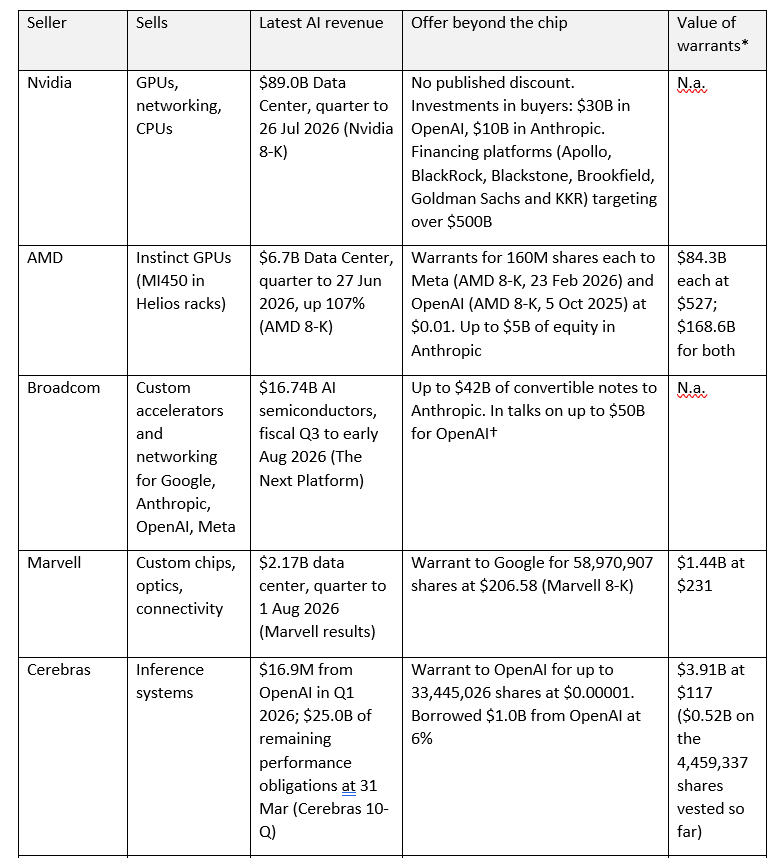
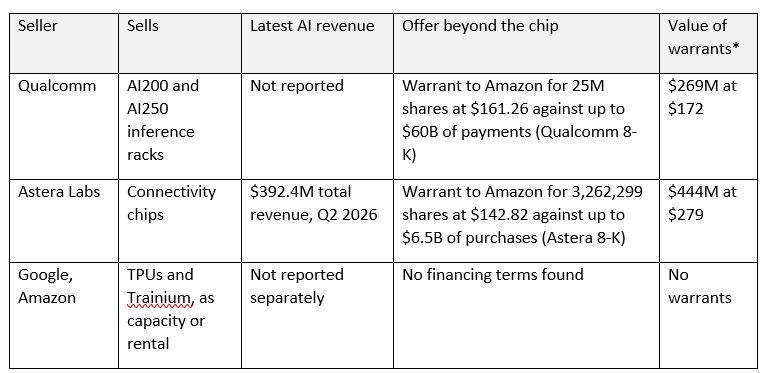
Warrant value is (price − strike) × all warrant shares, vested or not, at the 20 October 2026 pre-market prices: AMD $527, MRVL $231, CBRS $117, QCOM $172, ALAB $279.
The three largest challengers (Broadcom, AMD, Marvell) booked $25.6B in the latest quarter, 29% of Nvidia’s $89.0B. Their scope differs: Broadcom’s figure includes $4.52B of networking, and Marvell’s includes optics. Qualcomm does not report AI chip revenue yet.
Broadcom’s order book shows where the volume is going. Per The Next Platform it has six custom-chip customers (Google, Anthropic, OpenAI and Meta confirmed) and about 30 GW of capacity in view. For Anthropic it lists 1 GW of TPU 7 this year, 5 GW of TPU 8i in 2027 and 10 GW of TPU 9 in 2028; for OpenAI, 1.3 GW in 2027 and about 5 GW in 2028; for Meta, visibility to about 3 GW of MTIA.
How they compete
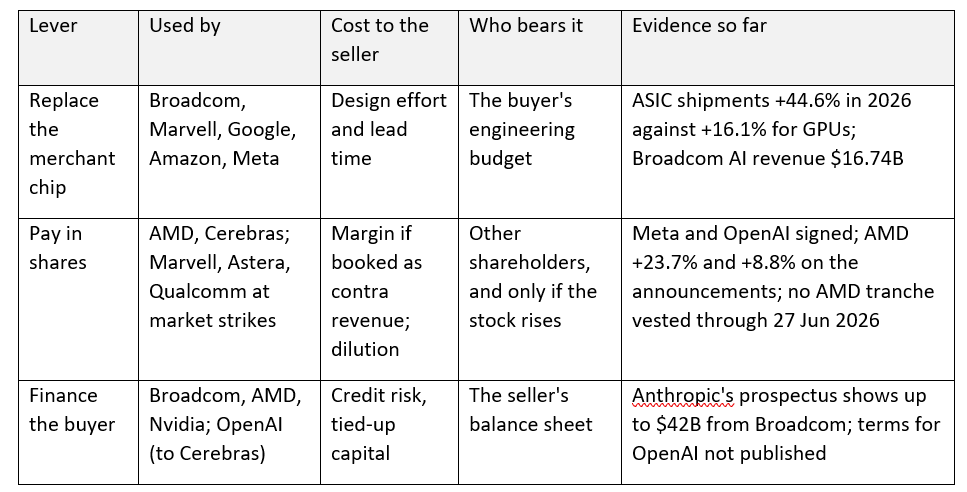
A challenger has three levers: change the chip so Nvidia’s margin disappears, cut the net price by paying in shares, or finance the purchase. Each costs the seller something different, and a different party bears the cost.
The room to cut price
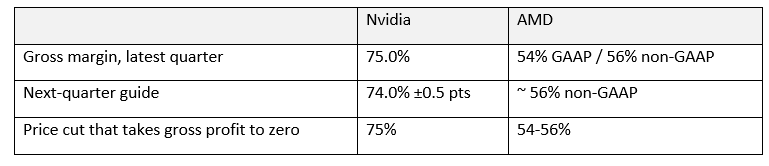
A price cut of d takes a gross margin GM to (GM − d) ÷ (1 − d), so gross profit reaches zero when the cut equals the margin. Nvidia can cut its price by up to 75% before it loses money on a sale; AMD can cut by up to 54-56%. This is my arithmetic on company-wide margins, not a disclosed product margin. Nvidia’s quarter ended 26 July 2026 and AMD’s 27 June 2026.
A cash discount takes that margin from the first sale. That is why the challengers look for other currencies.
Lever 1: replace the merchant chip
The buyer designs the accelerator with Broadcom or Marvell, or builds it in-house, and Nvidia’s margin is never paid. Broadcom and Marvell together hold about 95% of custom ASIC co-design. TrendForce projects ASIC shipments up 44.6% in 2026 against 16.1% for merchant GPUs, and Broadcom’s AI semiconductor revenue was up 3.22 times on the year at $16.74B. Anthropic has committed to up to one million Google TPUs, and AWS had deployed more than one million Trainium chips by December 2025.
The cost to the seller is engineering effort and years of lead time, not price. The buyer bears the design risk. The lever works only for a buyer with the scale to justify a chip, which is why it works for Google, Amazon, Meta, OpenAI and Anthropic and few others.
Lever 2: pay in shares, with AMD as the sharpest case
Meta and OpenAI buy AMD’s Instinct data center GPUs. Each also holds a warrant issued by AMD: OpenAI’s in October 2025 and Meta’s in February 2026. Each warrant is a right to buy up to 160,000,000 AMD shares at $0.01 each, OpenAI’s until 5 October 2030 and Meta’s until 23 February 2031.
Each customer “intends to deploy up to 6 gigawatts of AMD data center GPUs”, the first gigawatt on AMD’s MI450 series. AMD’s filings give gigawatts, not dollars, so the amount the customers will spend is not stated, and OpenAI’s binding commitment covers only its first gigawatt. The warrants vest in tranches in three steps:
Purchases. The customer reaches specified GPU purchase milestones, starting at 1 gigawatt and ending at 6.
Share price. AMD’s stock reaches specified targets, rising to $600 for the final tranche. OpenAI’s warrant also has stock-performance thresholds.
Conditions. Each vested tranche still needs technical and commercial conditions to be met before it can be exercised.
The discount on GPU purchase is the value of those shares divided by what the customer spends. At $527 (Oct 20, 2026 pre-market) the shares are worth $84.3B per customer; $168.6B for both.
AMD has not disclosed what 6 GW costs, so the discount is a range: a 50-100% discount needs AMD to earn $14.1B to $28.1B per gigawatt at today’s price ($16B to $32B at $600).
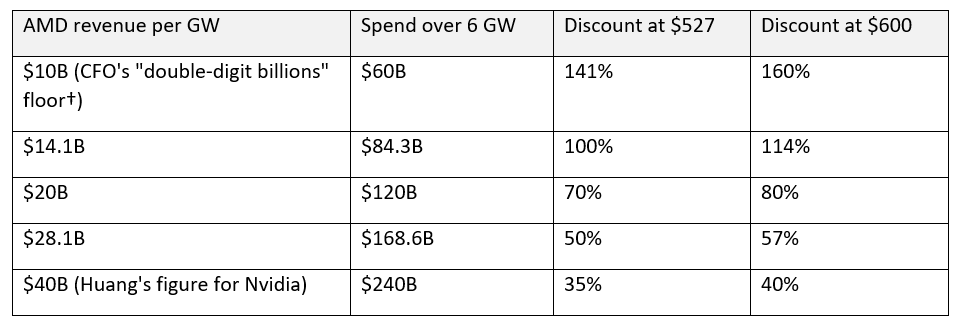
The discount rises with AMD’s success: at the $196.60 close on 23 February 2026 the same shares were worth $31.5B per customer, a 26% discount at $20B per gigawatt.
If AMD books the warrants as a reduction of revenue, as Astera does, its 56% gross margin falls to 41% at a 25% discount, 12% at 50% and zero at 56%. AMD reported no financial-statement impact from either warrant through 27 June 2026 (AMD 10-Q) because nothing has vested.
Who pays. A warrant costs nothing until both the purchase milestones and the share-price targets are met, and then every other AMD shareholder pays through dilution.
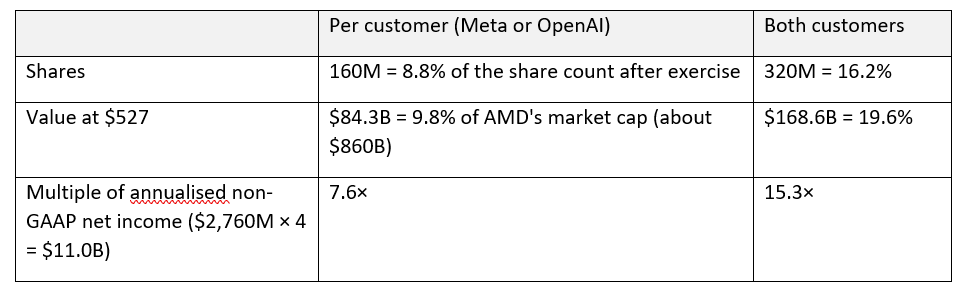
Share counts use the 1,659M diluted shares in AMD’s Q2 2026 results. The stock has so far paid for part of the offer: AMD rose 23.7% on 6 October 2025, the day the OpenAI warrant was announced, and 8.8% on 24 February 2026 after the Meta deal (my event study against SPY), and CRN Asia reports about $85B of market value added over two sessions around the Anthropic deal on 22 July 2026. Each win lifts the share price, which raises the value of the warrants already issued, which deepens the discount on the next order. The loop runs both ways: if the shares stop rising, later price targets are missed and the tranches do not vest.
Other suppliers’ warrants. Cerebras uses AMD’s design. Its warrant to OpenAI is for up to 33,445,026 shares at $0.00001, with a grant-date fair value of $82.02 a share (about $2.74B in total), and 4,459,337 shares vested in January 2026 (Cerebras 10-Q). Cerebras records the warrant as equity and reduces revenue by the warrant asset as related revenue is recognised, $2.1M in Q1 across all of its customer warrants.
Marvell, Astera and Qualcomm set their strikes near the market price on the grant date, so the customer gains only from the rise after it. Those warrants are bonuses and not discounts:
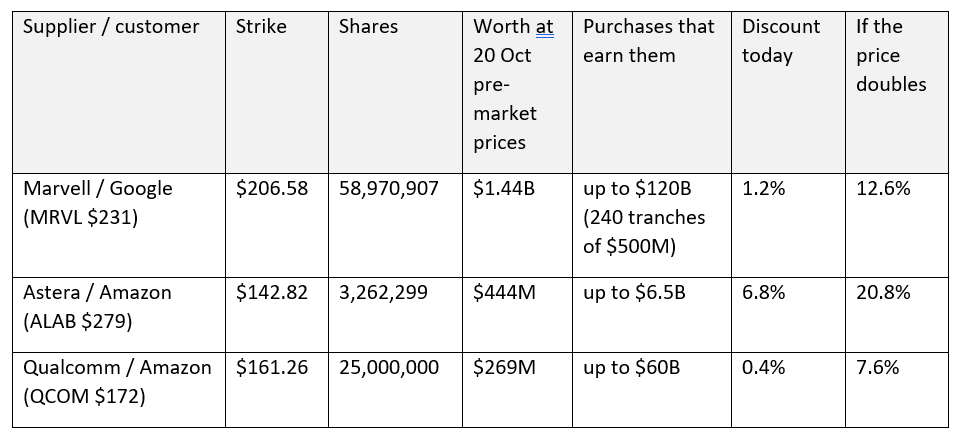
Discount = value of all the shares ÷ the purchases that earn them, assuming linear vesting; for Marvell it includes 1,360,867 shares that vest with time regardless of purchases. Only Astera reports a cost so far: $12.3M of warrant contra revenue in the first half of 2026, 2.6% of second-quarter revenue (Astera 10-Q), and the filing does not split it between Amazon’s two warrants. Marvell and Qualcomm have not disclosed their accounting. Marvell’s warrant agreement calls Google’s purchases “discretionary”.
Lever 3: finance the buyer
Broadcom’s chief executive argues that capital is now the bottleneck, so the seller that can fund orders wins them (as summarised by TheStreet†). Others are doing the same.
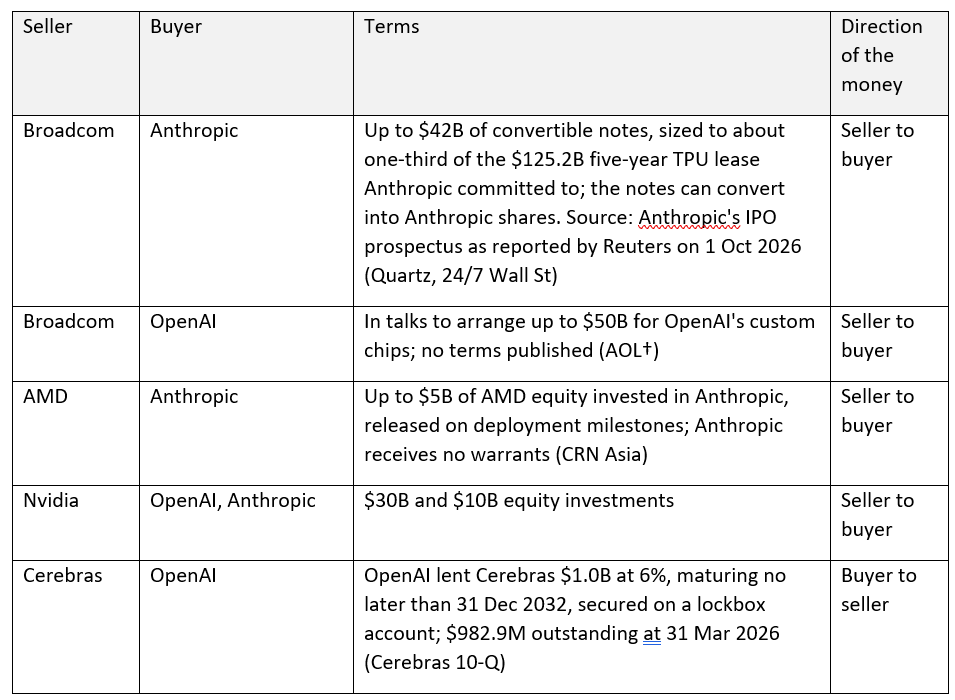
Broadcom’s loan is the largest. Per 24/7 Wall St, Anthropic placed cash in a restricted account for Broadcom’s benefit in April 2026 and may need to add more, and Anthropic’s prospectus flags “potential conflicts of interest” from Broadcom being supplier, lessor and lender. In June Broadcom had said it would provide no direct financing, though it might offer “modest residual value guarantees” on a $35B first tranche funded with Apollo and Blackstone for Anthropic’s one-gigawatt installations (same source), so the $42B note is a step beyond that. TheStreet† compares it to a car maker’s lending arm and puts a Broadcom backstop at up to about $29B on one customer’s rack leases; I have not confirmed that figure.
The cost to the seller is credit risk concentrated in two borrowers, and, per the AOL article†, collateral in custom chips that may resell for less than GPUs. Cerebras shows the reverse case: the buyer lends to the seller to get capacity built, and holds a warrant as well.
The three levers side by side
Nvidia’s moves, and whether it can match
Nvidia has not matched with warrants or a published discount. Its gross margin was 75.0% in the latest quarter and it guides to 74.0% ±0.5 points. It pays customers with investments and credit, and the customers then buy its chips. Huang’s reaction to AMD’s OpenAI warrant, on CNBC on 8 October 2025, was: “I’m surprised they would give away 10 percent of the company before they even built it” and “It’s clever, I guess” (TechSpot).
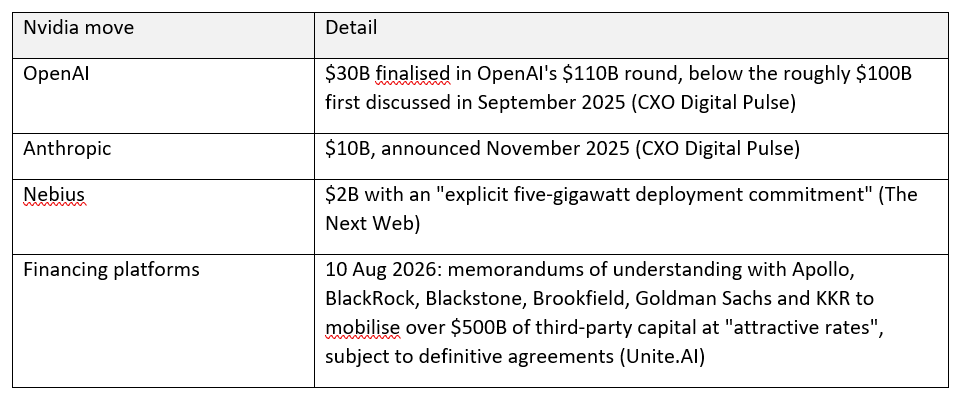
The Next Web counts more than $40B of Nvidia equity investments in the first four months of 2026. CXO Digital Pulse reports that Huang said in March 2026 the OpenAI and Anthropic stakes may be the last (a paraphrase, not a quote).
Could Nvidia match AMD’s percentages with stock? At $45B per gigawatt (the middle of Huang’s $40-50B), 6 GW is $270B for one customer. A 50% discount is $135B, 2.3% of a market cap of about $5.8T, and 100% is $270B, 4.7% (Crowdfund Insider†, 7 October 2026). AMD’s $84.3B is 9.8% of its cap. Nvidia’s market cap is about 21 times one customer’s six-gigawatt spend, AMD’s is 5 to 10 times, so stock is the cheaper currency for Nvidia, and it has not used it. My reading, which is not Nvidia’s stated reason: a published discount resets prices for every customer, while an equity grant tied to volume does not.
Meta shows the result. It signed a multiyear Nvidia deal for “millions” of Blackwell and Rubin chips on 18 February 2026, with financial terms undisclosed, and took the AMD warrant five days later. My read: the warrant pays Meta to keep a second source alive.
What to watch
AMD’s first vested tranche. The first contra-revenue line, set against the GPUs bought, will show the actual discount instead of my range.
The $600 target. AMD crossed $600 in early October; it is $527 in the 20 October pre-market. The final tranche needs $600.
Nvidia’s margin. Fiscal Q3 FY27 guidance is 74.0% ±0.5 points against 75.0% in Q2. A larger step down, or a warrant on Nvidia stock, would be the first sign that the challengers are forcing a response.
Broadcom’s loan. Terms of the OpenAI financing, any further disclosure in Anthropic’s prospectus, and the pricing of the $18B junior tranche.
Accounting at the other issuers. Marvell and Qualcomm have not disclosed how they will book their warrants; Qualcomm’s first report after the 3 September issue is due in November.
More Anthropic-style deals. AMD’s first gigawatt there starts in the first half of 2027, funded by up to $5B of AMD cash released on milestones.
Sources
Filings
Press and secondary
Semiconductors
Explore all company fundamental valuations, DCF intrinsic models, and thematic deep-dives in Semiconductors.
Quantitative Models
Automated daily equity screening across 6 quantitative factor models with 15-minute EMA regime confirmation.
More Research from the Desk
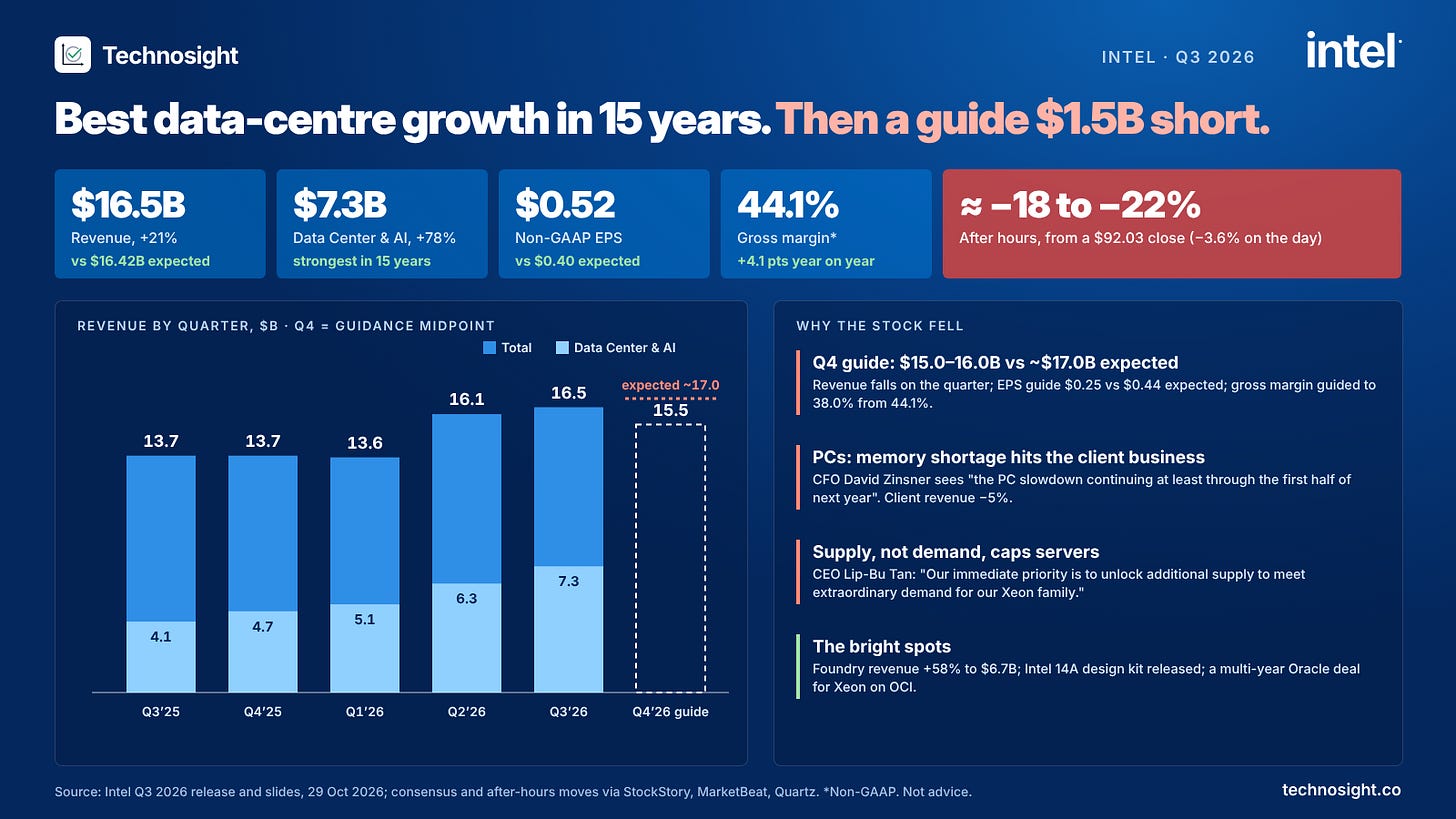
Intel Inc (INTC) earnings: data center jumps 78%, but Q4 guidance cut triggers 25% sell-off
Intel’s Q3 print delivered a stark contrast between a surging Data Center business (+78% YoY to $7.3B) and a severe guidance reset. While Q3 beat top- and bottom-line estimates ($16.5B revenue, $0.52 non-GAAP EPS), Q4 revenue guidance ($15.0B–$16.0B vs. $17.1B consensus) sent shares down ~25% pre-market. Management highlighted supply bottlenecks in substrate packaging, a memory-driven PC downturn running into H1 2027, and a $300M revenue hit from the Fab 28 explosion in Israel. With capex ramping for 18A/14A and 2027 expected to be cash-flow negative, we adjust the score from -2/10 to -1/10 Neutral.
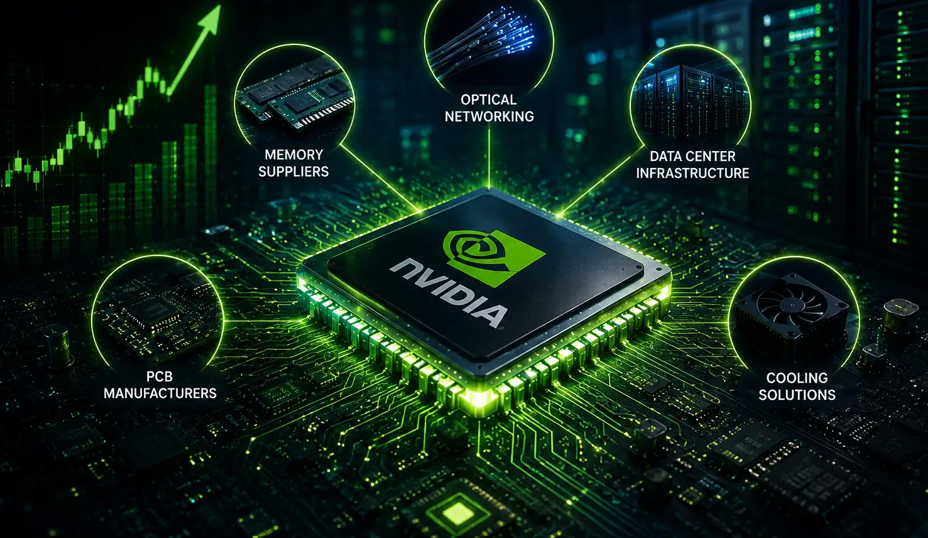
Nvidia’s $279B supply bill and $48B in stakes: a map of AI’s shortages and demand props
Nvidia is paying for the capacity it depends on, and the payments show where AI infrastructure shortages are. Supply and capacity commitments rose from $119B to $279B in one quarter, “primarily related to memory,” with $267B due by FY29. Supplier stakes are small beside that: $2B each in Lumentum and Marvell, Coherent and Synopsys. Non-marketable equity grew from $3.8B to $47.9B in a year, a further $25B is committed to AI model makers and infrastructure financiers, and guarantees reach up to $108.5B. The commitments rank memory as the tightest constraint, then power and data-centre capacity, then optics. The exposure runs both ways: Nvidia’s $23.7B of first-half equity gains and its commitments depend on the demand that payments help to create.