
Companies who dilute investor equity to earn revenue: $173B warrants by AMD
Four of the biggest AI chip buyers are paid in their suppliers’ stock for buying. Only Astera booked a cost so far (2.6% of Q2 revenue), but at today’s prices the warrants are worth about $2B at Marvell and $173B at AMD. The bill for these warrants arrives when tranches vest.
Companies who dilute investor equity to earn revenue: $173B warrants by AMD
MRVL +3/10 | ALAB +5/10 | AMD +3/10
Takeaway: Four of the biggest AI chip buyers are paid in their suppliers’ stock for buying. Only Astera booked a cost so far (2.6% of Q2 revenue), but at today’s prices the warrants are worth about $2B at Marvell and $173B at AMD. The bill for these warrants arrives when tranches vest.
Research series: The largest buyers of AI hardware are no longer only customers: they take equity stakes, receive warrants, prepay and sign take-or-pay contracts to secure chips, memory and optics. This series maps who is doing it, what each deal costs the supplier’s shareholders, and where it shows up in reported revenue and EPS. This report covers warrants at Marvell, Astera Labs, Qualcomm and AMD.”
The issue
Four of the largest buyers of AI chips now get paid in the suppliers’ stock for buying. Google (Marvell), Amazon (Astera Labs and Qualcomm), Meta and OpenAI (AMD) each hold suppliers’ warrants that vest as they spend. The supplier books the cost as a cut to revenue or as new shares. The bill goes to shareholders like you and me, and it grows with the supplier’s share price.
What is a warrant?
A warrant is a financial contract issued by a company that gives you the right (but not the obligation) to buy its stock at a fixed price within a set timeframe.
Company X issues a warrant that lets you buy 1 share for $10 anytime over the next 5 years.
If the stock goes to $25: You can exercise your warrant to buy a share for $10 and instantly sell it on the open market for $25, netting a $15 profit per share.
If the stock stays at $5: You simply don’t use the warrant. It eventually expires worthless, and you lose only what you paid to get the warrant.
Why Do Companies Issue Warrants?
Sweeteners for Investors: Companies often attach warrants to bond offerings or loan deals to make them more attractive. Investors get fixed interest from the bond plus upside potential if the company’s stock surges.
Raising Capital: When investors exercise warrants, the company creates new shares and receives fresh cash from the fixed exercise price.
How the accounting works. Under US accounting rules, payments or other consideration given to a customer normally reduce the supplier’s revenue. So when a warrant vests because the customer bought chips, the supplier records the value of the vested shares as a deduction from revenue (”contra revenue”), not as an expense. It is non-cash, but it lowers reported revenue and gross margin, and the shares are issued when the customer exercises. Practice differs by company. Astera books “Warrants contra revenue” and leaves it in its non-GAAP figures. AMD carries its warrants as liabilities until equity conditions are met and reports no impact yet. Marvell and Qualcomm have not said how they will book theirs.
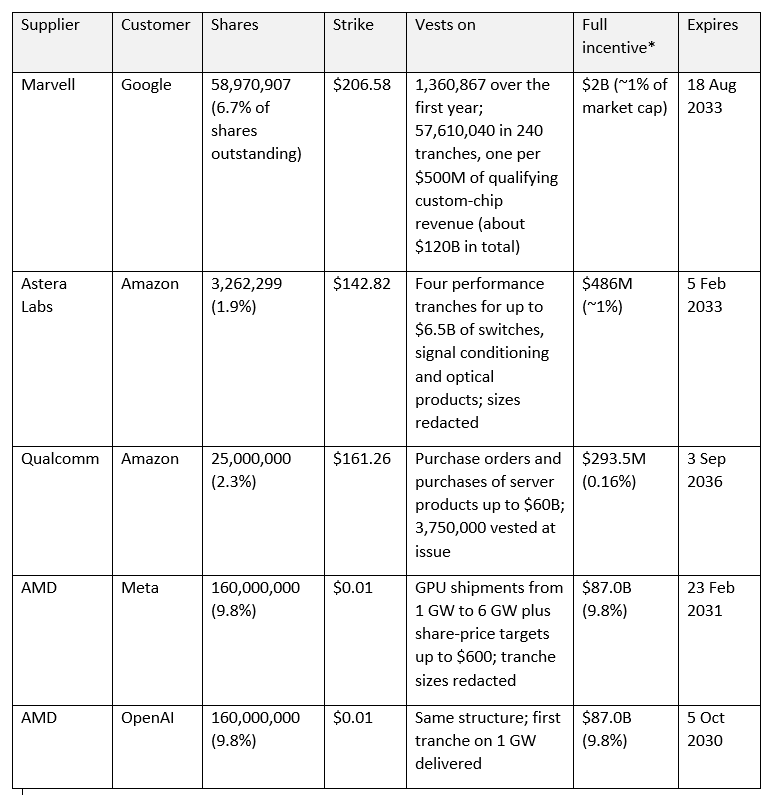
What the deals are:
* If all conditions were met at today’s prices
Sources: Marvell 8-K (19 Aug) and Exhibit 4.1; Astera 8-K (5 Feb) and Exhibit 4.1; Qualcomm 8-K (3 Sep); AMD 8-Ks (5 Oct 2025, 23 Feb 2026). Shares outstanding from each company’s latest 10-Q cover.
Marvell and Google
Google buys custom chips from Marvell and pays for them in cash. That is the sale. The warrant is a separate right that Marvell issued to Google on 18 August, under the commercial agreement signed on 29 July. The 8-K and exhibit describe no payment by Google for the warrant itself; it comes with the chip business.
The warrant is a right to buy up to 58,970,907 Marvell shares at $206.58 (current price $237, so ~$2B upside if conditions were met today) each until 18 August 2033. It is not shares. The right becomes usable (”vests”) in two ways:
With time. 1,360,867 shares (2.3% of the warrant) vest in four quarterly instalments over the first year, the first 340,216 on 18 November, regardless of whether Google buys anything.
With purchases. The other 57,610,040 shares vest in 240 tranches of about 240,000 shares. One tranche vests for each $500M of custom-product revenue Marvell earns from Google, counted from 1 August 2026 to 29 January 2033. All 240 tranches means $120B of revenue. The 8-K calls these purchases “discretionary”, so Google is not obliged to buy any amount and $120B is a ceiling, not a commitment.
To get shares, Google must exercise: pay $206.58 per share in cash, or take the cashless route and receive only the gain, in shares.
At the implied 19 October price of $237, $500M of chip purchases vests 240K shares, each $30.42 above the strike. That is $7.0M, or 1.4% of what Google spent, and on the cashless route Google would receive about 29,600 shares and pay nothing. Marvell has not yet disclosed how it will book this. Astera books the same kind of value as a reduction of revenue, which here would turn $500M of sales into about $493M.
The first 340,216 shares vest on 18 November whether or not Google buys anything. At the same $237 they are worth $10.3M (340,216 × $30.42), more than a full $500M purchase tranche, and on the cashless route Google would receive about 41,900 shares.
If Google were to exercise all 58.97M shares at $206.58 it would pay $12.2B for 6.7% of Marvell.
Astera Labs and Amazon.
Amazon buys Astera’s smart fabric switches, signal conditioning products and optical engine products and pays for them in cash. That is the sale. The warrant is a separate right that Astera issued to Amazon on 5 February 2026. The 8-K describes no payment by Amazon for the warrant itself.
The warrant is a right to buy up to 3,262,299 (1.9%) Astera shares at $142.82 (today’s price is $287) until 5 February 2033 ($470.4M upside if it was realised today).
Unlike Marvell’s, it vests only as Amazon pays Astera, and the 8-K sets the limit at purchases “up to a total of $6.5 billion”.
Four tranches: two for smart fabric switches, one for signal conditioning (payments from 1 April 2026) and one for optical products (payments from 1 January 2026). Payments by Amazon’s affiliates, or by third parties on its behalf, count.
Switch payments don’t count until the Scorpio vesting criteria under the earlier warrant are fully satisfied. The earlier warrant is the “Replacement Legacy Warrant”, whose terms weren’t disclosed. The signal conditioning tranche (payments from 1 April 2026) and the ceiling, not accounting chargeptical tranche (payments from 1 January 2026) count now.
As an illustration, take a tranche of $116.5M of payments and suppose shares vest in proportion to spend. Then each tranche vests about 58,500 shares ($116.5M ÷ ($6.5B ÷ 3,262,299)). At 19 October price of $287, each is $144 above the strike, which is $8.4M, or 7.3% of what Amazon spent. On the cashless route Amazon would receive about 29,500 shares and pay nothing. Astera already books this kind of value as a reduction of revenue ($10.2M in Q2, 2.6% of revenue), but its filing does not say how much comes from this warrant and how much from the earlier one.
Qualcomm and Amazon
Amazon buys Qualcomm’s server chips, technology, systems and manufacturing services, and pays for them in cash. That is the sale. The warrant is a separate right that Qualcomm issued to Amazon on 3 September 2026. The 8-K describes no payment by Amazon for the warrant itself.
The warrant is a right to buy up to 25,000,000 Qualcomm shares at $161.26 (current price $174) each until 3 September 2036. It vests as Amazon signs commercial arrangements, places binding purchase orders and makes payments, “up to a maximum amount of $60B in payments”.
Vested at issue: 3,750,000 shares (15% of the warrant) vested on day one, on Amazon’s initial purchase commitments, before any payment was made.
Not disclosed: how many shares each further tranche releases and at what spend.
As an illustration, suppose the other 85% vests in proportion to spend. Then $500M of purchases vests about 208,000 shares. At the 19 October price of $174, each is $12.74 above the strike, which is $2.6M, or 0.5% of what Amazon spent. On the cashless route Amazon would receive about 16,800 shares and pay nothing. The 3,750,000 shares that vested at issue are worth $53M at the same price, which is more than 17 such $500M tranches. Qualcomm has not disclosed how it will book the warrant. Its first report since issue is due in November.
If Amazon were to exercise all 25M shares at $161.26, it would pay ~$4B.
AMD with Meta and OpenAI
Meta and OpenAI buy AMD’s Instinct data center GPUs and pay for them in cash. Each also holds a warrant issued by AMD: OpenAI’s in October 2025 and Meta’s in February 2026. Each warrant is a right to buy up to 160,000,000 AMD shares at $0.01 each, OpenAI’s until 5 October 2030 and Meta’s until 23 February 2031.
Each customer “intends to deploy up to 6 gigawatts of AMD data center GPUs”, the first gigawatt on AMD’s MI450 series. AMD’s filings give gigawatts, not dollars, so the amount the customers will spend is not stated, and OpenAI’s binding commitment covers only its first gigawatt. The warrants vest in tranches in three steps:
Purchases. The customer reaches specified GPU purchase milestones, starting at 1 gigawatt and ending at 6.
Share price. AMD’s stock reaches specified targets, rising to $600 for the final tranche. OpenAI’s warrant also has stock-performance thresholds.
Conditions. Each vested tranche still needs technical and commercial conditions to be met before it can be exercised.
As of 27 June, nothing had vested and the warrants had no effect on AMD’s accounts. AMD carries them as liabilities until conditions for equity classification are met. At a $0.01 strike each share costs the customer almost nothing, so 160M shares are worth about $87B per customer at the 19 October price of $540. Because the spend is not stated, there is no discount per dollar of purchases to calculate.
What it has cost so far
Astera is the only one where the cost is visible. Its 10-Q reports “Warrants contra revenue” of $10.2M in Q2 and $12.3M in the six months, which is 2.6% of Q2 revenue ($392.4M) and cuts GAAP gross margin by about 0.7 points (73.3% reported against 74.0% without it).
CFO Mike Tate told investors on 10 Feb:
“You do take a non-cash charge for the value of what vests, and that goes directly against revenue and effectively directly against gross margins as well,” and guided to “about two points a quarter” from Q2.
The outcome so far is a third of that.
One caution: Amazon also holds an earlier Astera warrant (Tate: “This is a follow-on warrant”), and the new warrant’s switch tranches do not count until the earlier one is fully vested. The filing does not say how much of the $12.3M comes from which warrant.
AMD has booked nothing. The 10-Q for 27 June states: “no warrant shares had vested or become exercisable, and the warrants had no impact on the Condensed Consolidated Financial Statements.” The warrants are carried as liabilities until equity conditions are met, and they are excluded from the 27M potentially dilutive shares AMD reports.
Marvell and Qualcomm have not disclosed an accounting treatment. Marvell’s quarter ended 1 Aug, before the 18 Aug issue date. Qualcomm vested 15% of its warrant at issue (3.75M shares), and its first report since is due in November.
What the shares are worth
Value depends on where the stock sits against the strike. At the implied 19 October prices (market cap divided by shares outstanding):
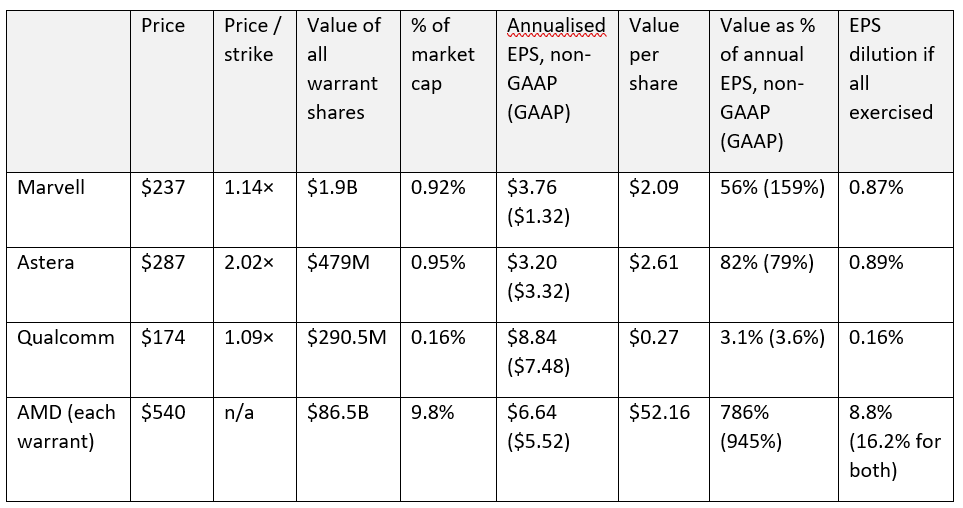
*EPS is the latest reported quarter’s diluted EPS times four: Marvell fiscal Q2 2027 (to 1 Aug), Astera Q2 (to 30 Jun), Qualcomm fiscal Q3 (to 28 Jun), AMD Q2 (to 27 Jun). “Value per share” divides the value of all warrant shares by that quarter’s diluted share count. “Value as % of annual EPS” is that per-share value over annualised EPS: a one-off transfer from existing shareholders, expressed in years of earnings. “EPS dilution” is the cut to EPS if every warrant share were exercised cashless, at today’s price and with earnings unchanged (shares issued = warrant shares × (price − strike) ÷ price). Neither includes the contra-revenue charge to earnings that vesting would also bring. Marvell’s GAAP EPS is depressed ($0.33 in the quarter against $0.94 non-GAAP), which is why its GAAP percentage is so high.
How to read the table. Price as of Oct 19, 2026. Price / strike shows how far in the money the warrant is: Marvell and Qualcomm are 14% and 9% above their strikes, Astera is at twice its strike. Value of all warrant shares is (price minus strike) times every share in the warrant, so it is what the customer would hold if everything vested today, before any purchase. % of market cap divides that value by the company’s market capitalisation, the share of the company’s equity the customer could take. AMD is large because the strike is a cent: each customer’s 160M shares are worth nearly the full price, about $87B each. Most shares have not vested, so these figures are ceilings on the cost, not charges already taken. The second table below turns the same shares into a discount on what the customer buys.
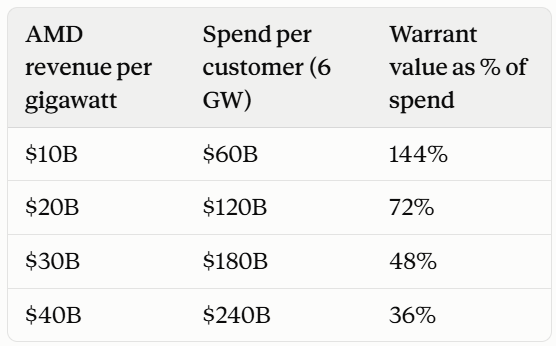
Effective discount on customer purchase:

Each figure is (price − strike) × all warrant shares, divided by the purchases that earn them in full: $120B for Marvell, $6.5B for Astera, $60B for Qualcomm. It assumes shares vest in proportion to spend and uses the 19 October prices above.
*AMD’s filings do not give the spend. The AMD figure uses $60B per customer (6 gigawatts at $10B a gigawatt), taken from the CFO’s remark, reported by Insider Monkey, that each gigawatt brings “double-digit billions” in revenue. Since that is a floor on revenue, the discount is a ceiling. A figure above 100% means the shares would be worth more than the purchases at that price, though the shares vest only as share-price targets are met.
** $600 is the share-price target for AMD’s final tranche, not a cap on value. At $600 the discount would be 160%, assuming 6GW revenue at $10B x 6.
Is AMD selling $120B of GPUs and giving back $173B of stock?
The $60B
AMD has not stated what Meta or OpenAI will spend. Its filings say only that each customer “intends to deploy up to 6 gigawatts” of GPUs.
The only revenue anchor is the CFO’s remark, reported by Insider Monkey, that each gigawatt brings “double-digit billions” in revenue. I took $10B per gigawatt, which makes 6 gigawatts at least $60B per customer.
“Double-digit billions” could mean $10B or $20B or more per gigawatt, so $60B is the low end. At $15B a gigawatt it would be $90B.
For NVIDIA, Jensen Huang at the G20 ministerial on 2 Sep 2026 has quoted $50B to $60B per $1 GW for the whole build: chips, data centres, cooling and power. 65% to 70% of it will be compute and networking (Barclays). AMD’s revenue per gigawatt is not disclosed; its chips are priced below Nvidia’s.
The $87B
It is 160M shares × $540.80 (price less the $0.01 strike). It is what the customer would hold if every share vested and the price stayed here. Each customer would pay only about $1.6M for the shares.
Nothing had vested at 27 June (10-Q). Shares vest only as the customer buys GPUs in 1 to 6 gigawatt milestones and AMD’s stock reaches price targets, rising to $600 for the final tranche. Tranche sizes and prices are redacted, so I can’t say how much vests at what price.
What this means for shareholders
If the customer spent the minimum $60B and the price stayed at $540.81, the shares would be worth about $26.5B more than the spend. That is the 144% in the table.
The cost to existing shareholders is not cash. It is 9.8% more shares for each customer, or 19.6% for both together. Cutting EPS by that fraction would be 8.8% each, or 16.2% for both, once exercise is netted by strike.
Measured against revenue, it is a large cost. AMD’s company-wide gross margin is 53.8%, so $60B of revenue would yield about $32B of gross profit, which is less than $86.5B of stock. That margin is an average, not a figure for these deals.
Why AMD might accept it
The price targets mean the shares vest mainly when AMD’s stock is already much higher. AMD closed at $196.60 on 23 February, when the Meta deal was announced, and the implied price is now $540.81. That is a rise of about $562B in market cap, against up to $173B for both warrants at today’s price.
Part of the rise followed the announcements: both customers get paid in shares after AMD’s stock has risen, which the market priced in on the announcement (+23.7% on the OpenAI deal, +8.8% on Meta’s).
AMD’s CFO argued that the deals stay accretive to non-GAAP EPS once the warrants are included.
How the market read it
Price reactions against SPY (excess return, volume against the prior 20-day average):
AMD, 6 Oct 2025 (OpenAI): +23.7%, +23.3% excess, 5.7× volume.
AMD, 24 Feb 2026 (Meta): +8.8%, +8.0% excess, 2.1×.
Astera, 6 Feb 2026: +18.9%, +17.0% excess, 1.6×.
Qualcomm, 8 Sep 2026: +3.2%, +3.7% excess, 2.8×.
Marvell, 19 Aug 2026 (terms public): +9.8%, +9.6% excess, 2.1×. On the 29 July signing day it fell 6.3% on normal volume.
In each case the market paid for the order and not for the cost. The first charge to reported revenue is a later event.
What to watch
Astera’s Q3 report: contra revenue against the CFO’s two-point guide, and any split between the two warrants.
Qualcomm’s November report: how the 3.75M vested shares are booked.
Marvell’s Q3 report: first accounting for the warrant; the first time-based tranche (340,216 shares) vests on 18 Nov.
AMD’s Q3 10-Q: first vested tranche and the liability’s fair value.
Sources:
Marvell and Google
Astera Labs and Amazon
Qualcomm and Amazon
AMD with Meta and OpenAI
Secondary sources († not confirmed in filings)
Insider Monkey: AMD crossed $600, so does Meta get 160 million shares for free now? (AMD above $600; CFO on “double-digit billions” per gigawatt)
De Belegger: customer warrants could earn 320 million AMD shares
Benzinga: “Jensen’s math” on cost per gigawatt, with Barclays
Crypto Briefing: Huang at the G20 on a gigawatt of AI infrastructure
Semiconductors
Explore all company fundamental valuations, DCF intrinsic models, and thematic deep-dives in Semiconductors.
Quantitative Models
Automated daily equity screening across 6 quantitative factor models with 15-minute EMA regime confirmation.
More Research from the Desk
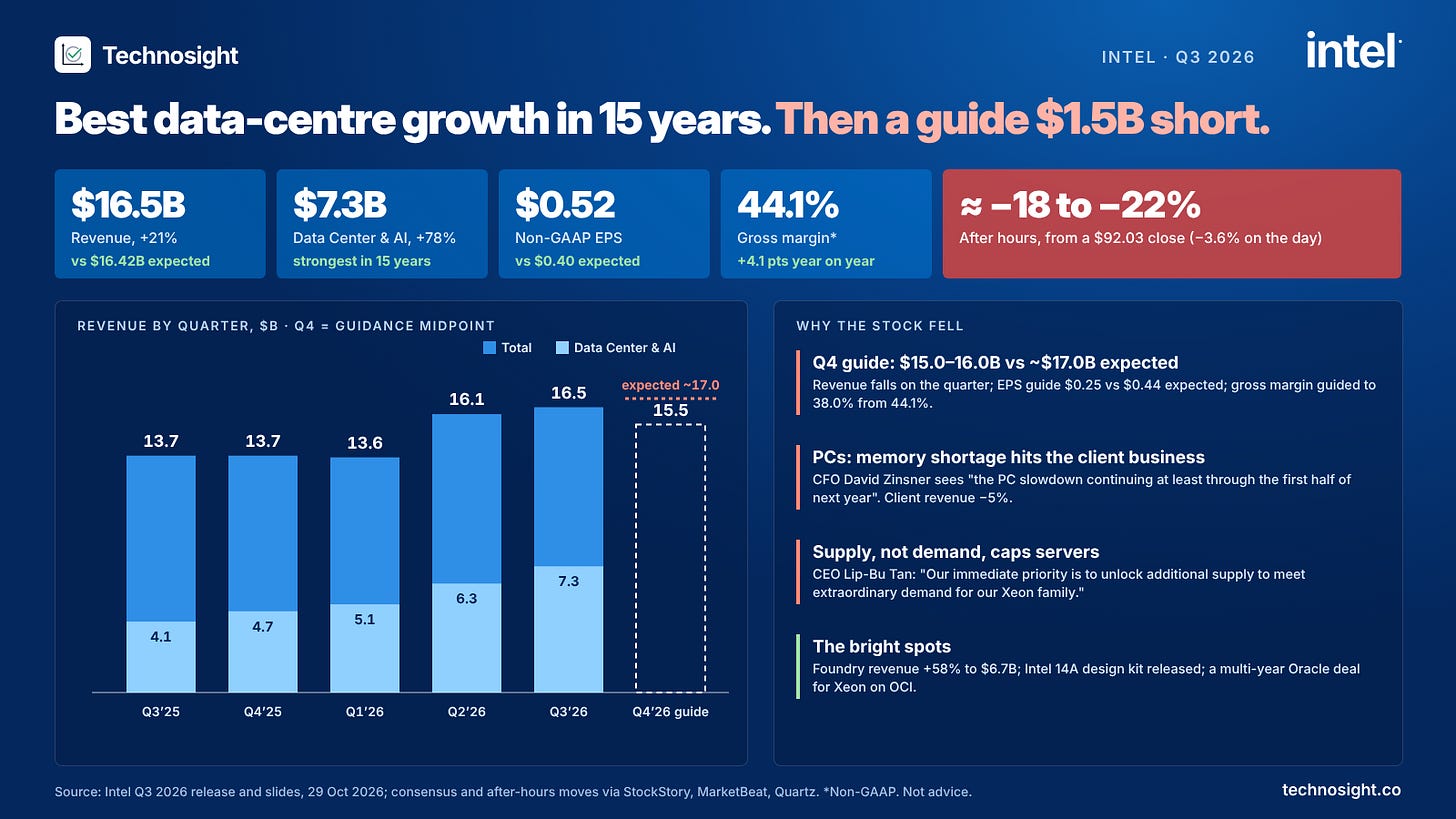
Intel Inc (INTC) earnings: data center jumps 78%, but Q4 guidance cut triggers 25% sell-off
Intel’s Q3 print delivered a stark contrast between a surging Data Center business (+78% YoY to $7.3B) and a severe guidance reset. While Q3 beat top- and bottom-line estimates ($16.5B revenue, $0.52 non-GAAP EPS), Q4 revenue guidance ($15.0B–$16.0B vs. $17.1B consensus) sent shares down ~25% pre-market. Management highlighted supply bottlenecks in substrate packaging, a memory-driven PC downturn running into H1 2027, and a $300M revenue hit from the Fab 28 explosion in Israel. With capex ramping for 18A/14A and 2027 expected to be cash-flow negative, we adjust the score from -2/10 to -1/10 Neutral.
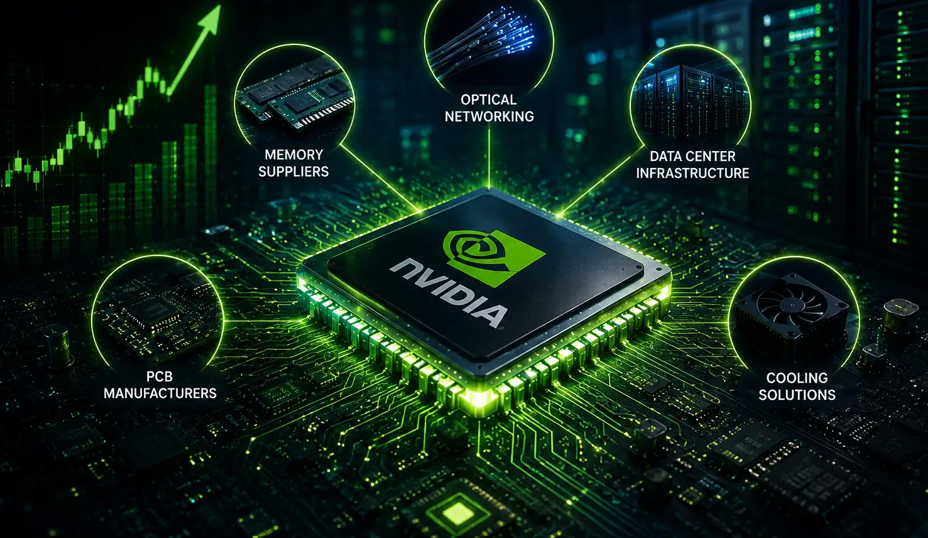
Nvidia’s $279B supply bill and $48B in stakes: a map of AI’s shortages and demand props
Nvidia is paying for the capacity it depends on, and the payments show where AI infrastructure shortages are. Supply and capacity commitments rose from $119B to $279B in one quarter, “primarily related to memory,” with $267B due by FY29. Supplier stakes are small beside that: $2B each in Lumentum and Marvell, Coherent and Synopsys. Non-marketable equity grew from $3.8B to $47.9B in a year, a further $25B is committed to AI model makers and infrastructure financiers, and guarantees reach up to $108.5B. The commitments rank memory as the tightest constraint, then power and data-centre capacity, then optics. The exposure runs both ways: Nvidia’s $23.7B of first-half equity gains and its commitments depend on the demand that payments help to create.