
Signals and themes from quant strategies after last week’s earnings: FTNT, F5 and healthcare
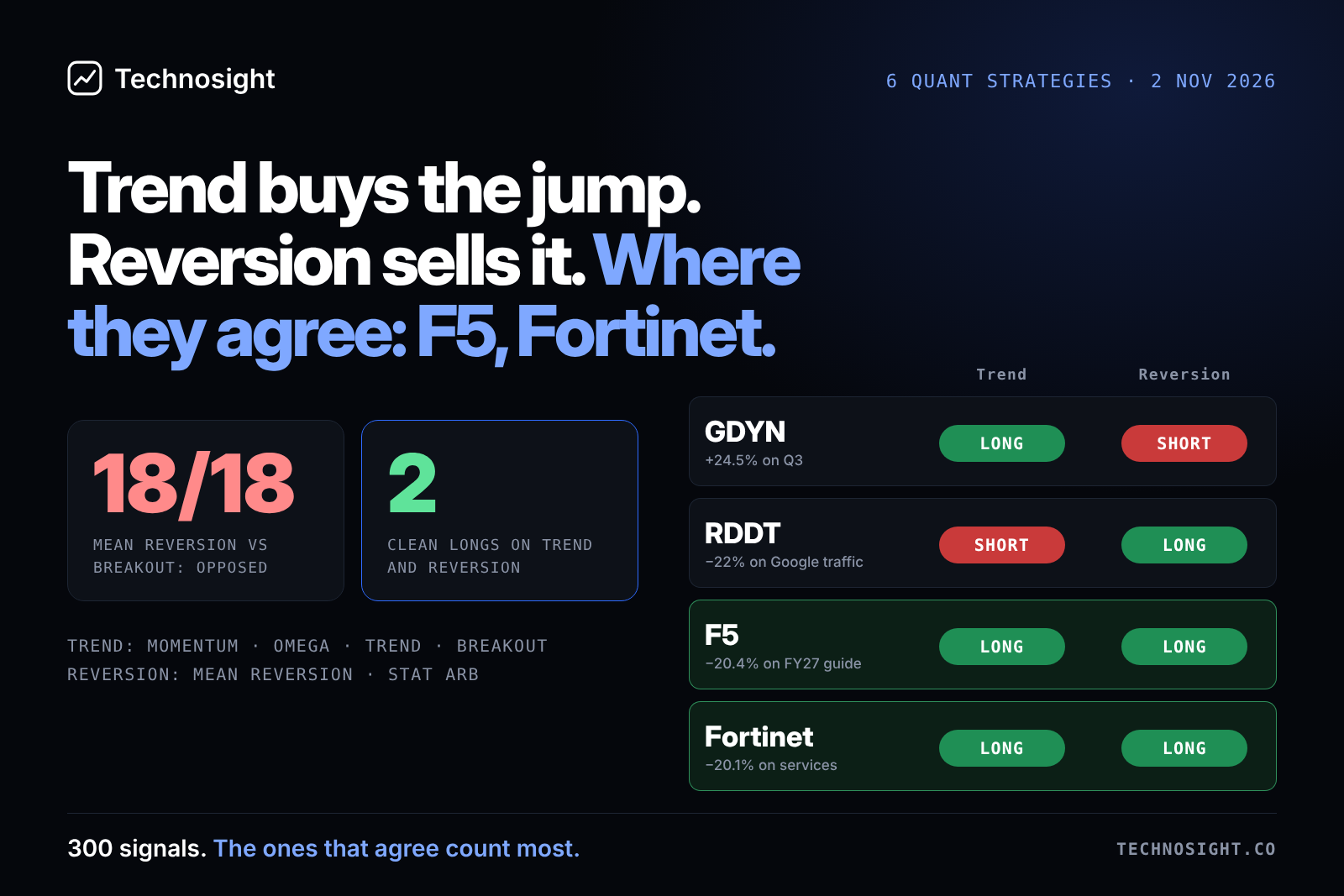
We reviewed 300 signals from our six quant strategies together. Strategies split into two families (trend and reversion) that read last week’s earnings in opposite ways. The trend family (Momentum, Momentum Omega, Trend Following, Volatility Breakout) is buying the stocks that jumped, such as Grid Dynamics (+24.5% on 30 Oct) and Regeneron (+11.5%). The reversion family (Mean Reversion, Statistical Arbitrage) is shorting them and buying the stocks that fell, such as Reddit (−22%). The most valuable signals are the ones both families back: F5 and Fortinet, each long across both families with no votes against them, each down about 20% after beating on the quarter and guiding to slower growth. Beyond the stocks, two themes stand out: healthcare catalysts lead momentum, and the market is selling companies that guide lower or pay heavily for AI.
The rare stocks where buyers of strength and buyers of weakness agree. Plus five market themes: healthcare catalysts, weak guidance gets punished, and AI costs bite.
Research series: Digging into the strategies and unpacking 300 daily signals.
What 300 signals say about the market
Read together, the six screens show a market that rewards hard catalysts, such as trial results and guidance raises, and sells companies that guide to slower growth, even after a beat. Five themes stand out.
Beats are not enough; next year’s guide decides. F5, Fortinet, Intel and Reddit all beat on the quarter and fell 20–29% within three days on what they said about the next one: F5’s 8–9% growth guide for fiscal 2027, Fortinet’s cut to its services forecast, Intel’s Q4 revenue $1.5B below consensus, Reddit’s warning that Google referrals are falling by more than a million a week. The reversion screens now list them as oversold. The question for each is whether the guide marks a slowdown or a pause. F5 and Fortinet are the two where both trend and reversion strategy families are bullish, with no vote against.
Healthcare is where the news is. Eight of momentum’s top ten are healthcare, and nearly all have a hard catalyst behind them: Moderna’s Phase 3 melanoma vaccine, Kodiak’s Phase 3 eye-drug win, Iovance’s 15% guidance raise, CareDx’s beat and raise, Regeneron’s record quarter. The leadership is rotating within the sector. The summer winners (Moderna, Kodiak) are fading on the screens, while Genmab’s momentum is strengthening (latest score 72% of its 10-day average, against 5% for Moderna).
The market is charging for the cost of AI. The AI hardware names still fill Momentum Omega, but last week showed the price of the build-out. Intel lost 28.6% on a guide hit by memory costs and a PC slump. Marvell has fallen 27% since talks to buy Lumentum leaked, so its all-stock offer is now worth about 10% less than Lumentum traded at before the talks, even though Lumentum’s revenue rose 137%.
Software is splitting. Security and developer tools (Okta, Zscaler, Rubrik, Qualys, Tenable, GitLab) hold steady uptrends on trend following, while Fortinet and ServiceNow sold off on results. The screens favour companies whose growth is still accelerating, not the category as a whole.
Quiet rotation into defensives. Volatility breakout shows utilities and industrials (WEC Energy, Fortis, Spire, Air Products, Allegion) breaking higher, while banks (Santander, BBVA, NatWest, XP) break lower. The pattern fits a market turning defensive ahead of the Fed’s expected rate rise on 9 Dec.
Our strategies
Standard momentum ranks every stock by its price return over a lookback of 2 to 12 months (42 to 252 trading days). The top 20% of the universe score long and the bottom 20% short, on the evidence that recent winners tend to keep winning for a while. It uses the full return up to today.
Momentum Omega is risk-adjusted momentum. It combines a stock’s return over the past year, split into the last month and the 11 months before it, and divides by six-month volatility. A steady climber scores higher than a volatile stock with the same gain.
Mean reversion measures how far a stock’s price has moved from its 20-day average, in standard deviations (a z-score). Two or more below the average is a long; two or more above is a short. The signal closes once the price is back within half a standard deviation of the average. It buys sharp drops and shorts sharp jumps, so it is contrarian and often early. Reddit’s latest score of +5.5 means it closed five and a half standard deviations below its 20-day average.
Statistical arbitrage looks at one stock against its industry. When a stock’s performance pulls far away from its industry’s, it bets the gap will close: long if the stock has lagged, short if it has run ahead. It goes neutral when the gap closes or the direction is not yet clear, which is why 15 of today’s 50 signals are neutral.
Trend following compares the 50-day and 200-day moving averages. When the 50-day is above the 200-day the stock is long; when it is below, short; the signal flips as soon as the two cross. With 200 days of prices behind it, it is the slowest of the six to change its mind, which is why 49 of its 50 signals have held for 10 days.
Volatility breakout draws a channel around the middle of the last 20 days’ closing range, two average true ranges wide on each side (the average true range measures a stock’s typical daily swing). A close above the channel is a long, a close below is a short, and the signal switches off when the price moves back inside. Earnings gaps like Grid Dynamics’ 24.5% jump are what it is built to catch.
All six use split- and dividend-adjusted daily prices for the signal, and 15-minute charts (50-, 200- and 800-exponential moving averages) to confirm it. For example, a long signal is confirmed if the price for the stock is above all 3 EMAs. The short signal is confirmed of the price for the stock is below all 3 EMAs.
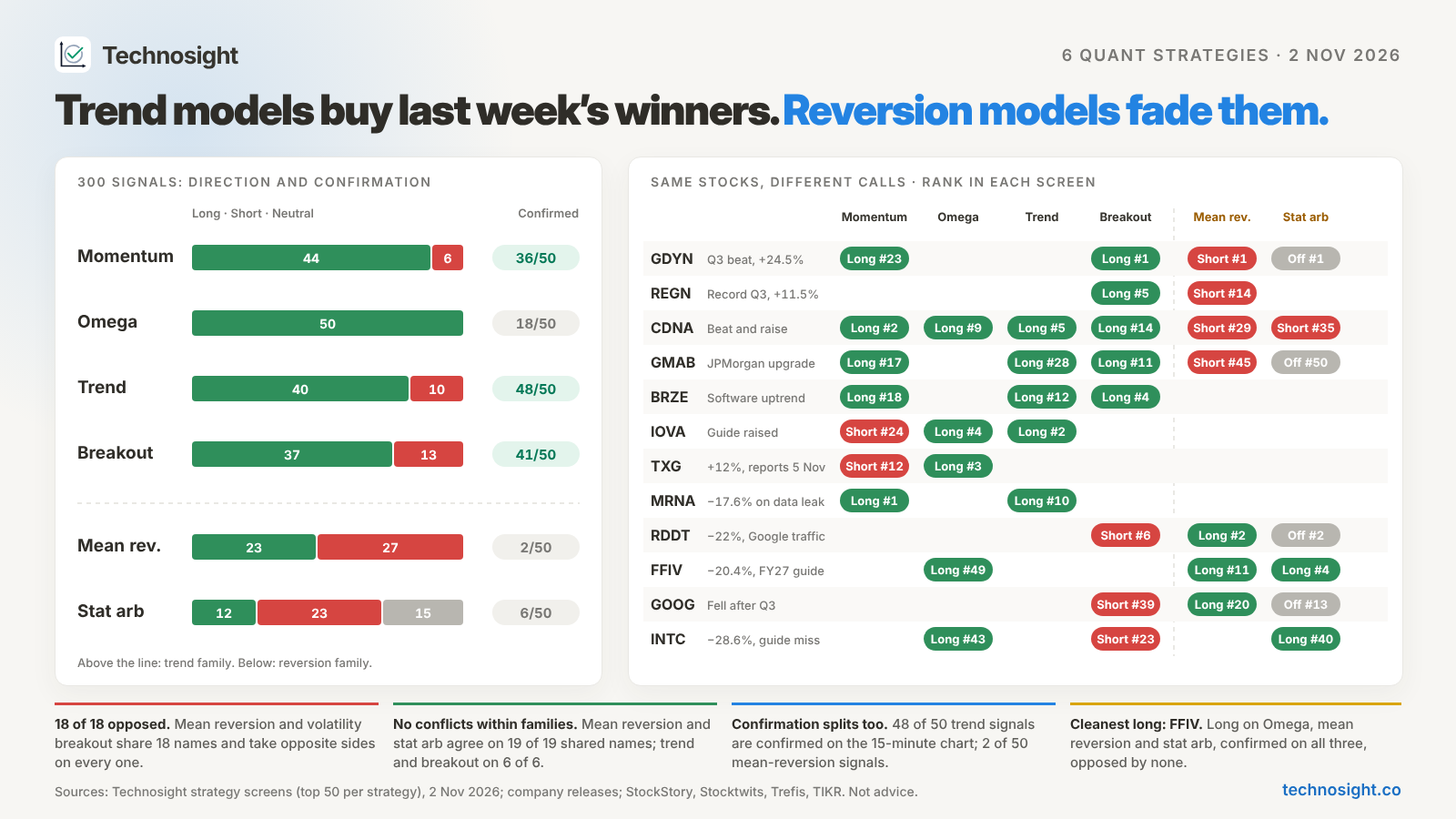
The chart below puts the 6 strategies side by side based on today (November 2, 2026). On the left, each strategy’s longs, shorts and confirmed signals:
The four trend strategies (Standard momentum, Momentum Omega, Trend following and Volatility breakout) are mostly long, and three of them have most signals confirmed;
The two reversion strategies are split between longs and shorts, with few confirmed.
On the right, 12 stocks that moved on news last week and how each screen ranks them. Read across a row and the pattern is clear: where a trend strategy is long, a reversion strategy is short, and the other way round.
How to read the screens
Each strategy scores every stock daily and ranks the top 50 by persistence, signal intensity and agreement with the 15-minute chart.
Two checks we use in this article:
Latest vs average. A latest score far below the 10-day average means the signal is fading, even if the rank is high. Moderna is #1 on momentum with a latest score of 0.17 against a 3.82 average.
Persistence of 1 day. A new signal, often a flip. Five of momentum’s six shorts are one day old.
Across the six strategies
The six strategies split into two families.
The “trend family” (standard momentum, Momentum Omega, trend following and volatility breakout) buys stocks that are rising and shorts those that are falling.
The “reversion family” (mean reversion and statistical arbitrage) does the opposite: it buys stocks that have fallen too far and shorts those that have risen too far.
Strategies agree within a family and clash across them, so when a stock appears in both, which family is looking at it decides the call, not anything specific to the stock.
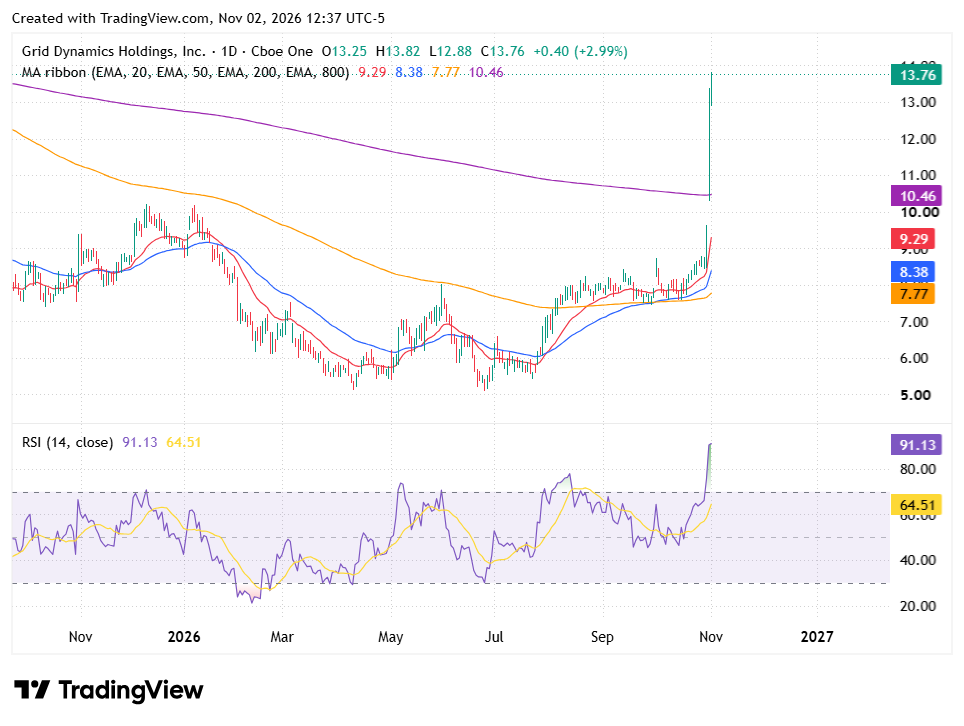
Example: Grid Dynamics Holdings (GDYN): up 64% after 3 sessions with daily RSI 91. It is picked up by Standard Momentum and Volatility Breakout as a long; and by Mean Reversion as a short. Breakout says “it broke out, buy” and Mean Reversion says “it’s stretched, sell”. It is possible that price will retest in the coming days / weeks and then continue it’s rally.
Grid Dynamics Q3 revenue rose 9.7% to $114.3M, adjusted EPS was $0.18 against $0.13 expected, and the shares rose 24.5% to a 52-week high on 30 Oct (StockStory).
Which side wins depends on whether the re-rating holds after the first week.
To illustrate, we compare strategies from trend and reversion families.
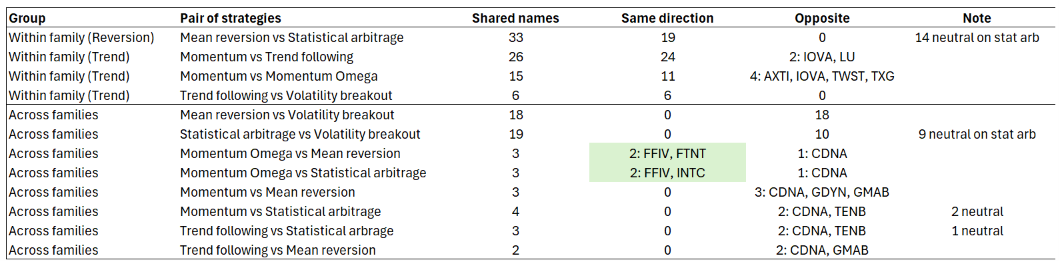
Agreement within a family is expected: the models look at prices the same way.
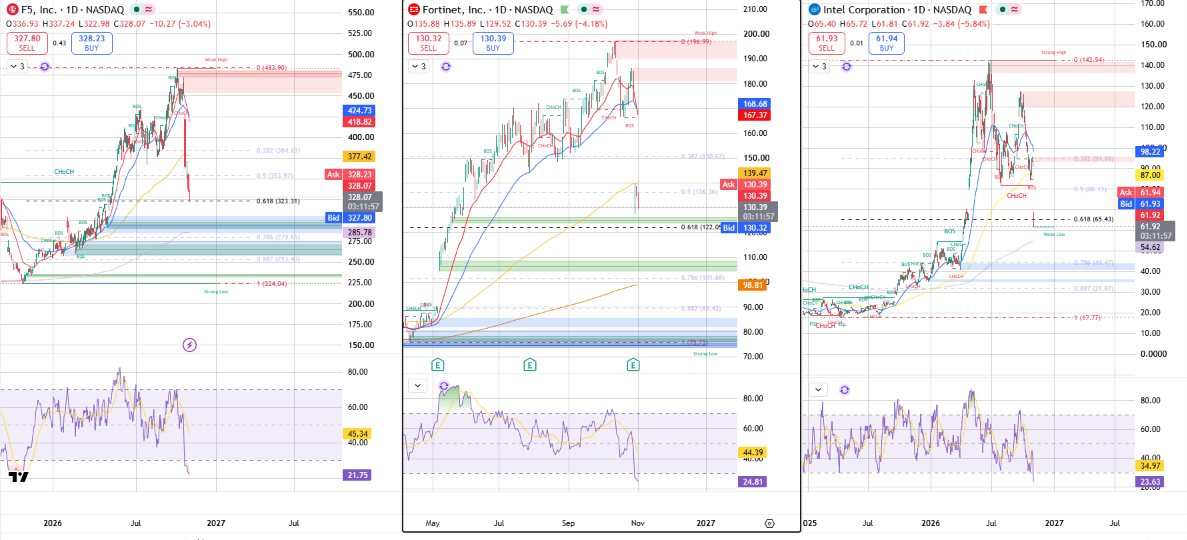
Agreement across families is rare and worth more, because two models built on opposite assumptions reach the same answer. Today there are three such names: F5 (long on Omega, mean reversion and stat arb), Fortinet (Omega and mean reversion) and Intel (Omega and stat arb).
F5 (FFIV) is long on Omega (#49), mean reversion (#11) and stat arb (#4), confirmed on all three and opposed by none. F5 fell 20.4% on 28 Oct, its worst day in a year, after guiding fiscal 2027 revenue growth to 8–9% from 11% in FY26, even though fiscal Q4 beat (revenue $917.4M, +13%) (Trefis). At $338.34 it sits 29% below its 9 Oct high of $479.83.
Fortinet (FTNT) is long on Omega (#19) and mean reversion (#13), confirmed on both and opposed by none. Fortinet fell 20.1% to $139.10 on 29 Oct even though Q3 beat: revenue $2.08B against $2.06B expected, adjusted EPS $0.91 against $0.86, and billings up 29%. The problem was services: service revenue grew 13% against 37% for products, and Fortinet lowered its full-year services forecast while raising its overall outlook (Trefis). At $136.08 it sits 30% below its 9 Oct high of $194.75.
Intel (INTC) is long on Omega (#43) and stat arb (#40), but with a caveat. Neither signal is confirmed on the 15-minute chart, and volatility breakout, in the trend family, has Intel short (#23). Intel fell 28.6% on 30 Oct after guiding Q4 revenue to $15.0–16.0B against $17.0B expected and EPS to $0.25 against $0.44. CFO David Zinsner said PC weakness would last through at least the first half of 2027. Q3 itself beat, with revenue up 20.9% to $16.51B (StockStory).
How to use it
Agreement inside a family is weak evidence. Momentum and trend following agreeing on 24 stocks is two similar tools giving the same reading.
Agreement across families is the strong signal. When a trend strategy and a reversion strategy reach the same answer from opposite starting points, take note.
Disagreement is a warning. A stock with opposite calls is a bet on whether the move continues or reverses. Keep it on the watch list, size it small, or wait a few days to see which side the price proves right.
Confirmation follows the family. 48 of 50 trend-following signals and 41 of 50 breakout signals are confirmed by the 15-minute EMAs. Mean reversion has 2 of 50 (F5 and Fortinet) and stat arb 6. Reversion trades fight the intraday trend by design, so low confirmation is expected; it also means their entries are earlier and riskier.
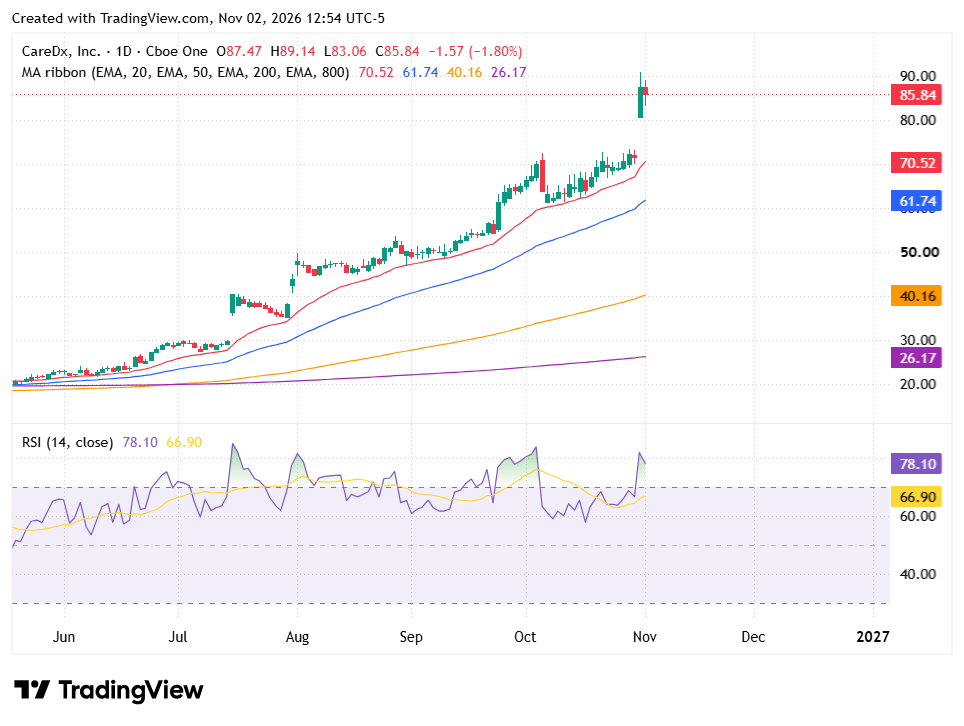
CareDx (CDNA) is the only stock on all six screens. It is long on momentum (#2), Omega (#9), trend (#5) and breakout (#14), and short on mean reversion (#29) and stat arb (#35). The news supports the trend camp: Q3 revenue rose 39% to $139M, tests rose 51% and 2026 guidance went to $520–530M from $490–500M (CareDx 8-K). The reversion camp is betting the reaction overshot.
Standard momentum: healthcare leads, the top names are slowing
44 longs and 6 shorts; 36 of 50 confirmed. Healthcare holds 8 of the top 10.
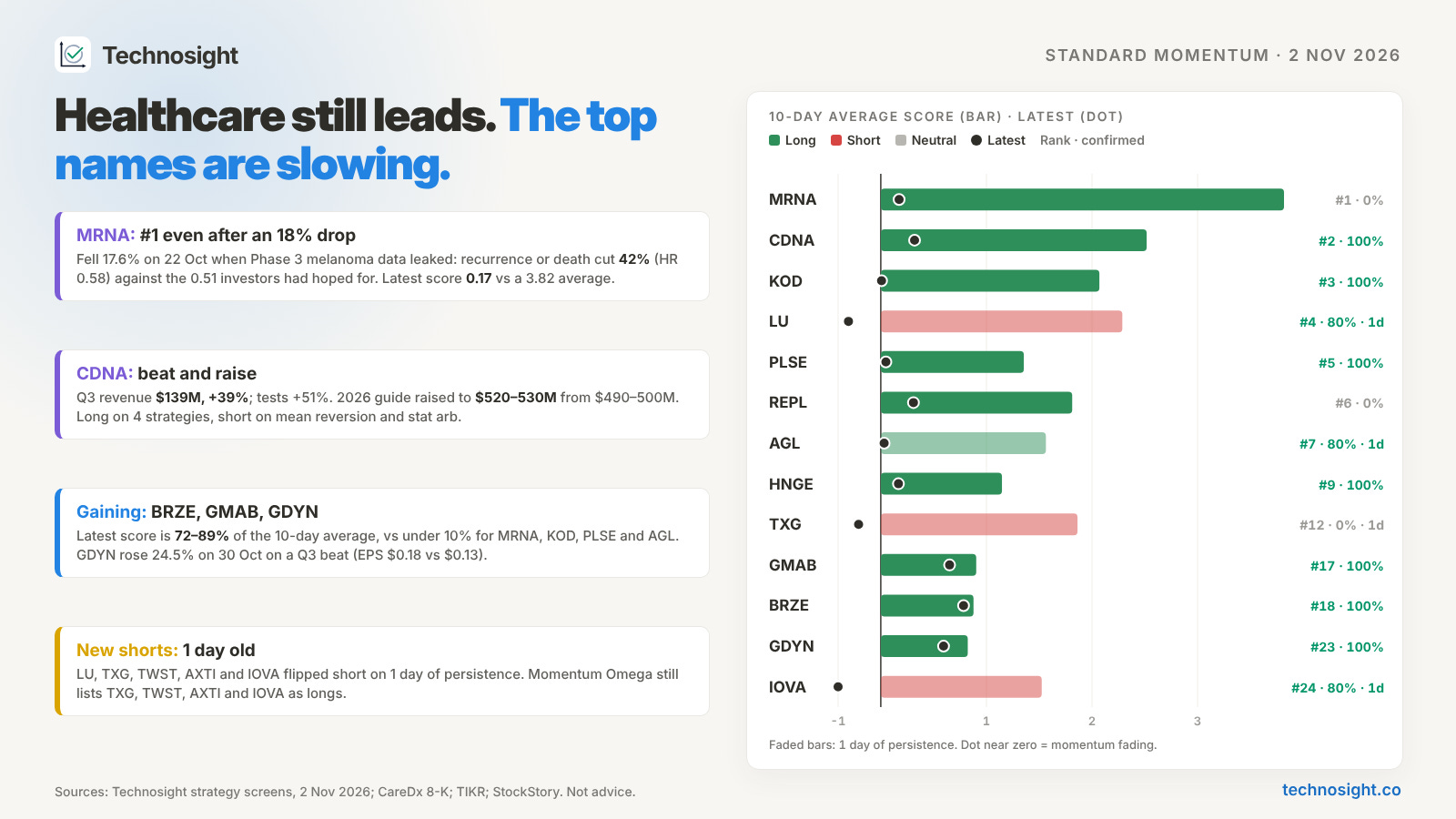
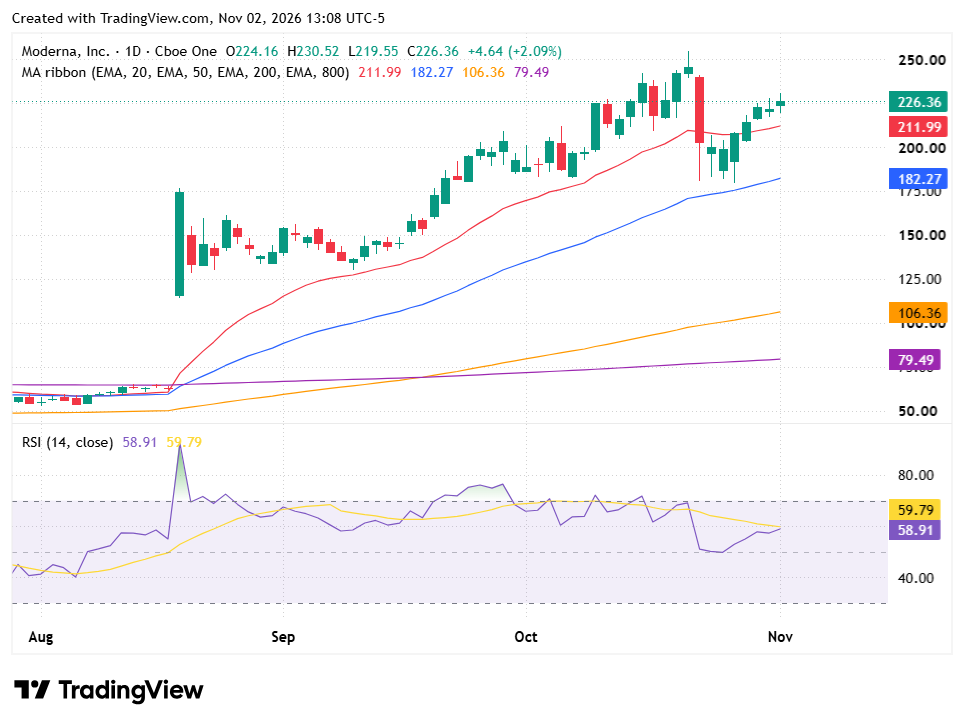
Moderna (MRNA), #1, fading. Shares fell 17.6% to $202.63 on 22 Oct when Phase 3 melanoma data leaked: intismeran with Keytruda cut recurrence or death by 42% (hazard ratio 0.58), against the 0.51 investors had anchored to from Phase 2. After six months the hazard ratio was 0.42 (TIKR). The stock is still up about 650% this year (Trefis) and trades at $221.72, but its latest score is 0.17 against a 3.82 average.
Kodiak (KOD), #3, stalled. DAYBREAK Phase 3 in wet AMD sent the shares up 31.9% pre-market on 28 Sep (Finviz). The latest score is 0.007, close to zero.
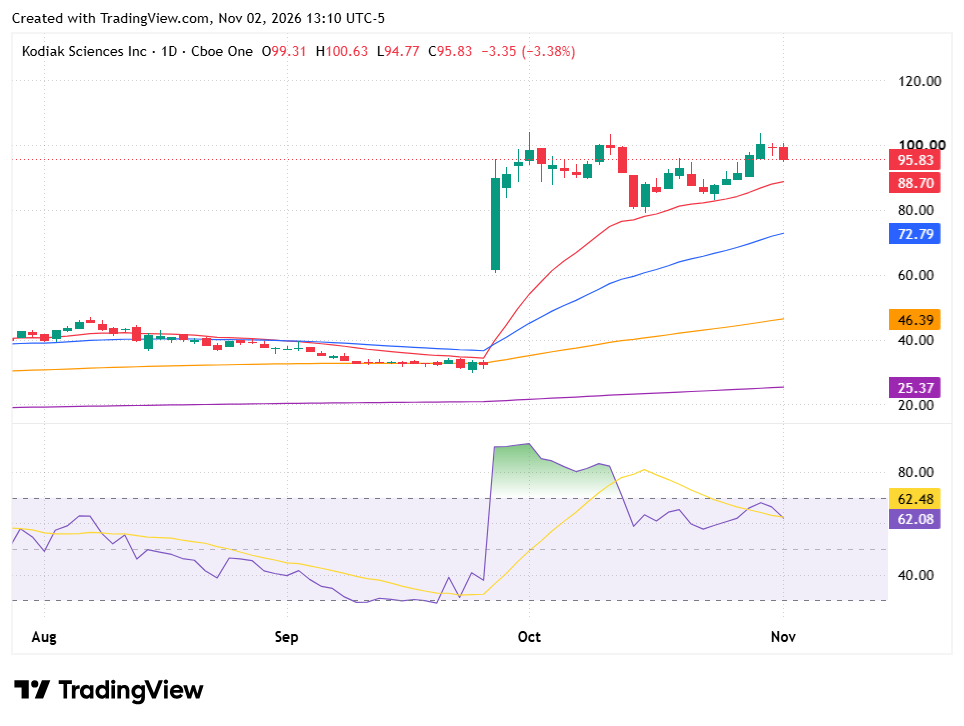
Gaining: Braze (BRZE), Genmab (GMAB), Grid Dynamics (GDYN). Their latest scores are 72–89% of the 10-day average, against under 10% for Moderna, Kodiak, Pulse Biosciences and agilon health. Momentum is moving from the summer biotech winners to these names.
New shorts, one day old: LU, TXG, TWST, AXTI, IOVA. Momentum Omega still lists TXG, TWST, AXTI and IOVA as longs. 10x Genomics and Twist both rose 12% on 28 Oct with no company news (TIKR); 10x reports Q3 on 5 Nov.
Corteva (CTVA), short. Corteva spun off its seed business as Vylor on 1 Oct; the remaining crop-protection company opened near $14.48 and now trades at $11.64 (Parameter).
Momentum Omega: takeovers top the list, AI hardware fills it
All 50 signals are long; 18 are confirmed. Read the top two with care.
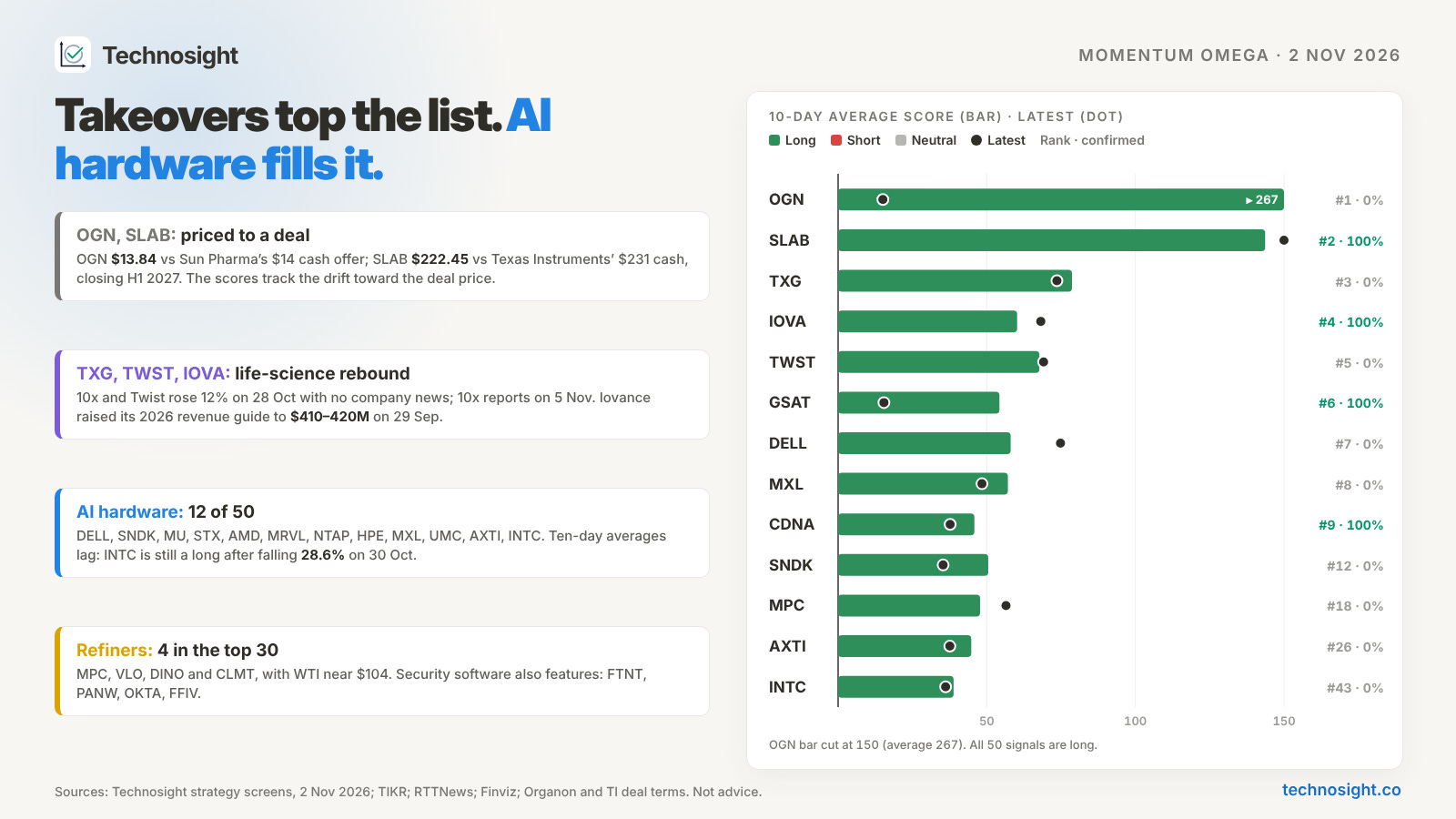
Organon (OGN) and Silicon Labs (SLAB) are deal prices, not momentum. OGN trades at $13.84 against Sun Pharma’s $14 cash offer (Organon/Sun Pharma). SLAB trades at $222.45 against Texas Instruments’ $231 cash offer, expected to close in the first half of 2027 (Finviz). Omega divides return by volatility, and a stock pinned to a cash offer barely moves, so its score balloons: OGN averages 267 against 30–80 for most of the list. The upside is capped at 1.2% and 3.8%.
Life-science tools: TXG, TWST, IOVA. Iovance raised its 2026 revenue guide to $410–420M from $350–370M on 29 Sep, citing “strong U.S. demand for Amtagvi and Proleukin”; the shares rose 33% that day (RTTNews).
AI hardware: 12 of 50. Dell, Sandisk, Micron, Seagate, AMD, Marvell, NetApp, HPE, MaxLinear, UMC, AXT and Intel. Intel, Dell and Sandisk remain on the list as longs after last week’s sell-off, including Intel’s 28.6% fall on 30 Oct.
Refiners: four in the top 30. Marathon Petroleum, Valero, HF Sinclair and Calumet, with WTI near $104. Security software also features: Fortinet, Palo Alto, Okta and F5.
Mean reversion: short the earnings jumps, buy the drops
23 longs and 27 shorts; only F5 and Fortinet are confirmed. The 48 others show 0%, including 14 in AAA regimes. The screen reads like a list of last week’s earnings reactions, reversed.
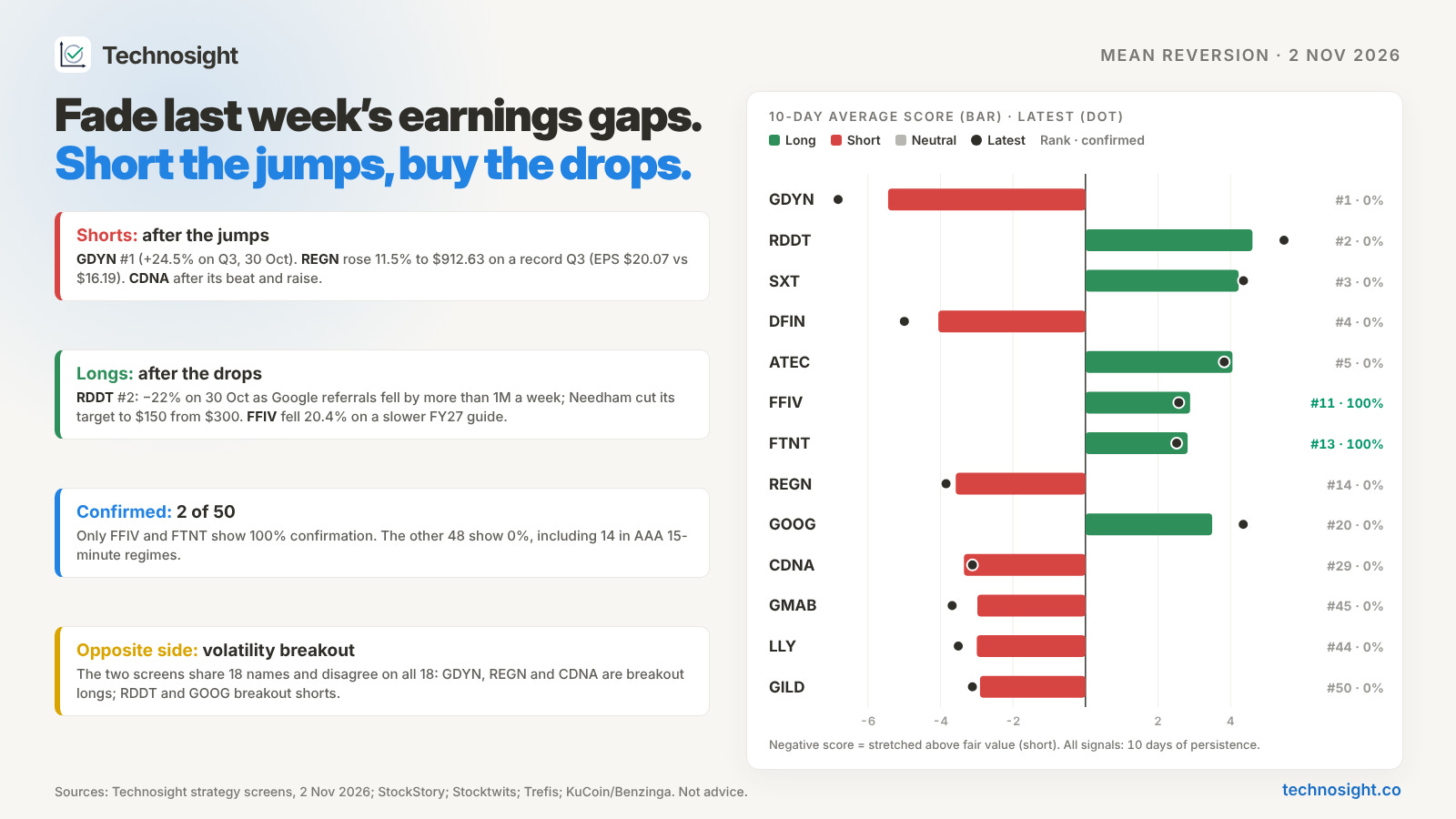
Shorts after jumps. Grid Dynamics (#1). Regeneron (#14) rose 11.5% to $912.63 on 30 Oct on a record Q3: revenue $5.12B (+36%), adjusted EPS $20.07 against $16.19, Eylea HD US sales $699M (+62%) (KuCoin/Benzinga). CareDx (#29) and Genmab (#45).
Longs after drops. Reddit (#2) fell 22% on 30 Oct, its worst day since listing. CEO Steve Huffman said Google search referrals fell by more than 1 million a week on average in October, and warned daily users could drop by a low-double-digit percentage in Q4. Needham cut its target to $150 from $300 and kept Buy; Wells Fargo warned “Google’s accelerated AI Overviews rollout could further pressure traffic” (Stocktwits). F5 (#11) and Alphabet (#20) also fell on results.
The other side. Volatility breakout holds the same 18 shared names the other way round: Grid Dynamics, Regeneron and CareDx are breakout longs; Reddit and Alphabet are breakout shorts.
Statistical arbitrage: one clean long, the top three switched off
12 longs, 23 shorts, 15 neutral; 6 of 50 confirmed.
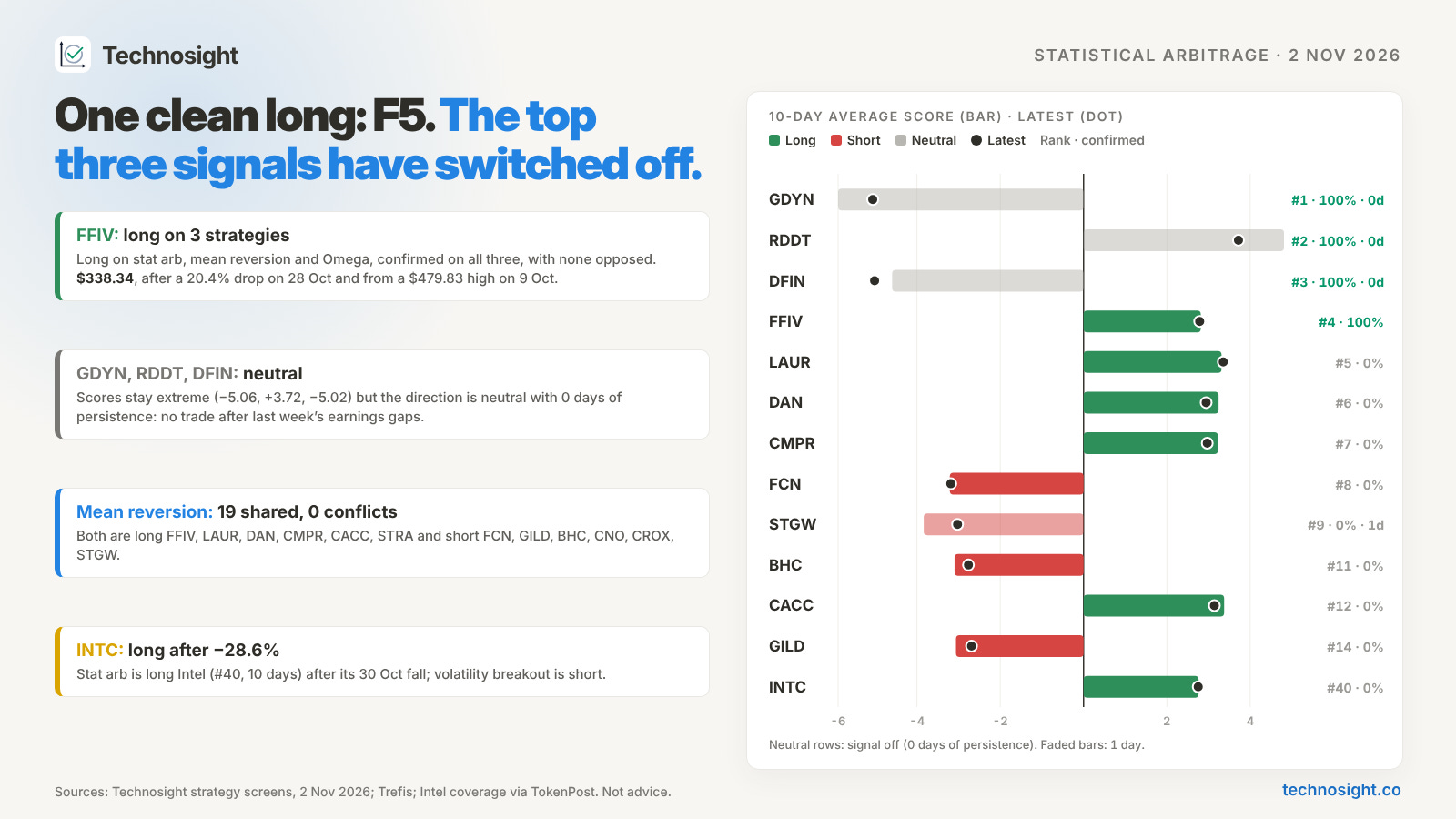
The top three are off. Grid Dynamics, Reddit and Donnelley Financial still have extreme scores (−5.06, +3.72, −5.02) but a neutral direction, with no long or short days in the last 10: they rank highest by score but carry no trade.
F5 (#4) is the strongest live long, confirmed, and shared with mean reversion and Omega.
Never opposes mean reversion. Of 33 shared names, 19 have the same direction and 14 are neutral on stat arb. Both are long F5, Laureate, Dana, Cimpress, Credit Acceptance and Strategic Education, and short FTI Consulting, Gilead, Bausch Health, CNO, Crocs and Stagwell.
Intel (#40) long after its 28.6% fall; volatility breakout has it short.
Trend following: 48 of 50 confirmed, software leads
40 longs and 10 shorts, the most confirmed screen of the six.
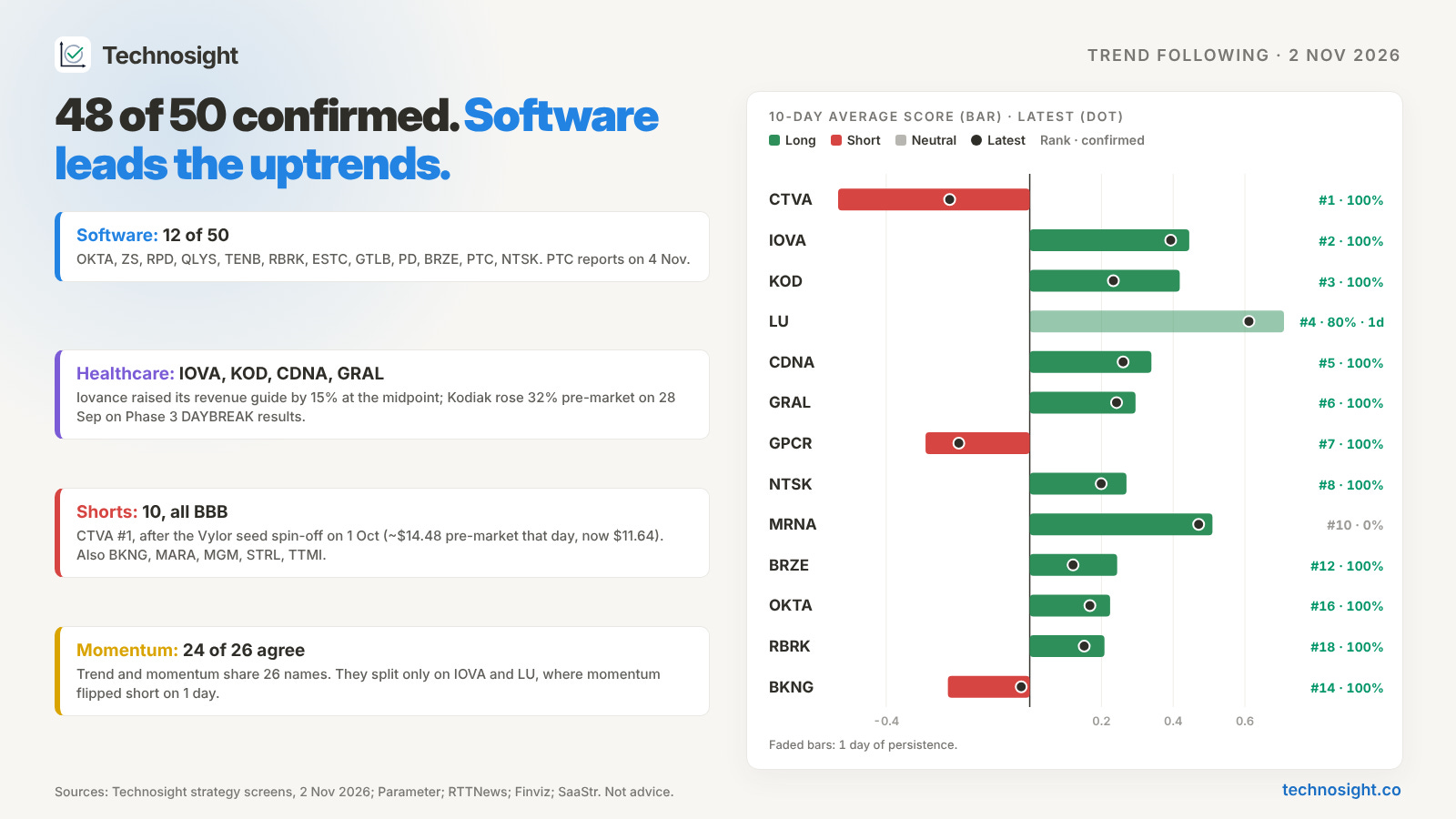
Software: 12 of 50. Okta, Zscaler, Rapid7, Qualys, Tenable, Rubrik, Elastic, GitLab, PagerDuty, Braze, PTC and Netskope, mostly security and developer tools. PTC reports on 4 Nov.
Healthcare uptrends. Iovance (#2), Kodiak (#3), CareDx (#5), Grail (#6), Moderna (#10).
Shorts: 10, all in BBB regimes. Corteva (#1), Structure Therapeutics, Booking, StoneX, Rush Street, MARA, Sterling Infrastructure, TTM, Hawaiian Electric and MGM.
Agrees with momentum on 24 of 26 shared names. The two exceptions, Iovance and LU, are where momentum flipped short on one day.
Volatility breakout: earnings gaps keep running, banks break down
37 longs and 13 shorts; 41 of 50 confirmed.
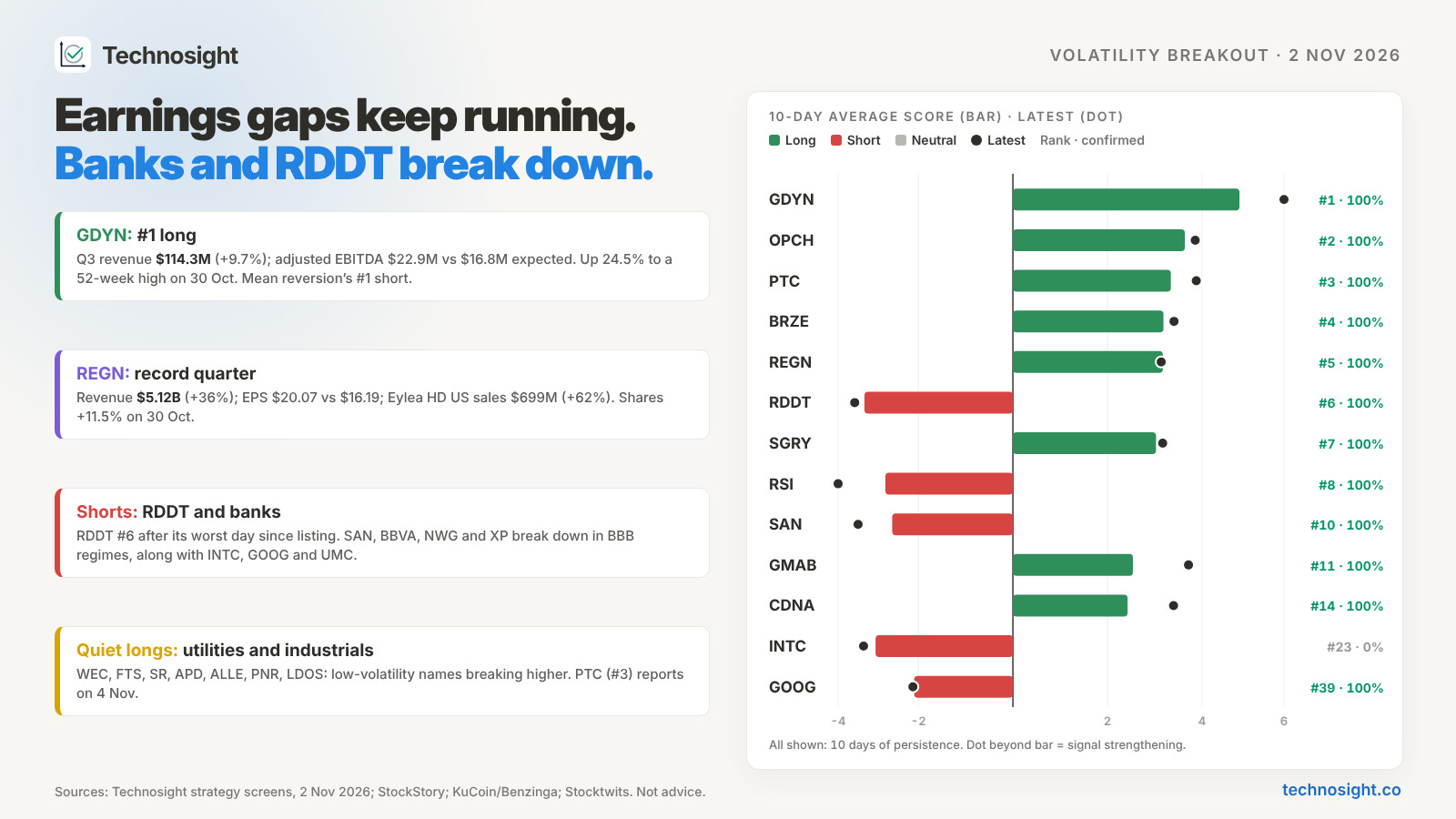
Grid Dynamics (#1) after its Q3 beat; adjusted EBITDA was $22.9M against $16.8M expected.
Regeneron (#5) after its record quarter.
Shorts: Reddit (#6) and banks. Santander, BBVA, NatWest and XP all break down in BBB regimes, along with Intel, Alphabet and UMC.
Quiet longs. Utilities and industrials break higher: WEC Energy, Fortis, Spire, Air Products, Allegion, Pentair and Leidos. PTC (#3) reports on 4 Nov.
Sources
Backtesting
Explore all company fundamental valuations, DCF intrinsic models, and thematic deep-dives in Backtesting.
Quantitative Models
Automated daily equity screening across 6 quantitative factor models with 15-minute EMA regime confirmation.
More Research from the Desk
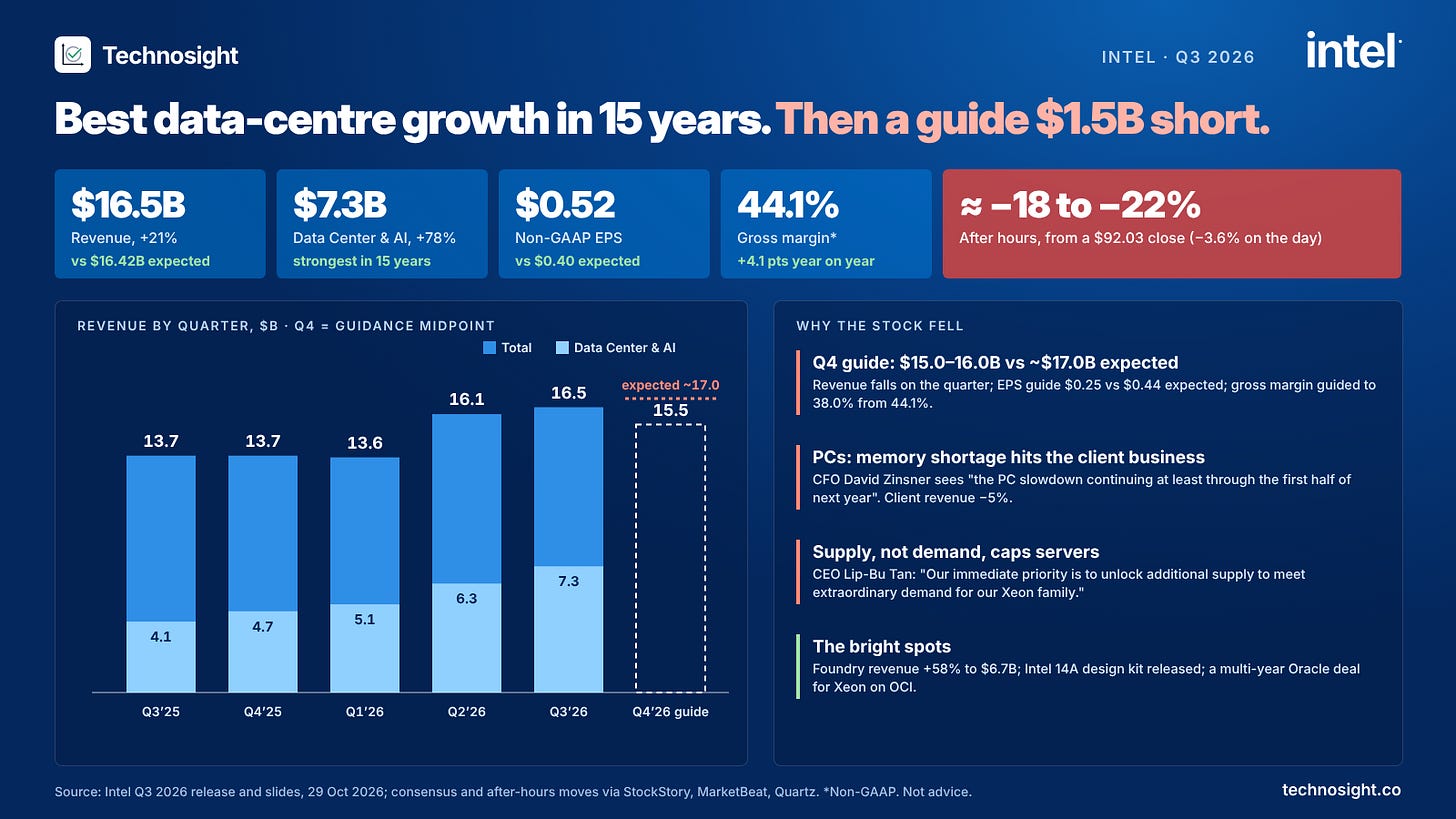
Intel Inc (INTC) earnings: data center jumps 78%, but Q4 guidance cut triggers 25% sell-off
Intel’s Q3 print delivered a stark contrast between a surging Data Center business (+78% YoY to $7.3B) and a severe guidance reset. While Q3 beat top- and bottom-line estimates ($16.5B revenue, $0.52 non-GAAP EPS), Q4 revenue guidance ($15.0B–$16.0B vs. $17.1B consensus) sent shares down ~25% pre-market. Management highlighted supply bottlenecks in substrate packaging, a memory-driven PC downturn running into H1 2027, and a $300M revenue hit from the Fab 28 explosion in Israel. With capex ramping for 18A/14A and 2027 expected to be cash-flow negative, we adjust the score from -2/10 to -1/10 Neutral.
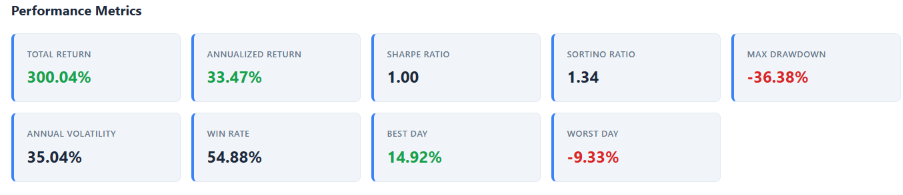
Momentum Omega: the long-only backtest returned 35% a year. $100K grown to $400K in 4 years
Momentum Omega’s long-only Scenario D1 grew $100,000 to $400,039 in 2022–2026 (33.5% a year, Sharpe 1.00), with a maximum drawdown of −36.4%. The returns are before slippage and carry no benchmark, and seven of today’s ten holdings are AI hardware or memory names.