Hyperscalers' two-customer problem: $1 trillion of commitments or who breaks first
Two AI labs, OpenAI and Anthropic, sit inside the backlogs of all four clouds, and the clouds also own stakes in them. Anthropic’s IPO filing shows at least $518B of compute commitments, $252.5B of it with the three clouds, against ~$4.6B of 2025 revenue; OpenAI has committed $250B to Microsoft, $138B to Amazon and about $300B to Oracle. Together the two labs have committed about $940B to the four clouds. Lab-linked contracts are roughly 22% of Alphabet's $514B backlog, 45-50% of Oracle's $664B and Amazon's $496B, and ~46% of Microsoft's $678B. On the equity side, Amazon has committed up to $83B across both labs, Alphabet up to $40B and Microsoft holds ~25% of OpenAI. Cloud growth therefore depends on lab financing as much as on enterprise demand. Alphabet is the least exposed. Oracle, funded by debt, is the most.
Hyperscalers' two-customer problem: $1 trillion of commitments or who breaks first
MSFT +4/10 | AMZN +4/10 | GOOG +5/10 | ORCL +6/10
Takeaway: Two AI labs, OpenAI and Anthropic, sit inside the backlogs of all four clouds, and the clouds also own stakes in them. Anthropic’s IPO filing shows at least $518B of compute commitments, $252.5B of it with the three clouds, against ~$4.6B of 2025 revenue; OpenAI has committed $250B to Microsoft, $138B to Amazon and about $300B to Oracle. Together the two labs have committed about $940B to the four clouds. Lab-linked contracts are roughly 22% of Alphabet's $514B backlog, 45-50% of Oracle's $664B and Amazon's $496B, and ~46% of Microsoft's $678B. On the equity side, Amazon has committed up to $83B across both labs, Alphabet up to $40B and Microsoft holds ~25% of OpenAI. Cloud growth therefore depends on lab financing as much as on enterprise demand. Alphabet is the least exposed. Oracle, funded by debt, is the most.
Research series: This is the summary article in a series about Hyperscalers: mega-cap companies driving cloud infrastructure growth, custom silicon adoption, and AI deployments. Earlier research: Amazon.com Inc (AMZN), Alphabet Inc (GOOG), Microsoft Corp (MSFT), Oracle Corp (ORCL).
The same two customers
Anthropic’s IPO filing, reviewed by Reuters, lists at least $518B of compute commitments over about a decade: $111.1B with Google, $110B with Amazon and $31.4B with Microsoft, plus $161.2B of Broadcom-related equipment leases. ~80% is owed even if Anthropic does not use the capacity.
In 2025 it spent $7.3B on compute against revenue of ~$4.6B, and held $20.3B of cash. The filing names Amazon, Google and Microsoft as investors, customers, cloud providers, distributors and competitors at once.
OpenAI is the other half. In October 2025 it committed to buy an incremental $250B of Azure services; in February Amazon agreed to invest up to $50B in it and expanded its AWS commitment by $100B to $138B in total. Its contract with Oracle is reported at ~$300B.
Every hyperscaler is partly a financing vehicle for these two labs. This article maps who sits inside each cloud, what each owns, who supplies them, and how much of each backlog depends on two customers.
Scoreboard
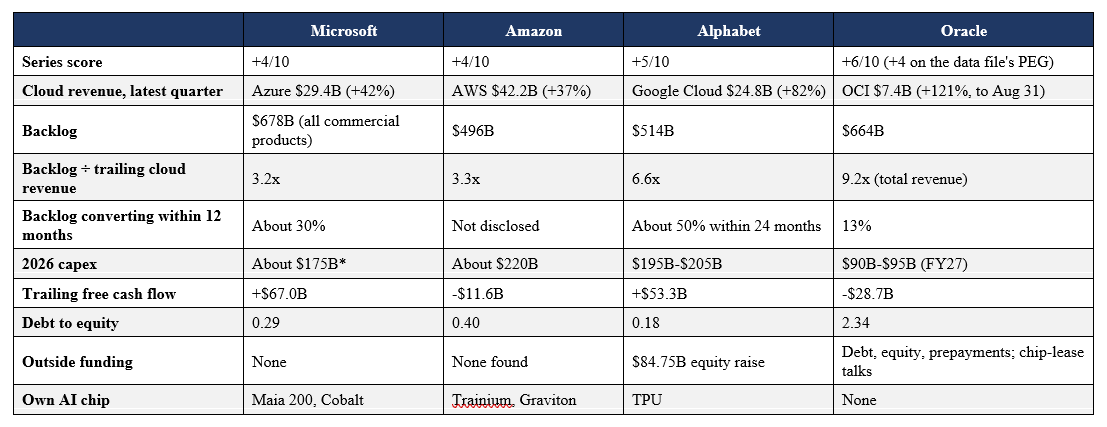
*Microsoft’s figure reflects lease reclassification, not lower spending. Oracle’s +6 uses the PEG from its own $8.10 guidance; the data file’s PEG of 2.41 gives +4. Figures are from the four earlier articles in this series.
Who sits on which cloud
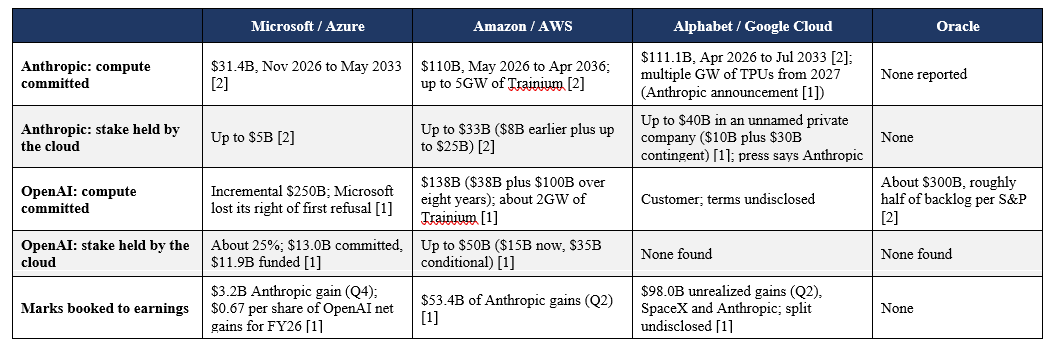
[1] company filing or announcement; [2] major outlet citing a named source, including Reuters’ review of Anthropic’s prospectus; [3] aggregator, analyst estimate or my arithmetic. Amazon and Alphabet do not disclose their ownership percentages; analyst estimates for Amazon’s Anthropic stake range from 15% to 21%.
Distribution runs through the same clouds. Reuters reports that 47% of Anthropic’s 2025 sales passed through Amazon’s and Google’s platforms, and Claude is also sold through Microsoft Foundry. The labs are the clouds’ customers, shareholders-in-waiting and competitors at once.
How much of each backlog depends on two customers
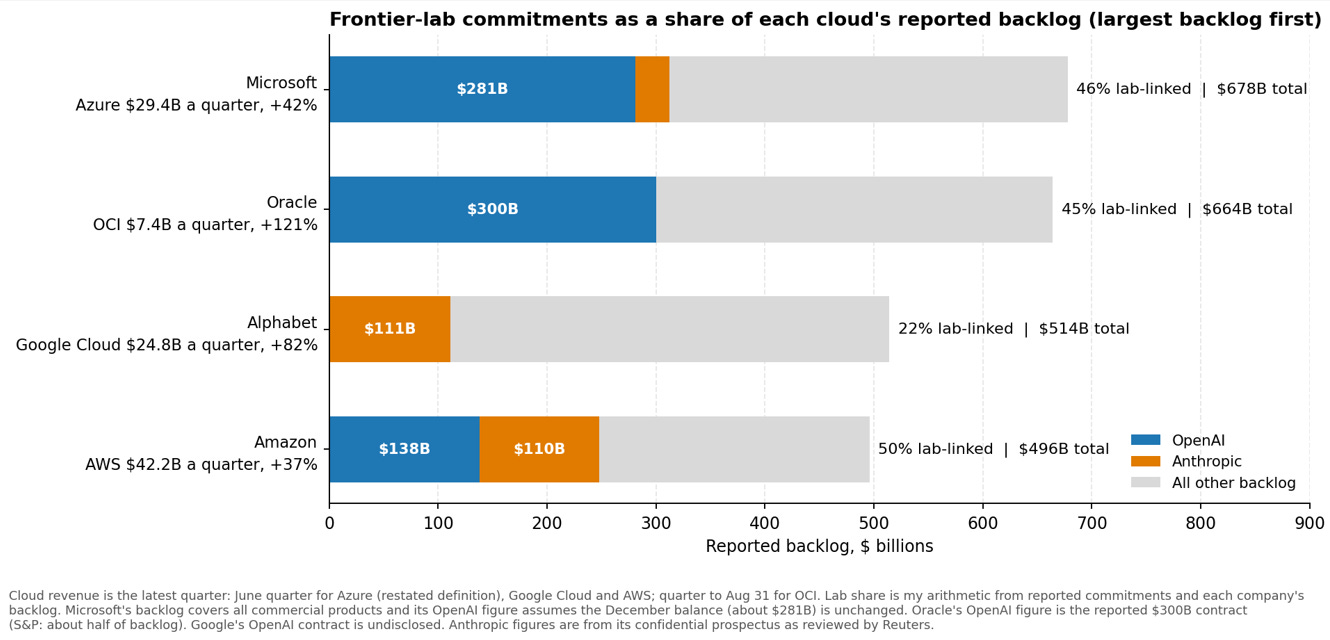
Microsoft, about 46%. OpenAI was ~45% of the $625B backlog at the December quarter, roughly $281B. Management said all sequential growth since came from customers outside frontier labs, so I hold that balance flat and add Anthropic’s $31.4B. Excluding OpenAI, backlog grew 25% against 84% in total.
Oracle, ~45-50%. One customer, OpenAI, at roughly $300B of $664B, and only 13% of the total converts to revenue within a year.
Alphabet, ~22%. Anthropic’s $111.1B of $514B. Google’s OpenAI contract is undisclosed, so the true figure is higher, but Alphabet is the least exposed of the four.
Amazon, up to 50%. OpenAI’s $138B and Anthropic’s $110B equal $248B against a $496B backlog, if all of it sits in backlog. Amazon does not break it out.
The four ecosystems
Microsoft: the model-agnostic landlord. Microsoft’s FY2026 10-K shows an equity stake of ~25% in OpenAI (down from 27% at the October 2025), $24.1B of revenue from OpenAI arrangements, 7% of the company’s total, and a $6.0B receivable. OpenAI’s exclusivity on Azure ended in April. Azure now hosts more than 11,000 models, including Anthropic’s, and Microsoft funds its buildout from cash flow (free cash flow +$67.0B). Its own Maia 200 chip and a $37B AI business run rate give it a second leg beyond OpenAI. The price is a 29.4 P/E and capex of $41B a quarter heading above $50B.
Amazon: financing both labs. Amazon has committed the most equity to the labs: up to $33B for Anthropic and up to $50B for OpenAI, against $248B of combined AWS commitments. Trainium capacity (up to 5GW for Anthropic, about 2GW for OpenAI) ties the chips business to those same customers; AI and custom chips are each above a $25B run rate. The cost shows in cash: free cash flow is -$11.6B on about $220B of capex, and $53.4B of Anthropic gains flattered Q2 earnings.
Alphabet: the only one that sells its own chips. Alphabet began selling TPU systems externally in Q2, and Anthropic’s compute deal with Google runs on them, with Broadcom as design partner. It holds the least concentrated backlog and a 17.2 P/E, but free cash flow turned negative in Q2 (-$5.9B), it raised $84.75B of equity including $10B from Berkshire Hathaway, and the $98.0B Q2 gain came from SpaceX and Anthropic marks, not operations.
Oracle: the leveraged challenger. About half its $664B backlog is OpenAI, it designs no AI chip (it sold its Ampere stake), its capex is 105% of revenue and S&P rates it BBB-. It is funding fiscal 2027 with about $40B of debt and equity and is negotiating an off-balance-sheet chip lease with Apollo and Goldman Sachs. Its Project Jupiter campus for OpenAI is waiting on a gas pipeline now due Feb 1, 2027. OCI is growing 121%; the question is who pays for the capacity.
Silicon and suppliers: NVIDIA at the center
NVIDIA reported $96.2B of revenue for its July quarter, $89.0B of it Data Center, and $48.7B of that from hyperscale customers. One direct customer was 16% of revenue. Its next-generation Vera Rubin systems began shipping in August to Google Cloud, Azure, Oracle, CoreWeave and Nebius, according to one secondary source; Amazon was not named.
NVIDIA is also a financier: $99B of equity investments and $25B of commitments on its balance sheet (10-Q), up to $105B of credit support for a campus leased to OpenAI, and a $30B stake in OpenAI’s latest round.
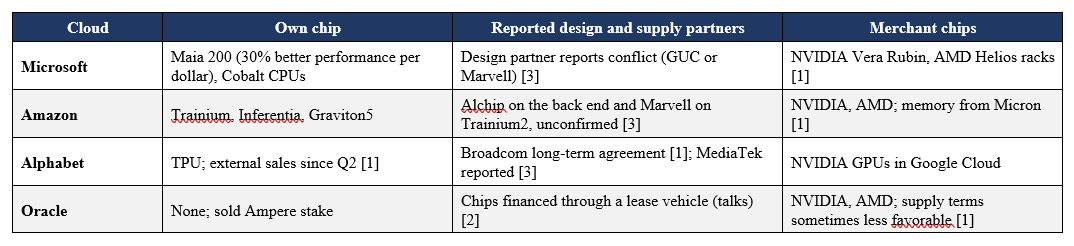
The pattern is that NVIDIA’s largest customers are building chip substitutes, while Oracle is the one big cloud without one.
Anthropic’s filing shows the same diversification: besides the three clouds, it lists $161.2B of Broadcom-related equipment leases, up to $84.5B of NVIDIA-based capacity from xAI through 2029, and AMD supplying more than $20B of compute and buying up to $5B of Anthropic shares (all via Reuters).
The money loop
Dollars travel in a circle. Clouds have invested ~$140B into the two frontier labs. The labs have committed ~$940B back to the clouds as multi-year compute contracts. To deliver that capacity the clouds buy chips, and the chipmakers (NVIDIA, AMD, Broadcom) finance the buyers through investments, credit support and lease structures. Private credit funds the chip purchases as well, in deals like Oracle's lease talks with Apollo and Goldman, Broadcom's $50B package for OpenAI and SpaceX's $40B for NVIDIA chips. The result is demand that looks organic but is deeply supplier-financed, which is why the labs' ability to pay matters so much.
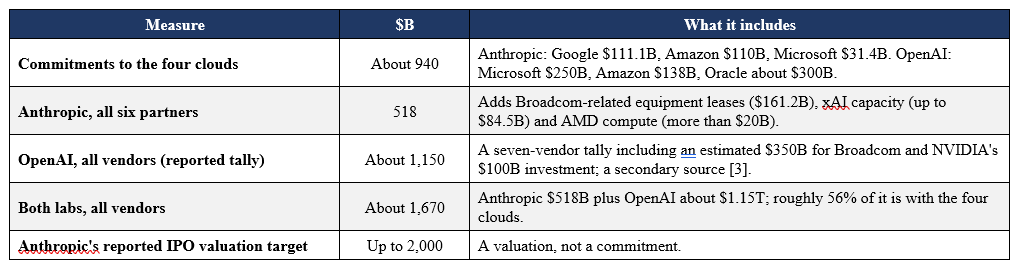
Clouds fund labs. Up to about $140B in total: Amazon up to $83B, Alphabet up to $40B, Microsoft about $12B funded into OpenAI plus up to $5B for Anthropic.
Labs commit that money back as cloud revenue, $940B: $252.5B from Anthropic (Google $111.1B, Amazon $110B, Microsoft $31.4B; its $518B total spans six partners) and $688B from OpenAI (Microsoft $250B, Amazon $138B, Oracle about $300B), over different horizons.
Marks flatter earnings. Amazon booked $53.4B, Alphabet $98.0B and Microsoft $3.2B of gains in one quarter each. Reported earnings overstate operating profit and trailing P/E ratios look lower than they should.
Chipmakers fund the buyers. NVIDIA’s investments and credit support, AMD’s share purchase and warrants, and Broadcom’s lease structure.
Private credit funds the chips. Apollo and Goldman Sachs are negotiating Oracle’s chip lease; Broadcom is arranging more than $50B for OpenAI’s custom chip; SpaceX is seeking about $40B for NVIDIA chips (WSJ, FT).
What breaks it
Ability to pay. Anthropic committed about 113x its 2025 revenue, though revenue is growing quickly and the comparison overstates the gap. OpenAI’s annualized revenue was reported near $50B in September, against $68B-$70B circulated earlier; its three headline cloud contracts sum to about 14x that, and OpenAI has ruled out a 2026 IPO (Sam Altman: 2027 at the earliest).
Concentration. One customer, OpenAI, is about half of Oracle’s backlog, and the two labs together are up to half of Amazon’s. A shortfall at either lab reaches four income statements.
A repricing event. Anthropic filed confidentially on Jun 1, and its listing has slipped from October to as soon as mid-November, according to Bloomberg and the Wall Street Journal: investor meetings from Oct 14 and marketing from the week of Nov 9. The company has not confirmed a date. The public prospectus will show how much Amazon and Google own, and the reported target of up to $2 trillion (against $965B in May) would reprice every mark above, up or down.
Physical limits. Power and permits already bind: Project Jupiter’s pipeline slipped to 2027, and a force majeure notice protects Oracle if the campus misses 2028.
Financing markets. Oracle is one notch above junk, bond yields rose on Oct 8, and Broadcom’s $50B-plus package is still early-stage. A slipped or shrunk deal would be the first visible stress in private credit.
What to watch
Oct 14 (Bloomberg): Anthropic's investor day at its San Francisco headquarters for select institutional investors. The company has not confirmed it, and a spokesperson declined to comment. A public prospectus has not been published and is required at least 15 days before the roadshow.
Oct 27-28: Federal Reserve meeting.
Oct 28: Microsoft (after the close, call 2:30pm Pacific) and Alphabet (1:30pm Pacific) report; Oracle holds its Investor Day in Las Vegas. Look at Azure growth against the 45% guide, Google Cloud’s margin and any update on lab concentration.
~Oct 29: Amazon reports (est). Check AWS growth vs 37% & capex against $220B.
Week of Nov 9 (reported): The start of Anthropic’s IPO marketing, with trading possible before Thanksgiving.
~25 Nov: NVIDIA’s next report (est) for hyperscale demand and Vera Rubin timing.
Dec 14: Oracle’s fiscal Q2, after the close.
Anytime: OpenAI funding news and the Apollo, Goldman and Broadcom financings.
Investor takeaways
Alphabet (+5/10) is the least exposed. Lab-linked contracts are about 22% of backlog, the P/E is the lowest at 17.2 (flattered by unrealized gains) and the chips are its own; the cost is negative free cash flow and an equity raise.
Microsoft (+4/10) is diversified but priced for it. About 54% of backlog is outside the labs and cash flow funds capex, yet the stock is up 35% since July and free-cash-flow yield is 1.7%.
Amazon (+4/10) is the neutral landlord with the most to lose. It is the largest funder of the two labs, up to $83B, and it carries negative free cash flow.
Oracle (+6/10) is the fastest grower and the most fragile. It is the leveraged bet on OpenAI paying.
The common thread. Cloud growth is strong, but the incremental dollar increasingly comes from two customers the clouds are financing. Check each report (Amazon.com Inc (AMZN), Alphabet Inc (GOOG), Microsoft Corp (MSFT), Oracle Corp (ORCL)) for how much of new backlog comes from outside the labs.
Sources
[1] Company filing or announcement. Microsoft’s 10-K, Amazon’s and Alphabet’s 8-Ks and 10-Qs, NVIDIA’s 10-Q, Oracle’s 10-K and 10-Q.
[2] Major outlet citing a named source. Anthropic’s commitments come from its confidential prospectus as reviewed by Reuters and repeated by several outlets; the document itself is not public. Oracle’s OpenAI contract and S&P’s backlog estimate are press-reported.
[3] Aggregator, estimate or my arithmetic. Lab share of backlog, ratios, Microsoft’s OpenAI balance, Trainium and Maia design partners (conflicting reports), Vera Rubin launch customers, and ownership percentages for Amazon and Alphabet.
For information only; not investment advice.
Hyperscalers
Explore all company fundamental valuations, DCF intrinsic models, and thematic deep-dives in Hyperscalers.
Quantitative Models
Automated daily equity screening across 6 quantitative factor models with 15-minute EMA regime confirmation.
More Research from the Desk
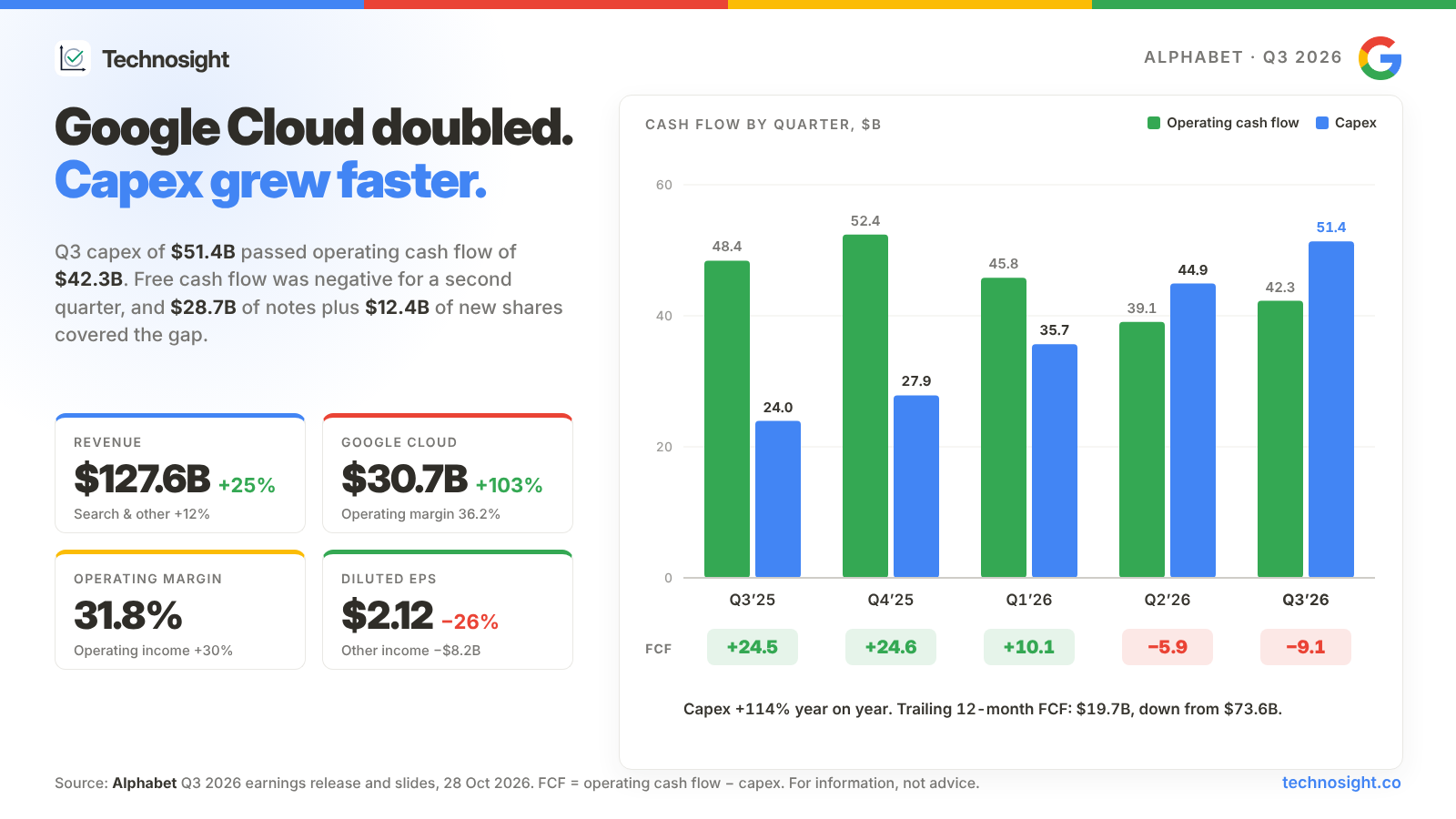
Alphabet (GOOG): Cloud doubles to $30.7B. -$9.1B cashflow and Search squeeze send price down 12%
Alphabet’s Q3 had two opposing forces: Google Cloud doubled revenue with an 80% growth beat and a $561B backlog, but Search slowed as AI answers monetised below classic queries, and $51.4B in capex drove free cash flow to -$9.1B. With the stock down ~11% pre-market to $287, the market is pricing in cash burn and Search cannibalisation while discounting the long-term value of proprietary TPU hardware and Cloud momentum. At ~19x 2027 EPS, the valuation offers upside, but near-term pressure remains until cash flow catches up.
Signals and themes from quant strategies after last week’s earnings: FTNT, F5 and healthcare
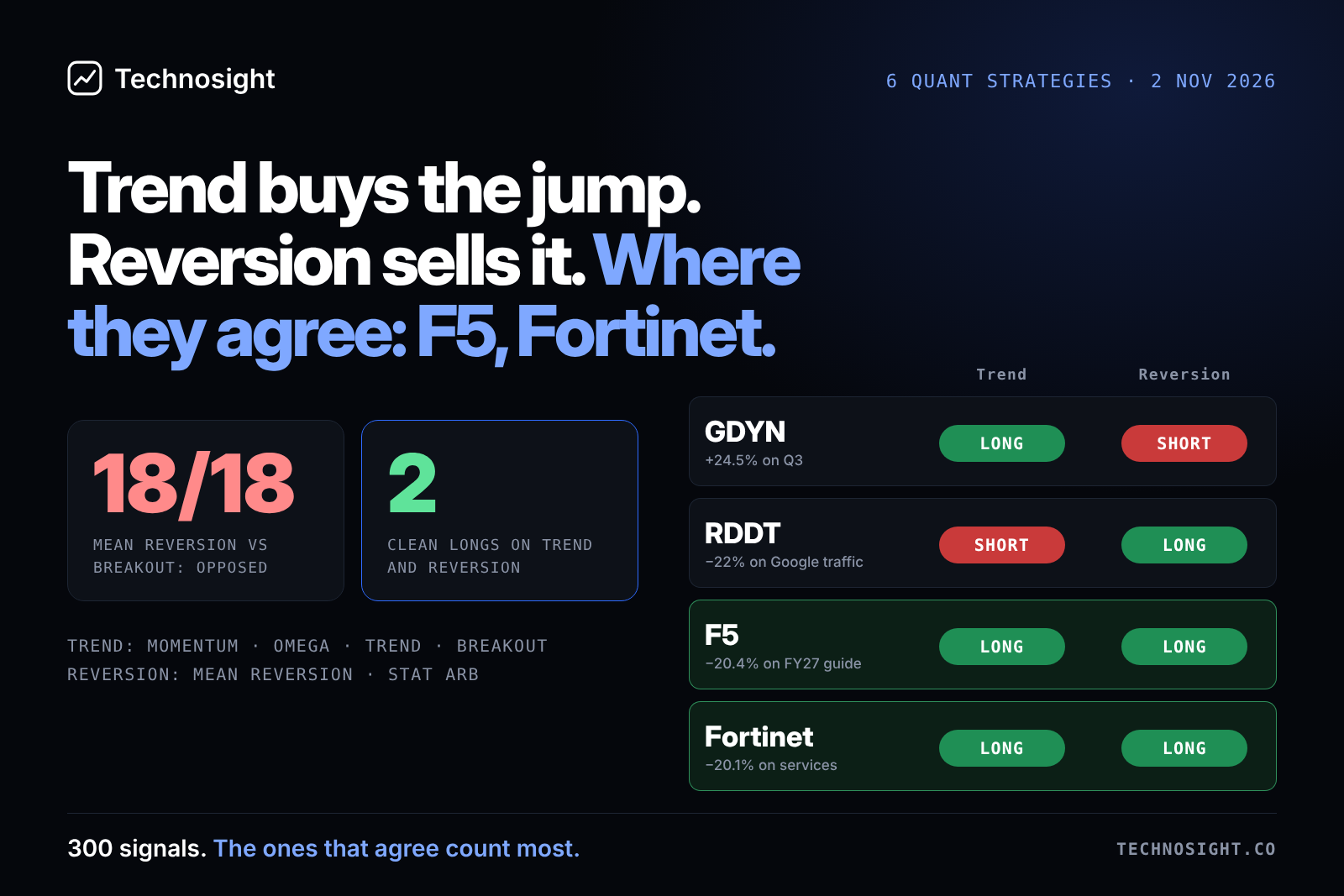
We reviewed 300 signals from our six quant strategies together. Strategies split into two families (trend and reversion) that read last week’s earnings in opposite ways. The trend family (Momentum, Momentum Omega, Trend Following, Volatility Breakout) is buying the stocks that jumped, such as Grid Dynamics (+24.5% on 30 Oct) and Regeneron (+11.5%). The reversion family (Mean Reversion, Statistical Arbitrage) is shorting them and buying the stocks that fell, such as Reddit (−22%). The most valuable signals are the ones both families back: F5 and Fortinet, each long across both families with no votes against them, each down about 20% after beating on the quarter and guiding to slower growth. Beyond the stocks, two themes stand out: healthcare catalysts lead momentum, and the market is selling companies that guide lower or pay heavily for AI.