Alphabet (GOOG): Cloud doubles to $30.7B. -$9.1B cashflow and Search squeeze send price down 12%
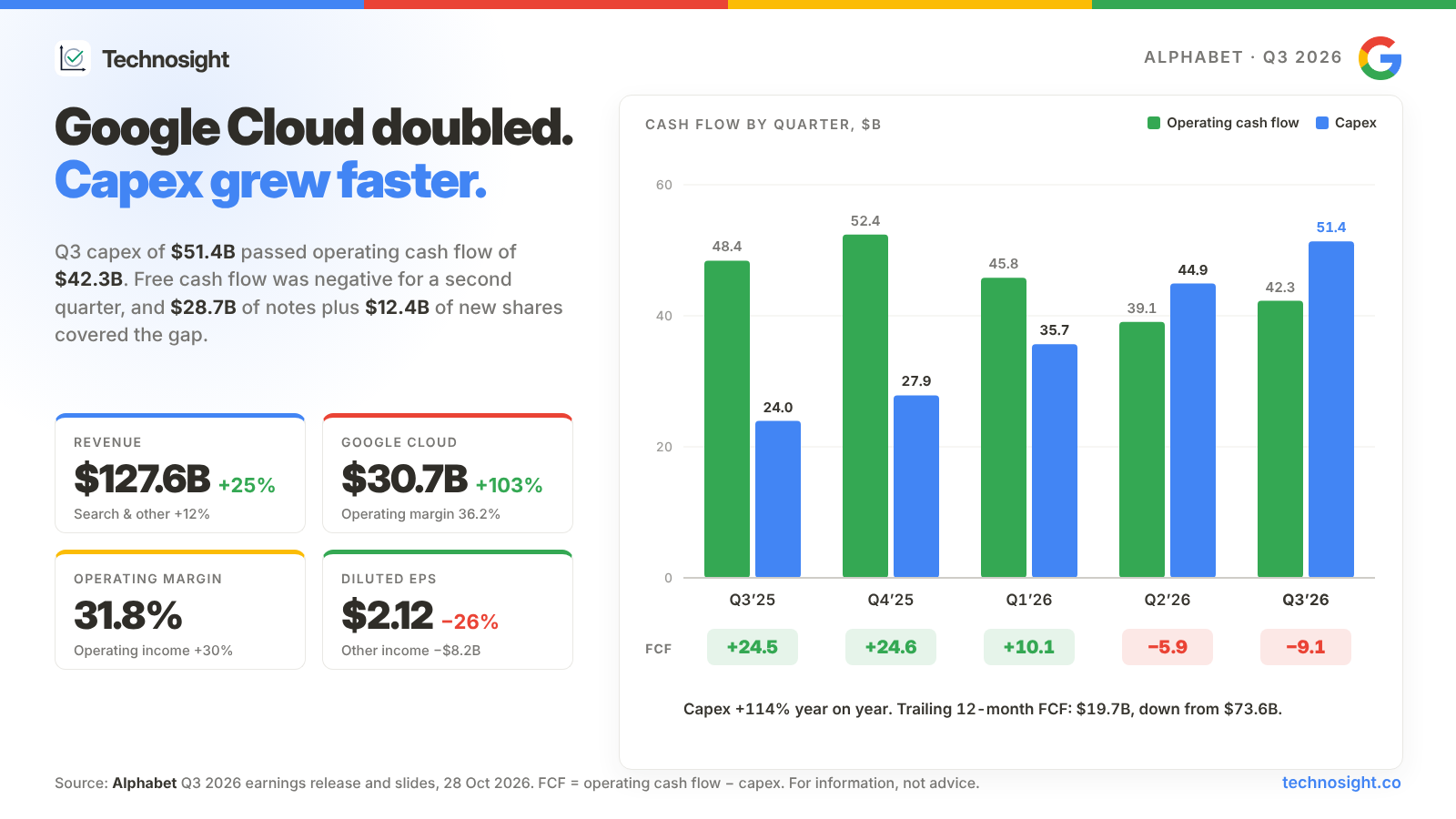
Alphabet’s Q3 had two opposing forces: Google Cloud doubled revenue with an 80% growth beat and a $561B backlog, but Search slowed as AI answers monetised below classic queries, and $51.4B in capex drove free cash flow to -$9.1B. With the stock down ~11% pre-market to $287, the market is pricing in cash burn and Search cannibalisation while discounting the long-term value of proprietary TPU hardware and Cloud momentum. At ~19x 2027 EPS, the valuation offers upside, but near-term pressure remains until cash flow catches up.
Alphabet (GOOG): Cloud doubles to $30.7B. -$9.1B cashflow and Search squeeze send price down 12%
+5/10 Long | Price $284 Target $411 (+45%)
Takeaway: Alphabet’s Q3 had two opposing forces: Google Cloud doubled revenue with an 80% growth beat and a $561B backlog, but Search slowed as AI answers monetised below classic queries, and $51.4B in capex drove free cash flow to -$9.1B. With the stock down ~11% pre-market to $287, the market is pricing in cash burn and Search cannibalisation while discounting the long-term value of proprietary TPU hardware and Cloud momentum. At ~19x 2027 EPS, the valuation offers upside, but near-term pressure remains until cash flow catches up.
Research series: This is a follow up on Alphabet’s Q3 2026 earnings (Oct 28, 2026). Earlier research: Alphabet (GOOG) Oct 8, 2026, Hyperscalers’ two customer problem Oct 9, 2026
Alphabet runs Google Services (Search, YouTube, Android, subscriptions, devices; 75% of Q3 revenue), Google Cloud (24%, including TPU systems) and Other Bets such as Waymo. It designs its own TPU AI chips and Gemini models. Rivals are Microsoft and Amazon in cloud, Meta in advertising.
Q3 2026 update
Alphabet reported Q3 2026 after the close on 28 Oct. Revenue was $127.6B, up 25%, roughly in line with the $127.3B-$128.2B consensus. Google Cloud beat: $30.7B, up 103%, against about $29.2B expected, with operating income more than tripling to $11.1B (Alphabet release via Converge Digest; Forbes, 28 Oct). Everything else disappointed. GAAP EPS was $2.12 against $3.01-3.03 expected, the first miss on both revenue and earnings in nearly four years by some measures (CNBC; SiliconANGLE, 28 Oct). An $8.7B paper loss on equity stakes explains part of it, but EPS without it (about $2.67, CNBC) still missed. Search grew only 12% (17% in Q2), YouTube ads 9%, and free cash flow fell to -$9.1B as capex hit $51.4B.
The stock fell about 10% after hours and was $287.34 pre-market, down 10.7% from the close and 16.7% below the $345 of the 8 Oct article (FMP; GuruFocus, 29 Oct). Microsoft rose about 4% the same evening on 48% Azure growth (SiliconANGLE, 28 Oct), so the market is separating the two names.
Q3 2026 in numbers
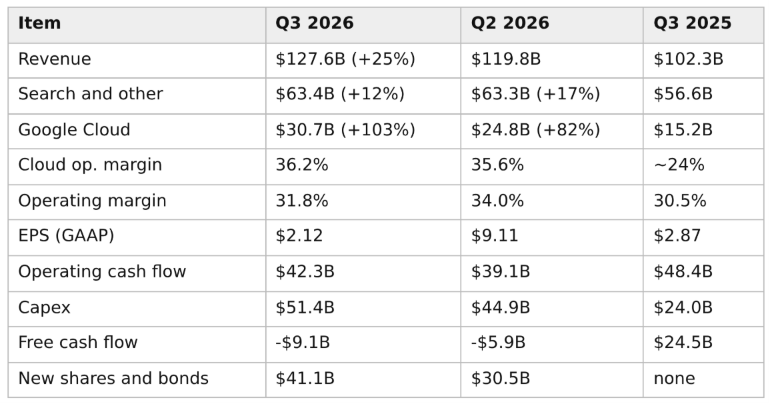
Why cash went negative. Capex rose another $6.5B on the quarter, inventory has risen about $11B this year as Alphabet builds TPU systems before it can recognise the sales, and it paid a $5.2B European Commission fine (call summaries, 28 Oct).
Funding mix. The $40B at-the-market (ATM) programme the 8 Oct article flagged has started: 12M Class A and 24M Class C shares were sold for $12.4B net in Q3. Long-term debt is about $125.1B, against about $46.5B at the end of 2025 (secondary summary of the 10-Q data).
Earnings call (28 Oct) messages
Cloud is supply-limited, not demand-limited. Backlog rose to $561B from $514B, and just over 55% should turn into revenue within 24 months (Q1: about half). Management said most of the backlog is ordinary GCP contracts (call summaries, 28 Oct).
TPUs are now a product line. Nearly 100 customers use TPU systems, including Anthropic (directly and via Broadcom) and Apple. CFO Anat Ashkenazi expects more TPU system revenue in 2027 (Yahoo Finance call highlights, 28 Oct).
AI Mode grows faster than it earns. AI Mode queries grow strongly but monetise below classic Search, which held Search to 12% growth. Management guided to more pressure on Search in Q4 and a slightly larger currency headwind (call summaries; The Desk, 28 Oct).
2027 capex rises “significantly”. The 2026 guide stays at $195B-$205B, which implies $63B-$73B in Q4. Details come on the Q4 call; one outlet’s “above $300B” is not a company figure (CNBC; call, 28 Oct).
Gemini scale. The Gemini app passed 1 billion users, and Alphabet announced Gemini 4 Carbon, its strongest frontier model, after Gemini 4 Argon on 30 Sep (call, 28 Oct).
“What to watch” list, Q3 update
‘What to watch’ list is from Alphabet (GOOG), 8 Oct, 2026, based on Q2 results
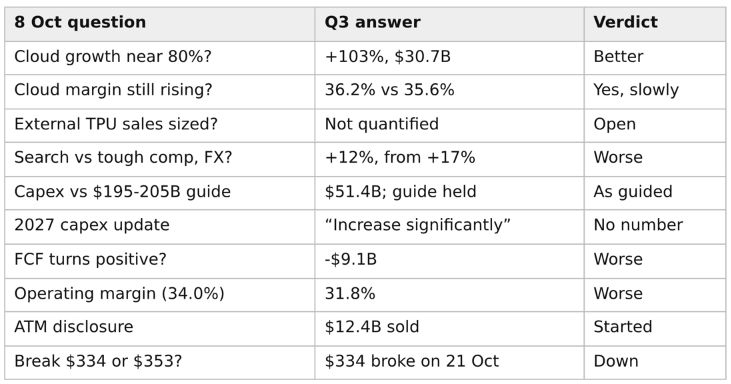
Growth: answered in Alphabet’s favour. Cloud beat the 80% bar by 23 points and still widened its margin. TPU system sales are now big enough to move hardware costs (other cost of revenue +32%, call summaries) but are still not given as a number.
Search: the miss that moved the stock. The article warned that Q3 laps last year’s acceleration. Search slowed five points, and management tied it to AI Mode monetising less, a structural issue rather than a currency one.
Cash: the article’s central test failed. It said Q3 “will test whether cash flow catches up”. Capex grew faster than operating cash flow again, and the ATM and $28.7B of bonds are now funding the gap.
Earnings quality cuts the other way this time. The article said to ignore GAAP EPS because of $98.0B of Q2 gains. Q3 has an $8.7B mark-down, so GAAP now understates profit. Operating income, the measure the article recommended, rose 30% but its margin fell 2.2 points.
Strategy and moat
Alphabet is turning a decade of in-house TPU chips into a second business: it sells TPU capacity in Google Cloud and, since Q2, TPU systems to outside customers, while Gemini runs across Search, Android, YouTube and Workspace. It is paying for the build-out with operating cash flow, debt and new equity, and accepts negative free cash flow while backlog grows.
Moat
Own silicon. The only hyperscaler selling its own AI chips as systems to other companies. That gives it a cost edge over GPU buyers and a product rivals cannot offer.
Distribution. 1B Gemini app users, Search, Android and YouTube reach most internet users without paying for access.
Least concentrated backlog. See the hyperscaler update below: about 20% of the backlog is tied to Anthropic, the lowest lab share of the four large clouds.
Threats. AI answers monetising below Search; capex rising faster than cash flow; dilution from the ATM; and the Anthropic IPO, which will re-price Alphabet’s stake.
Google Cloud, is now the strongest part. The new worry is the core: Search grew 12% with AI Mode cannibalising some monetisation, and 2027 spending will rise again. A buyer at $287 is betting that Cloud and TPU revenue reach free cash flow before Search slows further.
What changed for Google?
I wrote two articles based on Q2 2026 results:
Alphabet Inc (GOOG): pre-Oct 28 earnings. Google Cloud grows 82%, FCF negative (8 Oct 2026): +5/10 LONG at $345, target $431, buy zone $333-343.
“Hyperscalers’ two-customer problem: $1 trillion of commitments or who breaks first” (9 Oct 2026): Alphabet the least exposed of the four large clouds to OpenAI and Anthropic.
Based on Q3, the score is again +5/10 LONG, now at $287.34, and every component scores the same. Alphabet is still the least exposed to the labs. What changed is the price, the buy zone and the cash position.
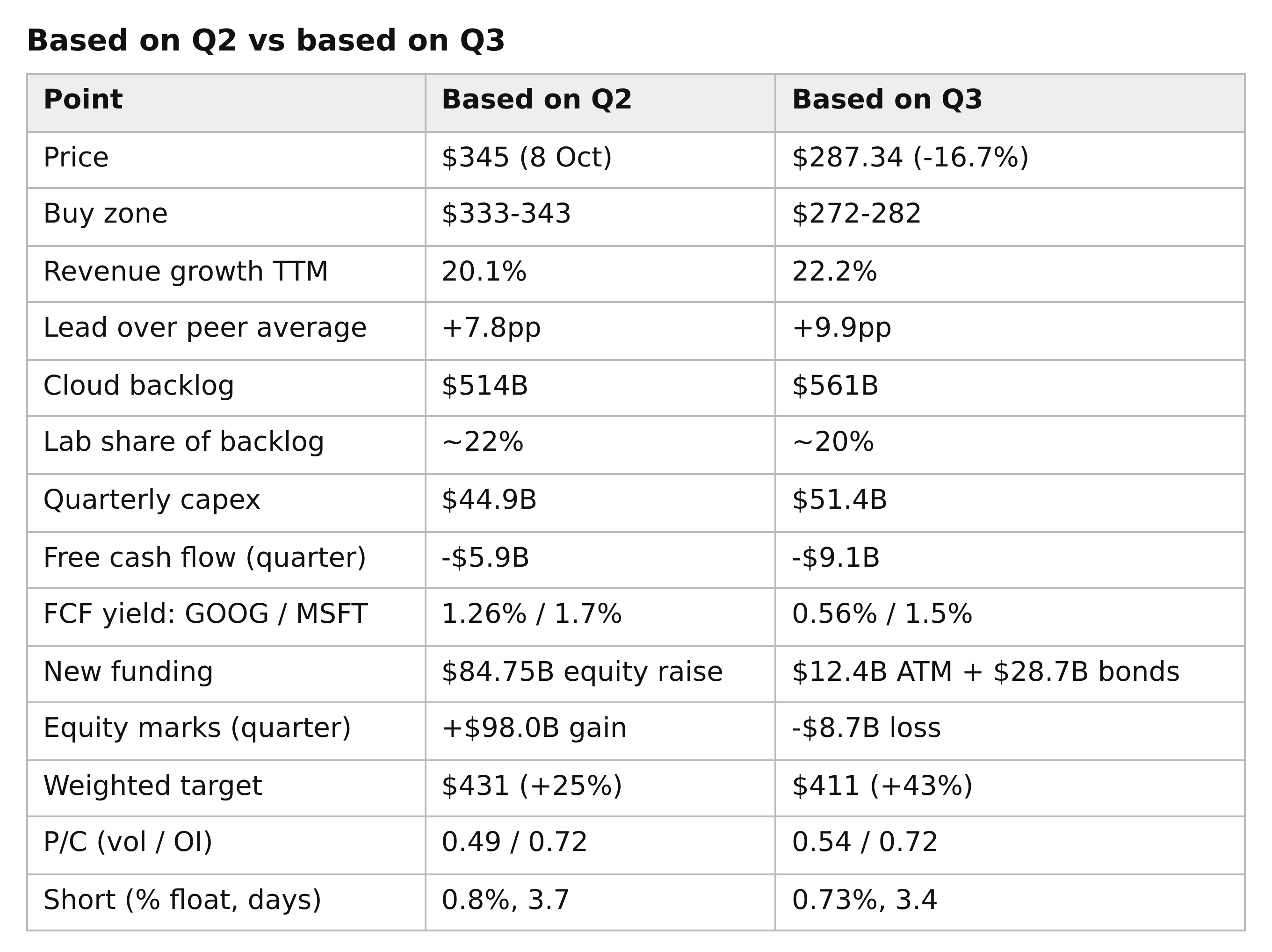
Cash is weaker. Quarterly free cash flow fell from -$5.9B to -$9.1B, and the trailing yield from 1.26% to 0.56%. Alphabet raised about $41B of new shares and bonds in one quarter. Its yield was already below Microsoft’s and is now less than half. FCF yield was already -1, so the score did not move.
Growth and backlog: stronger, and less concentrated. Cloud lifted growth to 22.2% and backlog by $47B, which management said is mostly ordinary GCP contracts. If Anthropic’s $111.1B is unchanged, the lab share falls from about 22% to about 20%.
Marks: a $98.0B gain became an $8.7B loss. The SpaceX and Anthropic stakes can move earnings either way, and the Anthropic IPO will re-price them.
Target: $431 to $411. Upside rose from 25% to 43% only because the price fell faster than the targets. Bernstein, Barclays and Morgan Stanley cut on 29 Oct.
Options: ratios unchanged, walls stranded. The call positions were built near $345 and are now 22-32% above the price.
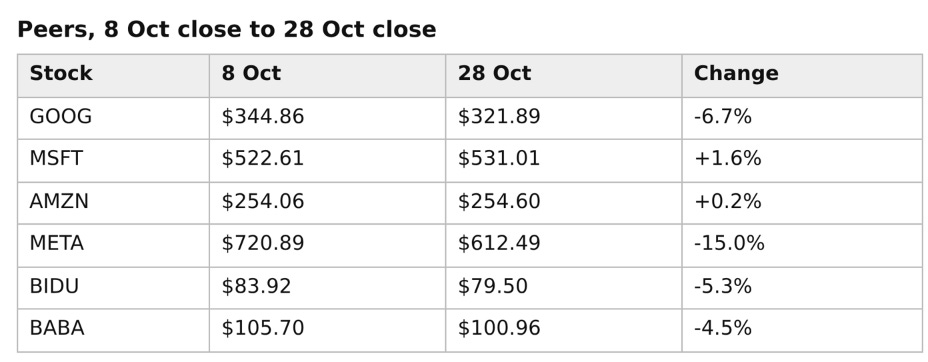
Takeaway. Meta and Alphabet, whose capex now exceeds operating cash flow, fell the most. Microsoft, which pays for its capex from cash flow, rose. Alphabet is still the least exposed to the labs, the only cloud selling its own chips, and the cheapest on P/E (14.8 vs Microsoft's 27.7). The gap is cash: Alphabet now funds capex with bonds and new shares, and in October the market priced free cash flow, not growth.
Thesis: Long but not yet. Cloud doubled with a rising margin and $561B of backlog; at about 19x 2027 consensus EPS the stock is cheaper than Microsoft (27.7x trailing). Against that, Search slowed and 2027 capex will rise again. The score stays +5 on the analyst and growth components, while the price structure is broken.
Price action
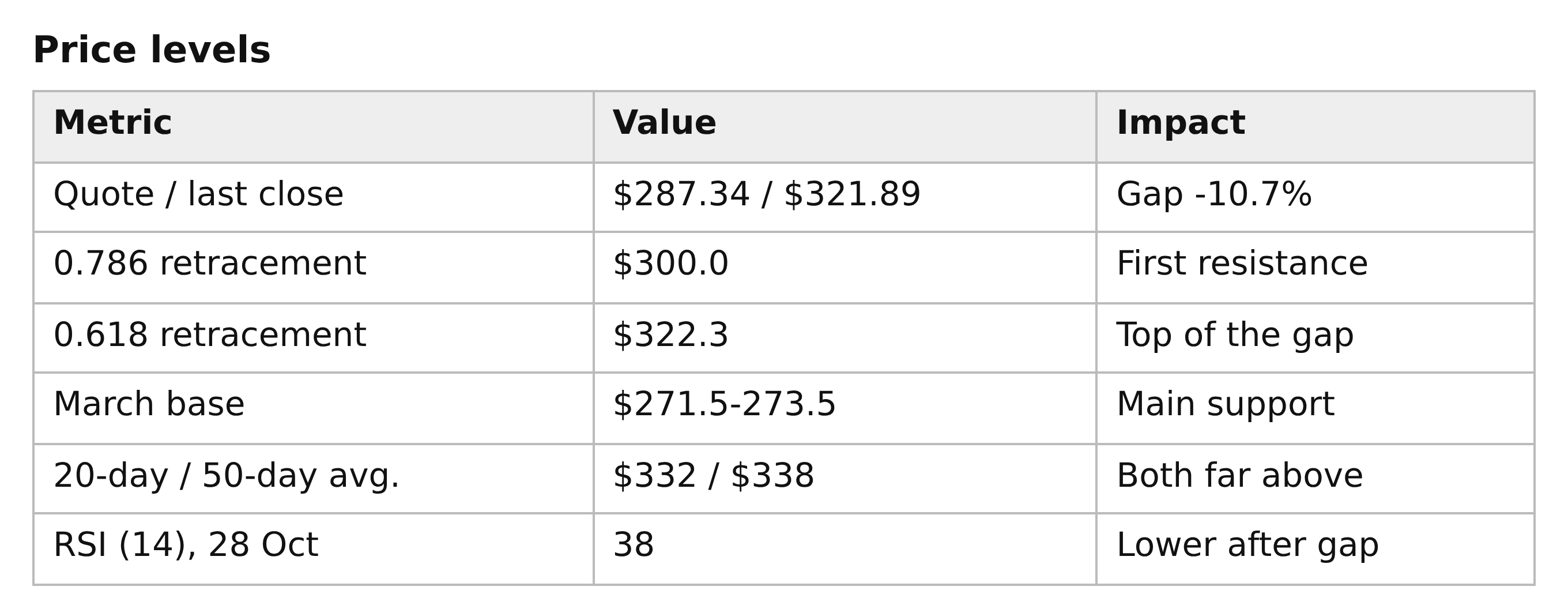
GOOG rallied from $271.54 (30 Mar) to $404.47 (18 May), then traded between $315 and $382 through the summer. It broke its rising support on 21 Oct ahead of results and gapped down 10.7% after Q3, to $287.34 pre-market: back to early-April prices.
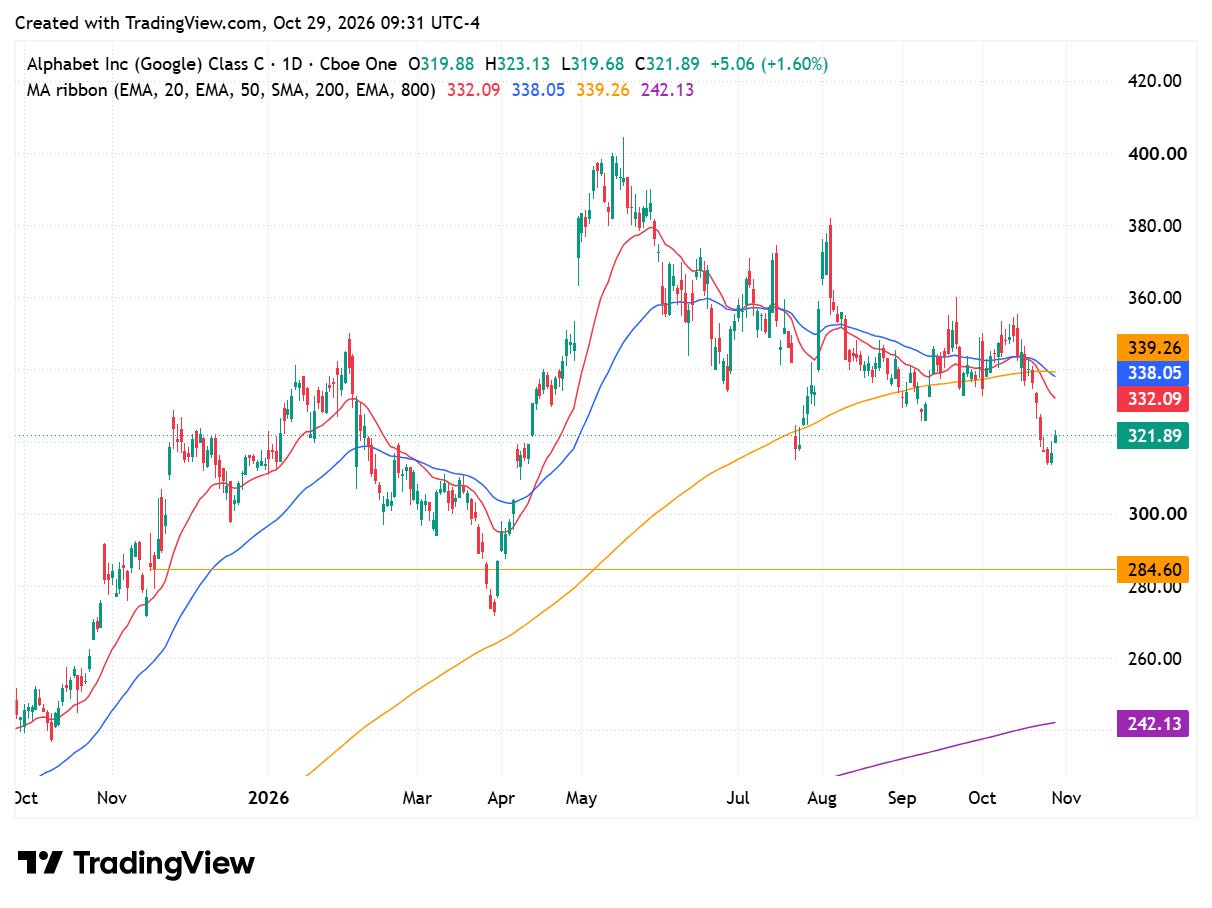
Institutional Buy Zone: $272-280. The low end is the March double bottom ($271.54 on 30 Mar, $273.48 on 27 Mar), the start of the rally to $404. The top is the 26 Mar close area ($280.74) and the $280 put strike (20 Nov).
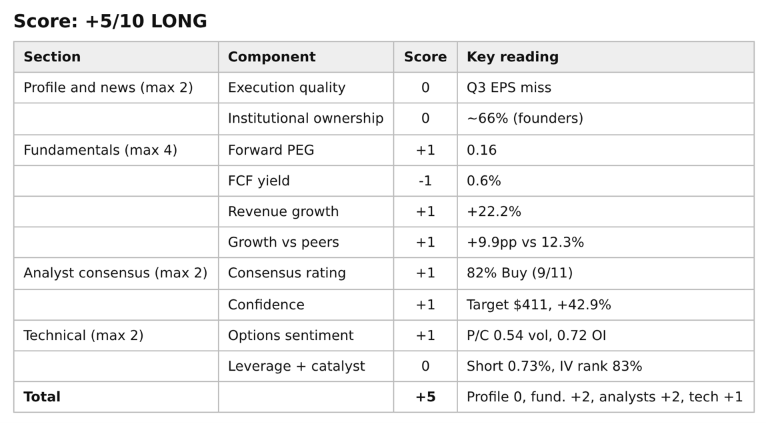
Analysts carry the score: 82% Buy and a weighted target 43% above the price. Growth (22%, ahead of peers), a low forward PEG and call-heavy options add +1 each. Free-cash-flow yield (0.6%) is the one -1: capex exceeded operating cash flow for a second quarter. Execution, ownership and leverage are neutral.
Fundamental analysis
All figures are trailing twelve months to each company’s last reported quarter. Alphabet, Microsoft and Meta include the September quarter; Amazon, Baidu and Alibaba run to 30 Jun. Baidu and Alibaba report in yuan and are converted to USD. Alphabet’s market value, P/E, PEG and FCF yield are restated at the $287.34 quote;
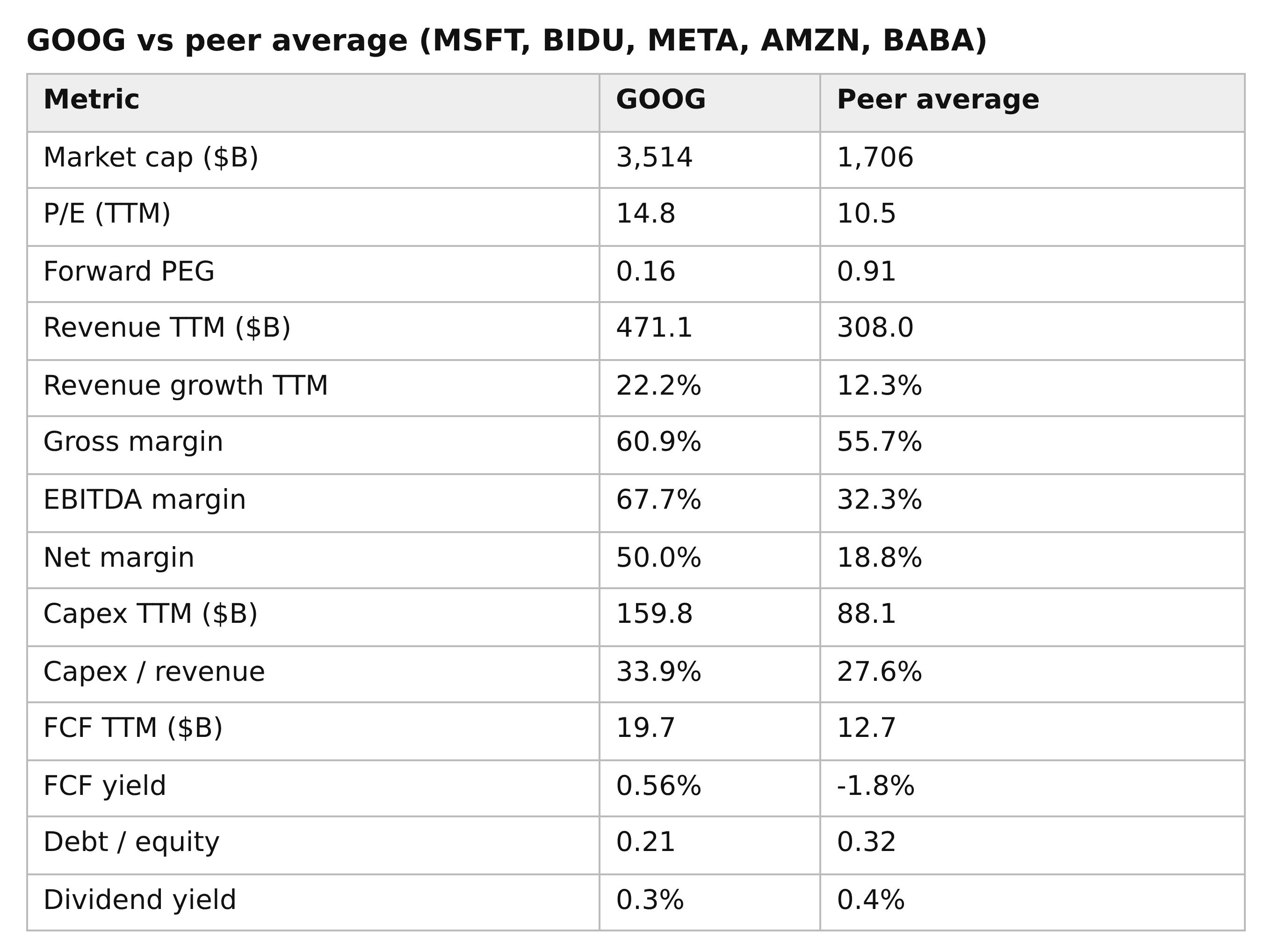
Peer P/E average includes Baidu’s loss-making -37.3; without it the average is 22.4. At the 28 Oct close FMP shows GOOG market cap $3,937B, P/E 16.6, PEG 0.18 and FCF yield 0.50%.
Growth: 22.2% is the second fastest in the set after Meta and has accelerated since 8 Oct (20.1%), driven by Cloud.
Margins: EBITDA (67.7%) and net margin (50.0%) are inflated by the Q1-Q2 equity gains ($134.9B together). The Q3 operating margin of 31.8% is the cleaner measure, and it fell 2.2 points on the quarter.
Investment and cash: capex rose to 33.9% of revenue from 29.7% on 8 Oct, now third after Meta (43.2%) and Microsoft (39.2%). Trailing free cash flow fell from $53.3B to $19.7B and will fall further: it still contains Q4 2025’s $24.6B.
Valuation: a 14.8 trailing P/E is flattered by gains. On the 2027 consensus EPS of $15.07 (8 Oct), the forward P/E is 19.1.
Balance sheet: debt/equity rose from 0.18 to 0.21 as long-term debt climbed to about $125B. Still below the 0.32 peer average.
Score: +2/4 (PEG +1, FCF yield -1, growth +1, growth vs peers +1).
Peers
Three groups: US hyperscalers that compete with Google Cloud for the same AI and enterprise budgets, the ads platform that competes with Search and YouTube for advertising, and the Chinese search and cloud counterparts.
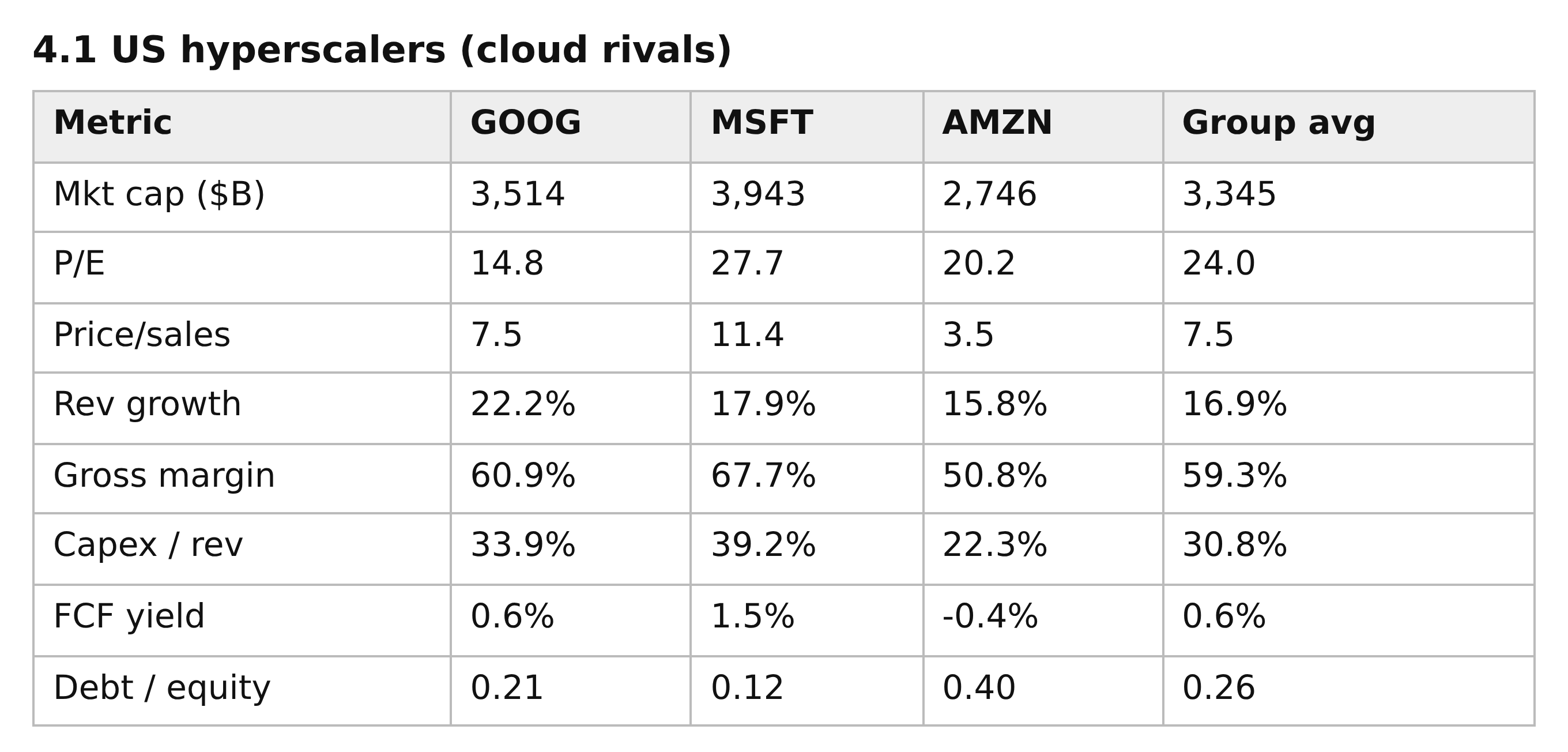
Group average excludes GOOG. FMP; GOOG and MSFT to 30 Sep, AMZN to 30 Jun (Amazon reports Q3 on 29 Oct).
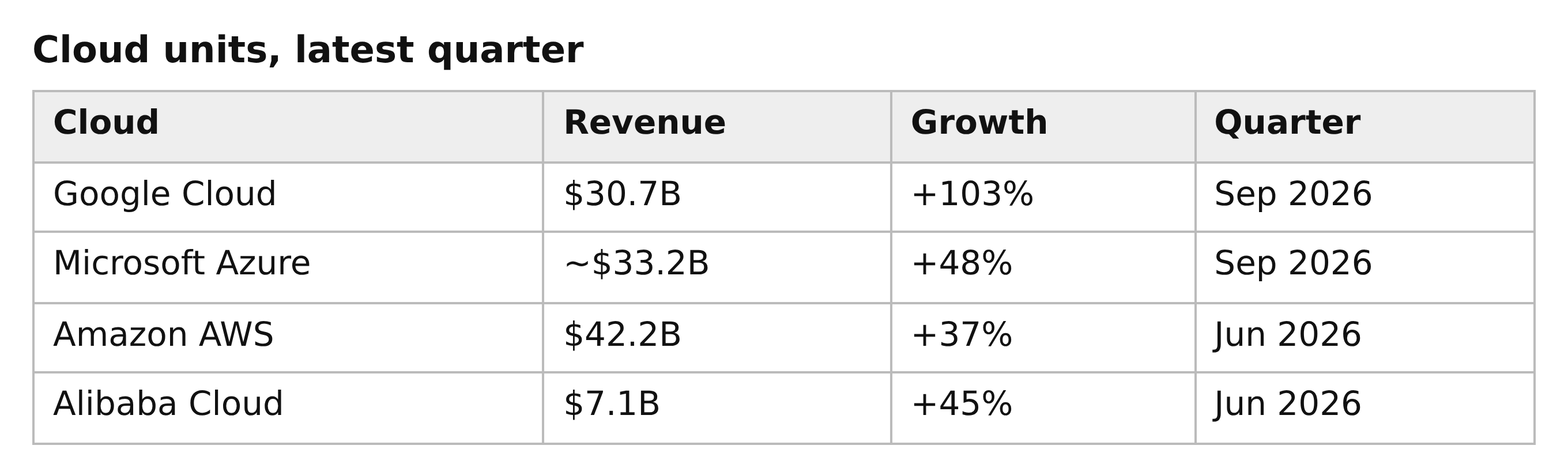
MSFT (Microsoft): Azure, Microsoft 365, Windows; main OpenAI partner.
AMZN (Amazon): AWS plus e-commerce and ads; Anthropic and OpenAI partner.
Google Cloud is now almost Azure’s size ($30.7B vs about $33.2B) and grows twice as fast, helped by TPU system sales. Yet Alphabet trades at about half Microsoft’s P/E and the same price/sales as the group.
The difference is cash: Microsoft funds its capex from operations, while Alphabet’s capex exceeded its cash flow and needed equity and bonds. The market paid Microsoft (+4% after hours on Oct 28 after earnings results) and sold Alphabet (-10%) on the same night for that reason.
Amazon reports on 29 Oct; AWS growth against its 37% will show whether Google Cloud is taking share or the whole market is accelerating.
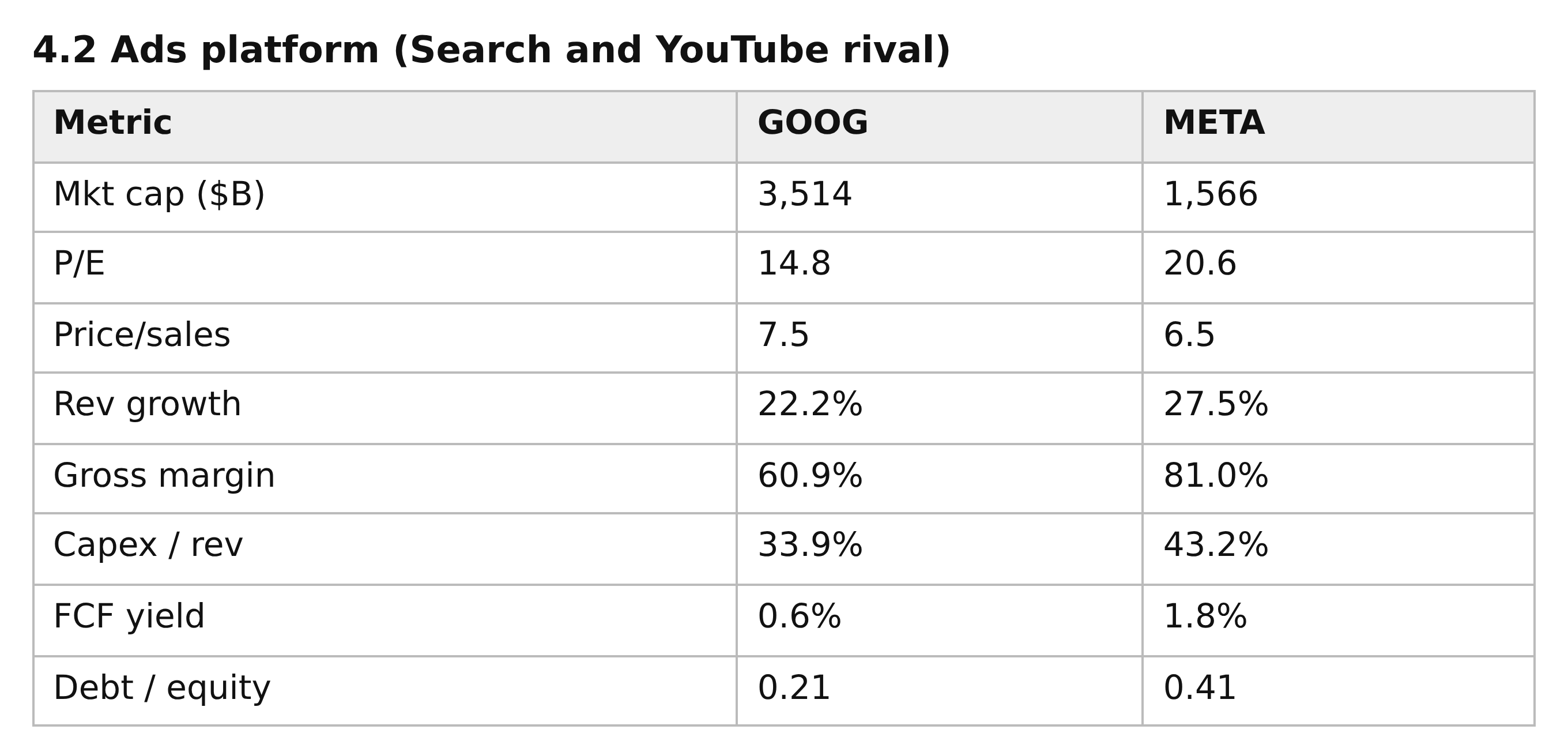
META (Meta): Facebook, Instagram, WhatsApp ads; no public cloud.
Meta’s ads grew 26% in Q3 while Alphabet’s Search grew 12% and YouTube ads 9%. Part of the gap is mix: Meta sells social and video ads that AI targeting lifts directly, while Search is shifting to AI answers that monetise less for now. Both now spend more on capex than they generate in operating cash, and both fell after reporting (Meta -15% from 8 to 28 Oct). Investors are treating the two ad giants’ AI spending with the same suspicion.
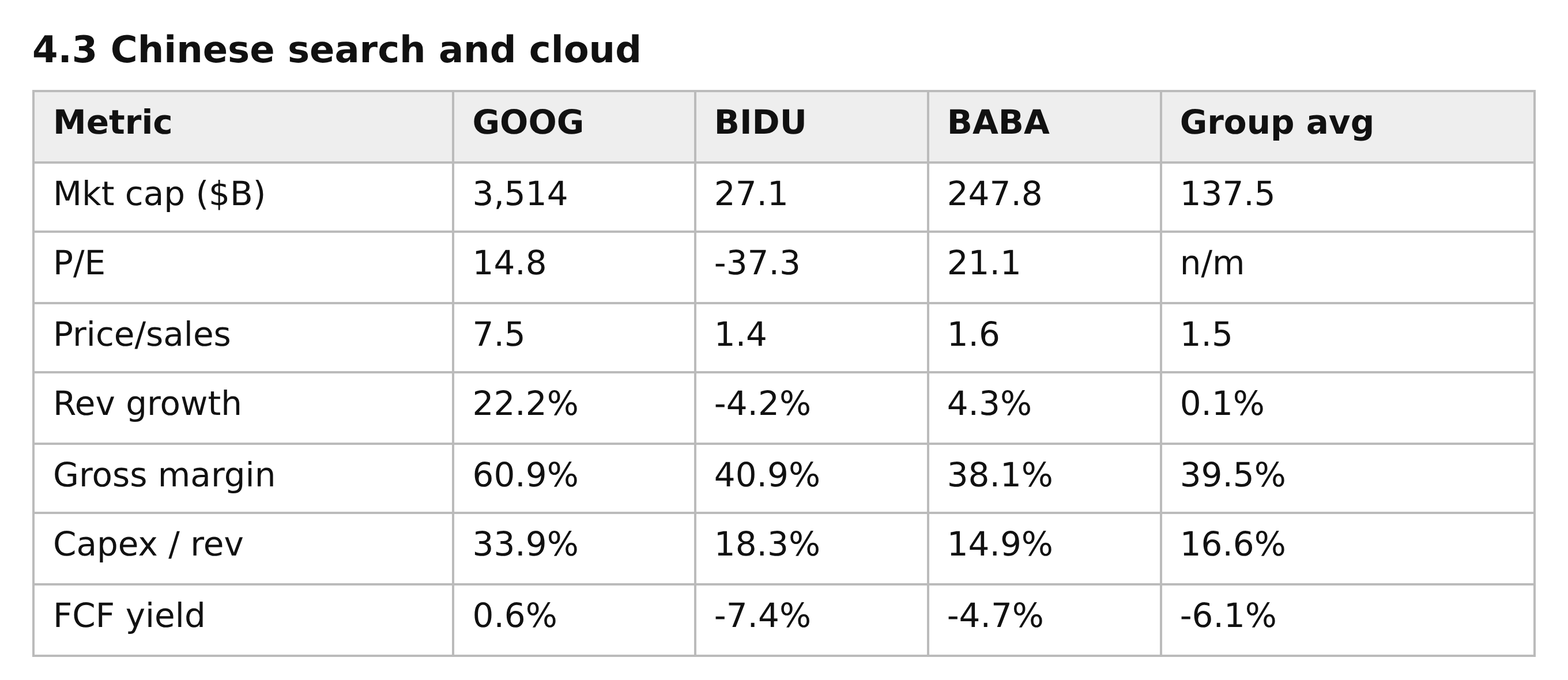
Group average excludes GOOG, both to 30 Jun, converted from yuan. Baidu’s P/E is negative (loss-making), so the group P/E is not meaningful.
BIDU (Baidu): China’s main search engine, Ernie AI models, AI cloud.
BABA (Alibaba): e-commerce plus Alibaba Cloud, China’s largest cloud.
These are Alphabet’s counterparts in China but not its competitors: neither operates in Google’s markets. Both grow slowly and burn cash, and they trade at 1.5x sales against Alphabet’s 7.5x. They show what happens to a search business when AI spending rises and ad growth stalls: Baidu’s revenue is shrinking. Their low growth is also what lifts Alphabet’s “growth vs peers” score.
The groups together. Against cloud rivals, Alphabet has the fastest-growing cloud but the weakest cash conversion. Against Meta, its ad growth is now slower. Against the Chinese names, it looks far healthier. The score’s growth lead depends on the Chinese group; the investment case depends on the hyperscaler comparison, where cash flow is the gap.
Analyst consensus
One row per firm (latest note), 90-day lookback. Weights by age: 0-30 days 1.0; 31-60 days 0.5; 61-90 days 0.2; older 0.
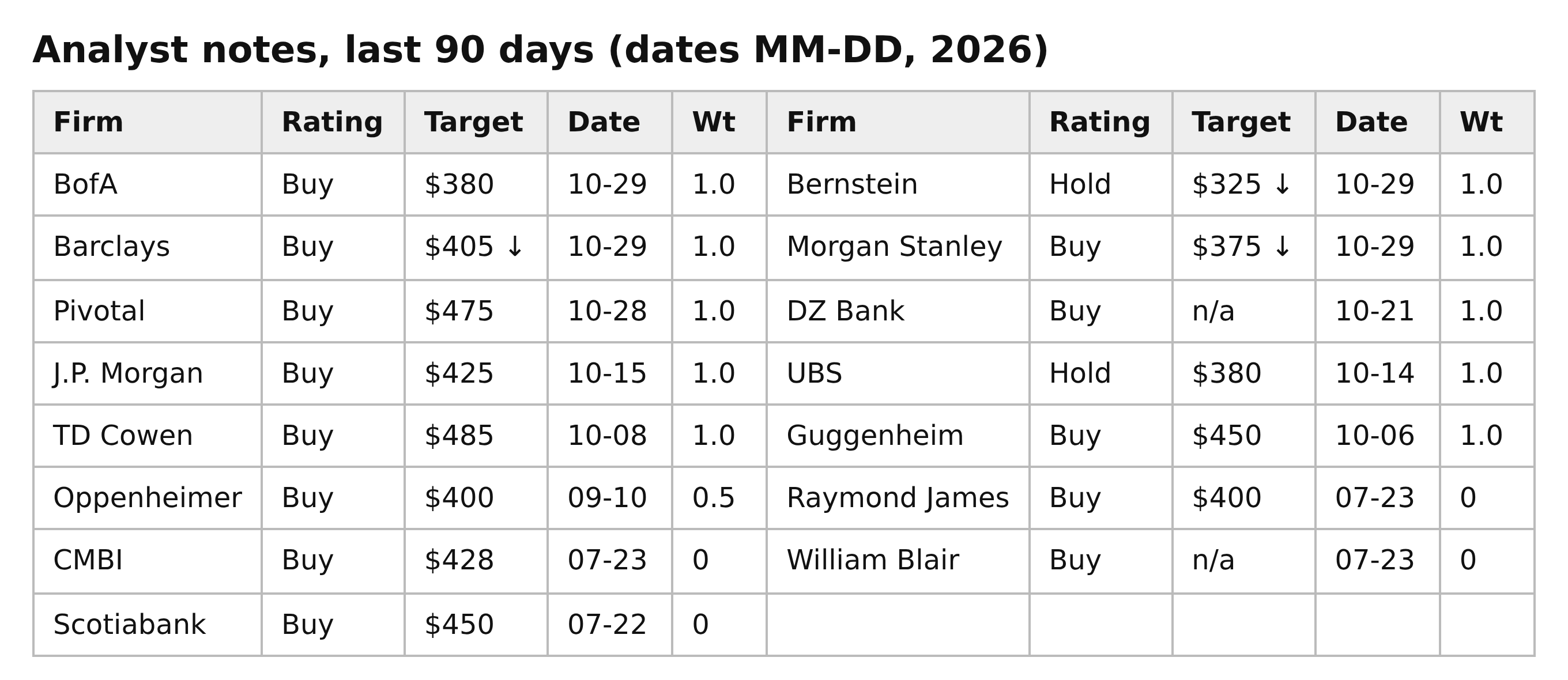
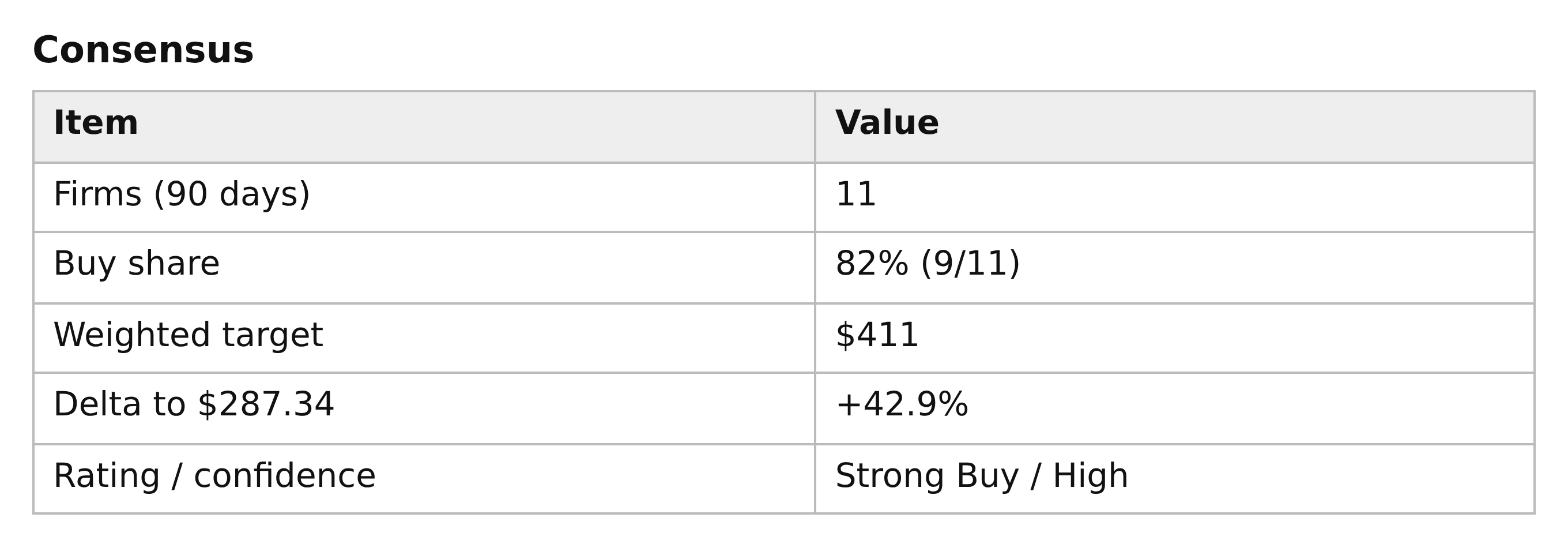
Most firms kept Buy ratings after the miss but cut targets. The five notes from 28-29 Oct average $392, against $430 for Irina’s list alone, so the weighted target is coming down. Bernstein’s $325 is the low end; TD Cowen’s $485 (before results) the high. Bank of America reiterated Buy at $380 on 29 Oct.
Technical analysis
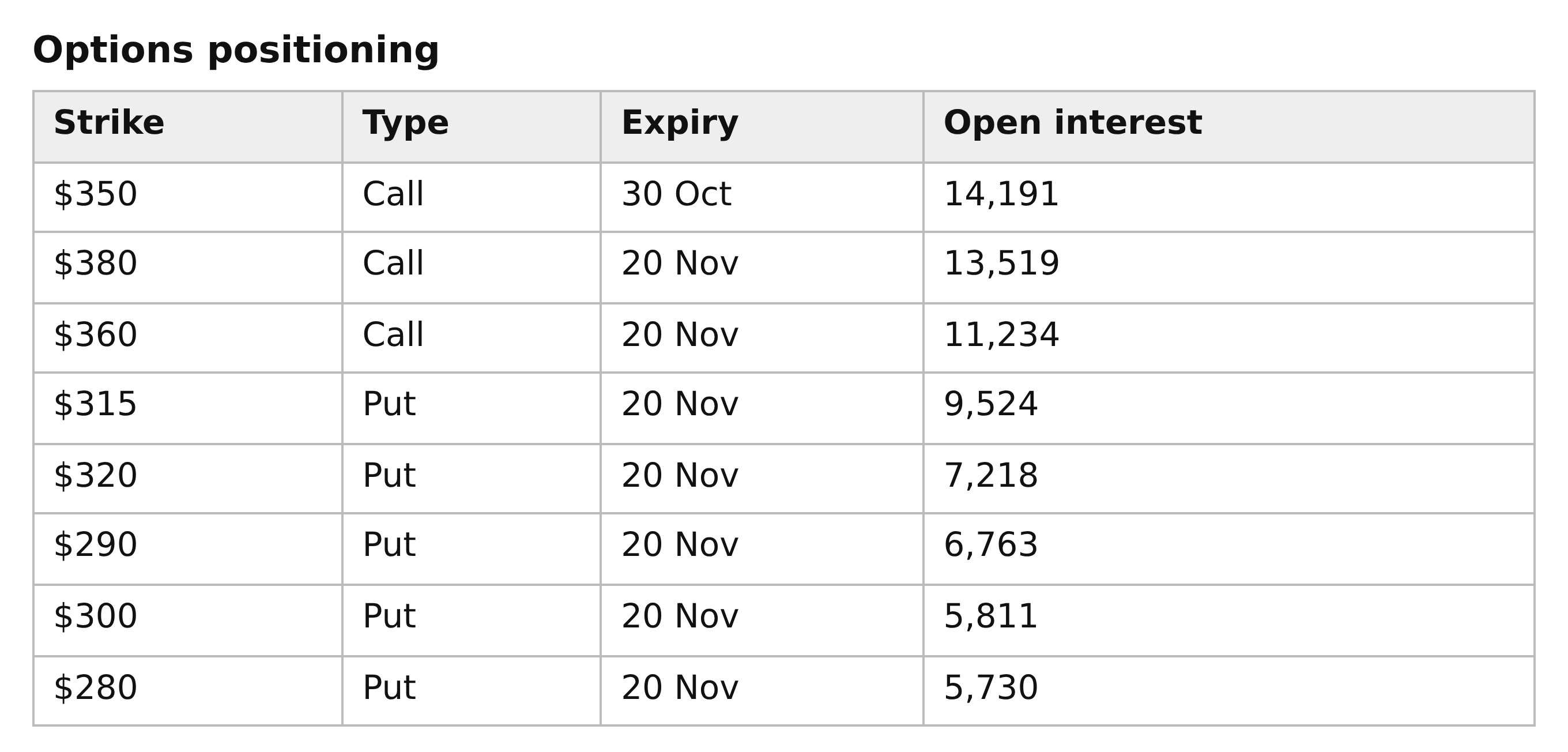
Call walls are stranded. All the large call strikes ($345-$400) were opened while GOOG traded near $340-350 and are now 20-39% out of the money. The $350 weekly calls will almost certainly expire worthless on Friday. They show how bullish positioning was into the print.
The put walls became profits. The $315 and $320 November puts, the largest put positions, are now in the money by $28-33. Dealers who sold those puts hedged by shorting stock; as holders cash in or roll down, dealers buy back that short stock, which tends to steady the price after a gap.
The nearest floor is $280-290. With the higher puts in the money, the live put cluster sits at $290 (6,763) and $280 (5,730), right at the price and at the top of the buy zone. $300 (5,811 puts, plus 4,467 in the 30 Oct weekly) is the strike the price is most likely to gravitate to before 20 November.
Expensive options. IV rank 83% (implied volatility near the top of its one-year range) means options are priced for large moves. Selling puts at $280 pays more than usual; buying calls costs more.
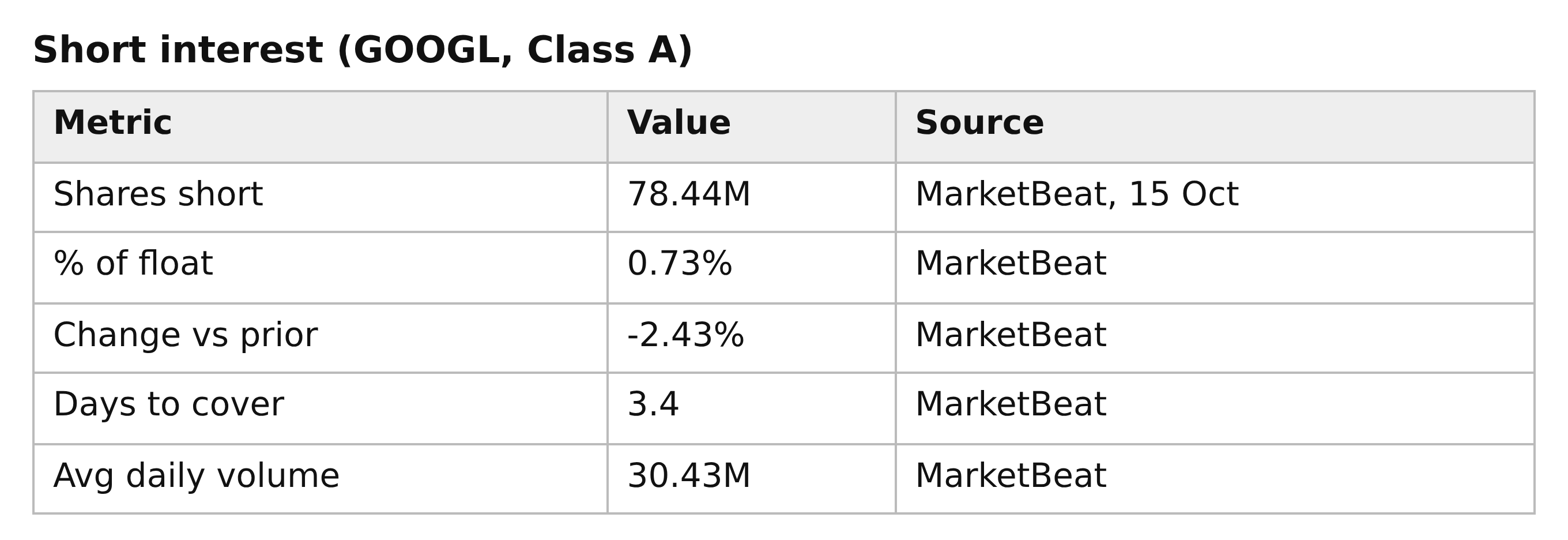
The figure is for Class A (GOOGL) shares, FINRA settlement of 15 Oct.
Short interest. Under 1% of float with 3.4 days to cover is small and fell slightly into the 15 Oct settlement. There is no squeeze fuel; the 30 Oct settlement will show whether shorts added into the results.
Score: +1/2. Sentiment +1 (both P/C ratios below 1); leverage 0 (no squeeze set-up).
What to watch. Amazon’s Q3 tonight (AWS growth against 37%, capex against about $220B) and the start of Anthropic’s IPO marketing in the week of 9 November, which will re-price Alphabet’s stake.
This research is for information, not advice
Hyperscalers
Explore all company fundamental valuations, DCF intrinsic models, and thematic deep-dives in Hyperscalers.
Quantitative Models
Automated daily equity screening across 6 quantitative factor models with 15-minute EMA regime confirmation.
More Research from the Desk
Hyperscalers' two-customer problem: $1 trillion of commitments or who breaks first
Two AI labs, OpenAI and Anthropic, sit inside the backlogs of all four clouds, and the clouds also own stakes in them. Anthropic’s IPO filing shows at least $518B of compute commitments, $252.5B of it with the three clouds, against ~$4.6B of 2025 revenue; OpenAI has committed $250B to Microsoft, $138B to Amazon and about $300B to Oracle. Together the two labs have committed about $940B to the four clouds. Lab-linked contracts are roughly 22% of Alphabet's $514B backlog, 45-50% of Oracle's $664B and Amazon's $496B, and ~46% of Microsoft's $678B. On the equity side, Amazon has committed up to $83B across both labs, Alphabet up to $40B and Microsoft holds ~25% of OpenAI. Cloud growth therefore depends on lab financing as much as on enterprise demand. Alphabet is the least exposed. Oracle, funded by debt, is the most.
Signals and themes from quant strategies after last week’s earnings: FTNT, F5 and healthcare
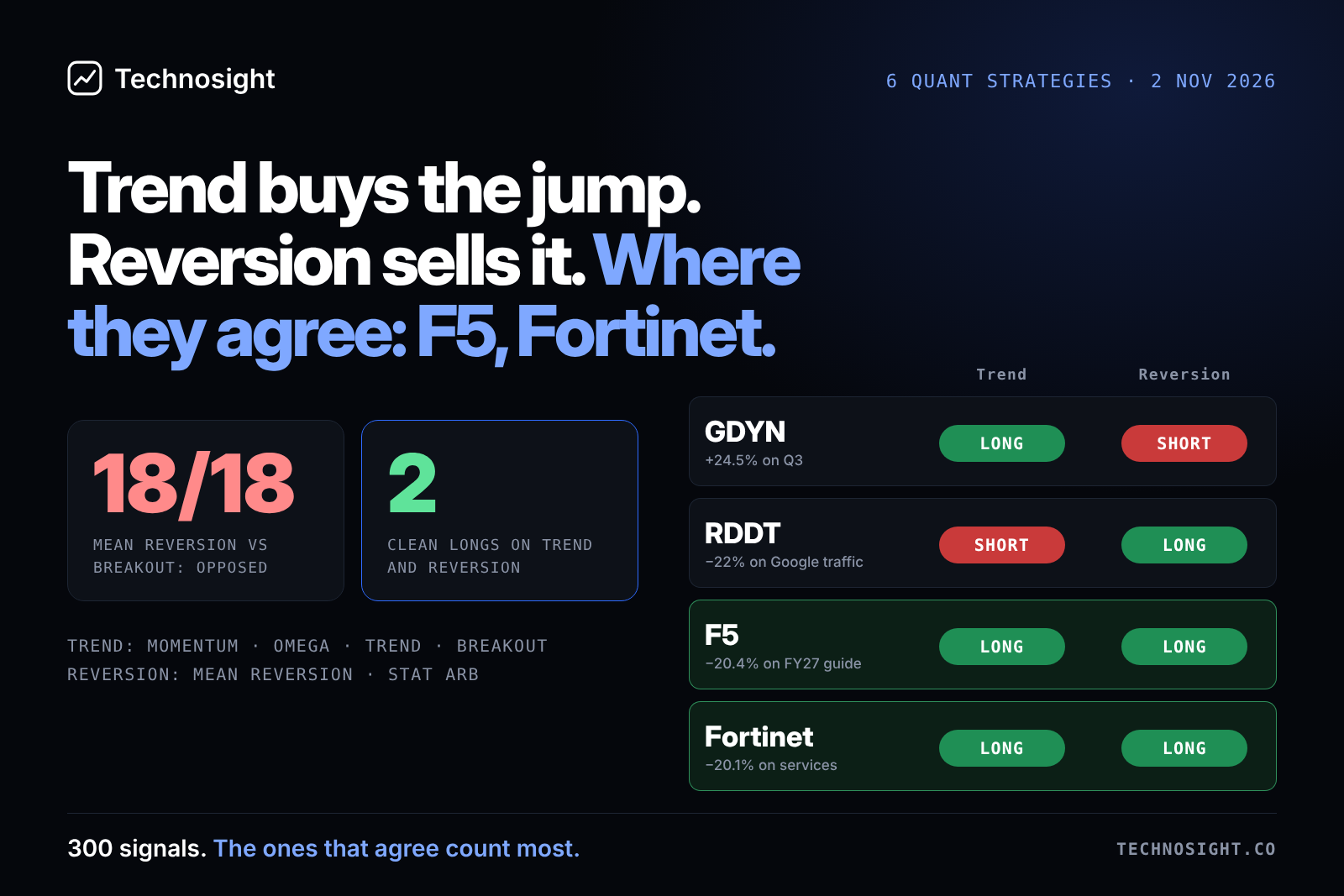
We reviewed 300 signals from our six quant strategies together. Strategies split into two families (trend and reversion) that read last week’s earnings in opposite ways. The trend family (Momentum, Momentum Omega, Trend Following, Volatility Breakout) is buying the stocks that jumped, such as Grid Dynamics (+24.5% on 30 Oct) and Regeneron (+11.5%). The reversion family (Mean Reversion, Statistical Arbitrage) is shorting them and buying the stocks that fell, such as Reddit (−22%). The most valuable signals are the ones both families back: F5 and Fortinet, each long across both families with no votes against them, each down about 20% after beating on the quarter and guiding to slower growth. Beyond the stocks, two themes stand out: healthcare catalysts lead momentum, and the market is selling companies that guide lower or pay heavily for AI.